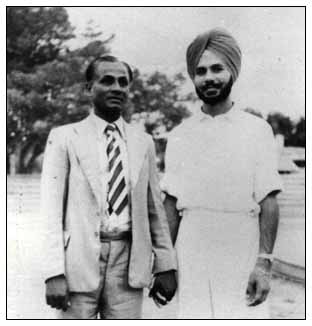
Hockey legend Balbir Singh Sr. sent India Field Hockey his personal remniscences of his hero, Hockey Wizard Dhyan Chand. This article came about in response to a European sportswriter's query on Dhyan Chand for a series to be published by L'Equipe on Great Sportsmen of the 20th Century.
Accompanying the text is a photograph of Dhyan Chand and himself from Balbir Singh Sr.'s personal collection. About ten years back, Balbir Singh Sr. donated his whole collection of pictures, medals (except the Olympic gold medals) and other mementos to the museum of Sports Authority of India in New Delhi. His remniscences follow:
Dhyan Chand belonged to Jhansi in Uttar Pradesh. He joined the Indian Army as a soldier and retired as a major. He played his entire Olympic hockey while in the Army. Later, for many years he was the Chief Hockey Coach at the National Institute of Sports, Patiala in Punjab. During that period he accompanied the Indian team to Mexico Olympic Games (1968) as the chief coach. Despite his name and fame Dhyan Chand was a most unassuming gentleman.
Dhyan Chand played centre forward and invariably scored most of his team's goals. He won gold medals at three consecutive Olympic Games (1928 - 1936), and captained the victorious team at Berlin (1936). As the story goes, after the final match Hitler offered him a Captain's rank in the German Army, an offer he politely declined. He was a recipient of the National Award Padma Bhushan in 1956. After his sad demise his bust was installed in front of the National Stadium New Delhi. His autobiography titled 'The Goal' can be obtained at the library of the same stadium.
Dhyan Chand had eleven children. One of his sons, Ashok Kumar was himself a distinguished player who represented India in the 1972 and 76 Olympics, and the first three World Cups, Barcelona in 1971, Amsterdam in 1973 and Kuala Lumpur in 1975. Ashok Kumar works with Indian Airlines and resides in New Delhi. Another son Raj Kumar attended the national coaching camp a couple of times but could not make the final team. Dhyan Chand's younger brother, the late Roop Singh, also represented India in the 1932 and 1936 Olympic Games, and was a captain in the Maharaja of Gwalior's army before India got its independence. One of Dhyan Chand's grand-daughters, a teenager Neha, was selected for the Womens' National Camp in 1997.
Note : The author of this article, Balbir Singh Sr., followed in the footsteps of his idol Dhyan Chand 20 years later by playing centre forward, scoring most of his team's goals, winning gold medals at three consecutive Olympic Games (1948-56), captaining the victorious team at Melbourne (1956), and receiving the National Award Padma Shri in 1957. His autobiography was titled 'The Golden Hat Trick'. Balbir Singh Sr. was the chief coach and manager of seven medal winning Indian teams.