| Australia
wins Commonwealth Men's Gold, India 4th |
 inal placings:
1. Australia 2. Malaysia 3. England 4. India. inal placings:
1. Australia 2. Malaysia 3. England 4. India.
Post-Mortem: This was the first major title for Australia in 5 years,
having last won the Champions Trophy in 1993. Pakistan, by failing to make it even to the
semi-finals, lost its unique record of winning the inaugural title of every world hockey
competition since the 1971 World Cup.
South Africa pulled off its first-ever victory over Australia 3-2. The amazing Greg
Nicol top-scored at the tournament with 14 goals in just 5 games, taking his tally to 102
goals in only 90 internationals. The second highest goal-scorer was Michael Brennan of
Australia with 7 goals in 7 games! Incidentally, Greg Nicol is the first ever South
African to score more than 100 goals in hockey.
For India, this was the first time since the 1982 Esanda Trophy that the men's team
qualified for the semi-finals of a world hockey event.
|
| Australia
Wins Commonwealth Women's Gold, India 4th |
inal placings:
1. Australia 2. England 3. New Zealand 4. India.
Post-Mortem: Olympic and World Champions Australia added the
Commonwealth title to their bag, whipping England 8-1 in the finals for their largest ever
victory over England. England had last reached the finals of a hockey competition way back
in 1975.
Australia scored 7 goals in the semi-finals (against New Zealand) and 8 goals in the
finals (against England) to totally dominate the hockey competition. Overall, Australia
scored 56 goals in 7 games, conceding only 3. During the course of the games, Australia's
goal-scoring machine Alyson Annan broke Jackie Perreira's record for the most number of
goals for Australia. Annan expectedly top-scored in the tournament with 11 goals.
For India, this was their best performance since the 1982 Asiad gold, and a much
improved showing from the Utrecht World Cup where they finished 12th and last.
|
| India vs. Malaysia Semi-Final : An
Eyewitness Report |
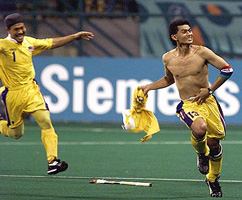
Courtesy The Star of Malaysia
 e did not get a seat that day
and stood through the entire match with our hearts beating and legs and hand trembling.
The entire match from start till the end was delightful and exciting. Every Indian player
on the field that day displayed superb stickwork, accurate passes but sadly, POOR
finishing. e did not get a seat that day
and stood through the entire match with our hearts beating and legs and hand trembling.
The entire match from start till the end was delightful and exciting. Every Indian player
on the field that day displayed superb stickwork, accurate passes but sadly, POOR
finishing.
We saw many clear chances, even a roll into the goalmouth by Pillay missing by inches.
Indeed it was the hosts' lucky day. What India misses is an opportunist goal scorer, and a
penalty corner specialist like Surjit Singh. In this we have to learn from the
Australians, who combined very well, especially in the 'D'.
It was indeed an extremely hostile crowd but nevertheless we Indian fans braved and
cheered the team only to be drowned by the opposing noise. Following the superb Indian
display, we heard statements such as the following from the partisan Malaya crowd: "What
is India playing?", "Why can't Malaysia play like that?"
"This is how hockey should be played." After the game, we saw some fans
crying in the stands. Many of my Malaysian friends acknowledged that it was India who
should have gone through to the finals.
Maharaj Krishen Kaushik, I saw you playing in Kuala Lumpur before - I think you are on
the right track. Tell the world - "Look out, the Indians have returned." For
those 78 minutes, I felt I was reliving the Indian team of Kuala Lumpur 1975, the team of
Harcharan, Ajitpal, Ashok Kumar and Govinda. CONGRATULATIONS.
Courtesy Jaswant Singh
|
| Fun With Numbers |
 t the semi-final stage of the
Commonwealth Games, it was Australia vs. England and India vs. Malaysia. The pre-match
favourites were Australia and India. England had beaten Australia only 4 times in over 40
meetings. The last time was in 1985. t the semi-final stage of the
Commonwealth Games, it was Australia vs. England and India vs. Malaysia. The pre-match
favourites were Australia and India. England had beaten Australia only 4 times in over 40
meetings. The last time was in 1985.
Of the 32 matches played against Malaysia on the synthetic pitch, India had won 25,
lost 3 and drawn 4. Interestingly, of the 10 played in Kuala Lumpur, India had won 8, lost
1 and drawn 1. Malaysia last won against India in 1991, when Malaysia won 3-2 in the
pre-World Cup qualifier in Auckland.
Going by the World Cup rankings, Malaysia were 7th among the Commonwealth nations
participating in the games. Malaysia had never in its history reached the finals of an
international hockey competition. It was clear that India were the overwhelming
favourites.
Australia played true to form, and rallied twice against England to beat them 3-2.
However, India disappointed the hearts of millions of its fans by losing by the golden
goal to Malaysia. India had 8 penalty corners in the semi-finals, but couldn't get the
ball past goalkeeper Roslan even once.
|
| Police Report on the Canadian Team |
 he Canadian men's hockey team
left a trail of destruction at the National Hockey Stadium in Bukit Jalil after losing a
crucial Pool B semifinal decider against Malaysia. The players went berserk after losing
the match 1-2 and damaged the door of their dressing room with hockey sticks and signages
along the way leading to their waiting bus. he Canadian men's hockey team
left a trail of destruction at the National Hockey Stadium in Bukit Jalil after losing a
crucial Pool B semifinal decider against Malaysia. The players went berserk after losing
the match 1-2 and damaged the door of their dressing room with hockey sticks and signages
along the way leading to their waiting bus.
The object of the Canadian players' fury was Scottish umpire David Wallis, who allowed
Malaysia's winning goal in the 65th minute by Calvin Fernandez, instead of awarding an
infringement against him. After the final whistle, the Canadians manhandled and abused the
umpire. However, timely intervention by officials defused the situation.
A Canadian player threw an object into the stands. The crowd then took over and rained
empty plastic bottles at the Canadians for their unsporting behaviour. The Canadian
players retaliated by throwing back objects to the crowd. A police report on the team's
and crowd behaviour was then lodged.
The Canadians utter lack of class was shown by 2 incidents - their captain Peter
Milkovitch refusing to step into the 'sin bin' after getting a yellow card, and their
goalkeeper Mike Mahood kneeing the Malaysian captain in the chest, while the latter was
down on his knees, praying after their victory. A report is certain to go to the FIH
before their next meeting, and the Canadians may have to face a charge of bringing the
game into disrepute. Aware of the strict police laws in Malaysia, the Canadians deemed it
fit to submit an apology and offer compensation.
The brash Canadians should learn from the Pakistanis who did not protest against the
umpiring in their decisive game against England, in which four Pakistani players were put
under temporary suspension. Pakistan lost that match 2-3 and did not qualify for the
semi-finals, like the Candians. Pakistan team manager Zakauddin said it was better to
accept defeat with dignity although disappointment was inevitable. The final word comes
from the Canadian Reform Party MP Inky Mark, "If the players cannot accept their
responsibility as ambassadors, they shouldn't be representing our country."
|
| Malaysia to bid for 2002 World Cup
Hockey |
 alaysia has joined 7 other
countries who has shown interest in hosting the first World Cup of the new millenium.
Malaysia has suddenlty become a strong contender to host hockey's next World Cup in 2002
after visiting officials from the FIH were impressed by the stadium built especially for
the Commonwealth Games. Even the response from the audience was fantastic, with capacity
crowds of 12,000 - 15,000 chanting Malaysia Boleh and banging on drums and kompangs,
being present for most of Malaysia's matches. alaysia has joined 7 other
countries who has shown interest in hosting the first World Cup of the new millenium.
Malaysia has suddenlty become a strong contender to host hockey's next World Cup in 2002
after visiting officials from the FIH were impressed by the stadium built especially for
the Commonwealth Games. Even the response from the audience was fantastic, with capacity
crowds of 12,000 - 15,000 chanting Malaysia Boleh and banging on drums and kompangs,
being present for most of Malaysia's matches.
A decision on which country will host the World Cup, the second-most important hockey
tournament after the Olympics, was to have been made at the last championship in the
Netherlands in May. The FIH delayed its decision because several changes to the
tournament's format are being considered. Another factor to keep in mind is whether or not
to hold the women's World Cup simultaneously with the men's World Cup. The MHF is not too
keen on co-hosting the Women's World Cup. The successful bid will now not be announced by
the FIH until at least December 1998.
Already Kuala Lumpur has made a bid to host the 2006 Asian Games, and there has been
talk Malaysia would also enter the bidding war for the 2008 Olympics. Kuala Lumpur had
already held the World Cup in 1975, the first Asian country to do so.
|
| Paul Lissek's magic |
ifty two year old Paul Lissek of
Germany is one of a handful who has a FIH master's coaching certificate. The master's
certificate is the highest coaching certificate issued by the governing body. Among others
in this select club are Horst Wein, Terry Walsh and Richard Agiss.
During the course of the Commonwealth Games, the Lissek-coached Malaysian team drew
with Pakistan 1-1, drew with England 2-2, beat Canada 2-1 and beat India 1-0 to emerge 2nd
among Commonwealth nations. Malaysia went into the final with five unbeaten matches. The
Malaysians until the final match had the best defensive record with only 4 goals against
them. They conceded 35 penalty corners but only let in 3.
Paul Lissek spent almost 15 hours each day on the job. His work involved not only field
training, but also video sessions, assessing the opponents, discussions with his
assistants and selection committee meetings. Discipline was the key in Lissek's training,
and he dared to introduce juniors into the fold at the expense of seniors who were not
willing to change. In an important step, the MHF gave Lissek a free hand to run the
programme his way. Most importantly, the coach was allowed to select his team.
Six players selected by Paul Lissek from the Project 2001 squad will go for a 3-month
stint with German clubs in the Bundesliga from April to July 1999. After the 3-month
league, the other 2001 Junior World Cup squad will join the selected six in a centralised
training camp being organised by Lissek for the German junior squad. The Malaysian team
will train and play friendlies with the German team for two weeks.
As for his future plans, Lissek, who is currently the Director of Coaching in Germany,
has this to say, "For me, I want to end my job in Germany by achieving the target of
winning the World Cup. That is something we have not been able to do. After I have
finished with German hockey, the challenge to build a new team elsewhere may take me to a
new direction." Are you listening, IHF?
|
| Hockey in October |
he 20th Men's Champions Trophy
hockey tournament will be held at the National Hockey Stadium, Lahore, from October 31 to
November 8, 1998. The world's six leading teams, Australia, England, Germany, Holland,
Spain and hosts Pakistan are clubbed together in this premier hockey competition.
Pakistan have won the Champions Trophy on 3 occasions, in 1978 at Lahore under the
captaincy of Islahuddin Siddiqui, in 1980 at Karachi under the late Munawaruz Zaman, and
in 1994 at Sydney under skipper Shahbaz Ahmed.
The astro-turf to be laid for the Champions Trophy has yet to arrive in Pakistan. This
has made a mockery of the FIH requirement that the astro-turf be laid 6 months before the
event. The following is the schedule of the 20th Champions Trophy:
| Date |
Matches |
| Oct 31 |
Netherlands vs. Spain
Australia vs. Germany
England vs. Pakistan |
| Nov 1 |
Germany vs. Netherlands
Spain vs. Pakistan |
| Nov 2 |
England vs. Australia |
| Nov 3 |
Germany vs. Spain
Pakistan vs. Australia
Netherlands vs. England |
| Nov 4 |
Pakistan vs. Netherlands |
| Nov 5 |
Spain vs. Australia
Germany vs. England |
| Nov 6 |
Australia vs. Netherlands
Spain vs. England
Pakistan vs. Germany |
| Nov 7 |
REST DAY |
| Nov 8 |
5th vs. 6th, 3rd vs. 4th, 1st vs. 2nd |
|
| Hockey in November |
 ndia will be playing hosts to
Malaysia in a five-match Test series in November. The India-Malaysia Test series was
revived in 1995 with Malaysia as hosts. India were to host the next series but were unable
to do so for the last two years. ndia will be playing hosts to
Malaysia in a five-match Test series in November. The India-Malaysia Test series was
revived in 1995 with Malaysia as hosts. India were to host the next series but were unable
to do so for the last two years.
Meanwhile, Thailand will host a six-nation hockey tournament in early November to test
their facilities for the Asian Games. India, Pakistan and Malaysia have been invited to
play in the tournament. The other two teams are expected to be Australia and South Korea.
|
| Hockey in December |
he 43-member OCA, the Asian
equivalent of the International Olympic Committee, runs the Asian Games which will take
place in Bangkok this December. "It is important for us to see hockey on the upswing
because it is Asia's first great claim to sporting success," said Abdul Muttaleb
Ahmed, director-general of the Olympic Council of Asia (OCA).
The Asian Games is an important competition as only the gold medallist will qualify
automatically for the 2000 Sydney Olympics. The other teams will have to play in the
qualifiers in Osaka, Japan in early 2000. South Korea is the defending Asian Games hockey
champion.
Asian Games hockey starts on December 6. The venues for hockey are at the Kasetsart
University hockey field, and the Queen Sirikit 60th Anniversary Stadium. Both the fields
have poligras pitches.
The pools for the Asian Games hockey competition are as follows:
Men : Pool A : South Korea, Malaysia, Japan, Sri Lanka, Singapore,
Uzbekistan
Pool B : Pakistan, India, Bangladesh, China, Thailand, Hong Kong
Women : Pool A : South Korea, India, Uzbekistan, Kazakhastan
Pool B : Japan, China, Sri Lanka, Thailand
|
| Visitor of the Month |
ndia Field Hockey received a
visitor from Holland, Catrien van Zutphen,
who is the Marketing Communications Manager of Desso DLW Sports Systems. His company
manufactures Desso Turf - which was the pitch on which the World Cup was played in Utrecht
this year.
Desso DLW supplies two kinds of pitches - made of nylon (DD ActionTurf), and made of
polypropylene (DD Sportilux S). Pitches of the former are found primarily in Holland,
while pitches of the latter kind can be found in Pakistan, Hong Kong, Malaysia, Egypt and
Oman, besides Holland of course.
Desso DLW's website can be located at http://www.dessodlw.com/.
|
| War of Words between Gill and
Pargat |
ndian Hockey Federation
President K. P. S. Gill said at a press conference that the problem with regard to payment
to players, "engineered by an ex-player," had been sorted out. He was referring
to an issue raised by former India captain Pargat Singh, though Gill refused to name him.
What started as a routine question and answer session generated intense heat. "In
my opinion, he had done disservice to Indian hockey. It is totally disgraceful and
extremely reprehensible. It's sad that a renowned player had made this an issue,"
said Gill.
Gill also mentioned that the ex-player had started a magazine and gone to the extent of
writing in an article stating that a greatest disaster would befall Indian hockey if Gill
was elected as president of the IHF. But the same player later wrote to him stating,
"It's nice that you had been elected. Shall I come over for an interview," Gill
closed the topic by saying, "What can we do with such people?"
When journalists persisted in linking payments made with the performance of players,
Gill shot back, "Do you think money will make players play better?" Only if you
excel, will the money come. Any one who thinks that money will make a player play better
is on the wrong side of the street."
Applying the same yardstick to our esteemed hockey officials, will they all refuse to
take any salary until they start excelling too. For starters, by conducting the national
junior and senior championships, for both men and women, for all years of their term.
Incidentally, that is the basic mandate of the IHF, though it tends to get lost amongst
foreign trips and election intrigues and sacking of coaches.
|
| Tailpiece |
 ver the Labor Day weekend in
September, hockey legend Shahbaz Ahmed was in Kuala Lumpur, New York and Holland at the
same time. While this feat could be ascribed to modern day jet travel, it was more likely
a case of unsubstantiated rumours. Let us explain. ver the Labor Day weekend in
September, hockey legend Shahbaz Ahmed was in Kuala Lumpur, New York and Holland at the
same time. While this feat could be ascribed to modern day jet travel, it was more likely
a case of unsubstantiated rumours. Let us explain.
An Agence France Press (AFP) report originating from Kuala Lumpur on Sept 6 reported that
the Pakistan manager Zakauddin had requisitioned the services of Shahbaz Ahmed to lead
Pakistan in the Commonwealth Games.
The Secretary of the Pakistan Hockey Federation (PHF), Col. Syed Mudassar Asghar, came
out with an immediate contradiction. "I am deeply hurt that an international news
agency can carry such an irresponsible story. It is a blatant effort on the part of some
vested interests to damage the morale of our boys a few days before the Commonwealth Games
hockey tournament begins," said the PHF Secretary.
Pakistan coach Shahnaz Sheikh had this to say, "I had to hide the newspaper from
my players. We have a harmonious team and I don't want them to be upset with his kind of
reports."
Around the same time, a $10,000 Big Apple Hockey Tournament took place in New York. One of
the entrants was the Zindabad team - which was supposed to get the services of Shahbaz and
Tahir Zaman. The team had to wait in vain for Shahbaz and Tahir never landed up in New
York.
All this while, Shahbaz was in Holland, playing for the Eindhoven club Oranje Zwart.
Shahbaz is contracted to play for the Dutch club between September 1 - December 18, 1998,
and from January 26 - May 16, 1999. His contract fee is close to $40,000, plus other
facilities. Both Shahbaz and his brother-in-law Tahir will not be playing for Pakistan in
3 important tournaments in 1998 - Commonwealth Games, Champions Trophy and the Asian
Games, due to their committments in the Dutch Hockey League.
|