| Shocking Omission of the 'Asiad
Six' from Probables List |
 re the drunkard and the clerk
upto their tricks again? re the drunkard and the clerk
upto their tricks again?
73 probables have been selected for conditioning camps for the Indian team keeping in
view the Sydney 2000 Olympics. The list was released to the media by Mr. K. P. S. Gill,
IHF President and Mr. K. Jothikumaran, the IHF Secretary, after the final match of the
National Hockey Championship. These 73 select probables will be pruned to 30 to form the
core group for the Sydney Olympics, and will play over the next few months with Germany,
South Africa and Netherlands.
Stars of newly crowned national champions Indian Airlines, Mukesh Kumar
and Ashish Ballal, find themselves out of the probables list for Sydney
2000. Mumbai-based Dhanraj Pillai and Sabu Varkey, who
skipped the nationals to play professional league in Bangladesh, are similarly omitted. Sandeep
Somesh and A. B. Subbaiah, who make up the remainder of the
'Asiad Six' are similarly out in the wilderness.
The Gill-Jyothikumaran combine should learn from the BCCI as to what happens when they
unjustly drop players. The Indian cricket board once suspended senior players for playing
in a masala match overseas. The players moved the Supreme Court. A lot of
unthinkable questions were raised, including the locus standi of the board itself.
The court said if the board questioned the right of players, then the larger issue of
the board's monopoly status and its authority to ban the players would crop up. The apex
court told the board to settle the issue outside the court instead of forcing the
judiciary to sit in judgment over the running of the game. In fact, the court bailed out
the cricket board, which readily agreed to sort the matter out with the players.
Unfortunately, in India, hockey just ain't cricket.
|
| Et Tu Cedric? |
 ho exactly formed the selection
panel that meekly toed the establishment line and discarded the 'Asiad Six' from the
probables list. ho exactly formed the selection
panel that meekly toed the establishment line and discarded the 'Asiad Six' from the
probables list.
Only two selectors were present at the Hyderabad nationals, Haripal Kaushik and Cedric
D'Souza. Olympians Joaquim Carvalho and Harcharan Singh were invitees. In addition, 3
officials with no hockey qualifications worth their name also sneaked into the selection
committee (Hyderabad Hockey Association secretary Satyanarayana, vice-president
Ramchandra, as well as the IHF secretary Jyothikumaran).
The IHF officials made it clear that the selectors went only by performances seen
during the present National championship in Hyderabad. In that case it is hard to accept
that the star players of national champions Indian Airlines, captain Mukesh Kumar and
goalkeeper Ashish Ballal, have not been selected.
The IHF top brass then attributed the non-inclusion of the 'Asiad Six' in the probables
list to the selectors, who had simply not recommended them forcefully. "The new
coach, a 'responsible' and 'accountable' one, will decided whether he needs any of these
senior players," Gill said. "One or two of these six senior players don't make
the team in any case but the others have a chance of coming back."
The grapewine has it that Cedric D'Souza, the coach for the Sydney World Cup and the
Atlanta Olympics, is set to return to the hot seat of Indian hockey. Gill has stated that
whoever is selected as the national coach will join duty for the European tour in June
1999, and will be in charge till the Sydney 2000 Olympics.
Cedric is definitely a 'responsible' and 'accountable' coach. He is also known to be
respectfully obsequious to K. P. S. Gill ("the IHF President has made his
decision, and it is my duty to adhere to it"). No one will forget that India's
worst ever showing in the Olympics - 8th - was under Cedric.
If indeed Cedric has not selected Dhanraj, Ashish Ballal, Mukesh Kumar and the other
stars, Cedric has committed an unfair act. If Cedric had selected them, and then was
vetoed by the IHF President, then also Cedric cannot escape censure. Imagine 11
goalkeepers have been selected in the list, and India's two best goalkeepers, Ashish
Ballal and A. B. Subbaiah, are not in the list. It is all the more galling that Cedric
D'Souza, a former goalkeeper himself, is party to this injustice.
Cedric's reaction as told to FieldHockey.com
was : "There are certain matters that are done in total confidence and so disclosing
any details concerning players selection will not be appropriate. However, I would like to
mention that the National coach and the IHF Secretary/ President have the discretionary
powers to alter, include or reject any player they deem fit to do so. This a normal
practice..."
The first duty of any coach is to stand up to the players. Anything else is mere
pontification. Ashok Kumar resigned from the selection committe when the 'Asiad Six' were
dropped for the Indo-Pak series. Not angling for any official favours, this talented son
of Hockey Wizard Dhyan Chand has shown the rest of the selectors the way.
Can the selectors truthfully say that Dhanraj and Mukesh were not selected on purely
hockey grounds. Say it ain't so, Cedric.
|
| National
Hockey Championships |
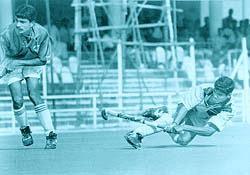
Photograph Courtesy : The Hindu
 orty one teams took part in
the PSB and SBI 59th Senior National Hockey Championship for the Rangaswamy Cup, held at
Hyderabad from March 10 to 26. Hyderabad was hosting the event again after 22 years.
Bangalore hosted the previous national championships in 1997. The championships were not
held in 1998. orty one teams took part in
the PSB and SBI 59th Senior National Hockey Championship for the Rangaswamy Cup, held at
Hyderabad from March 10 to 26. Hyderabad was hosting the event again after 22 years.
Bangalore hosted the previous national championships in 1997. The championships were not
held in 1998.
Institutional teams making their debut in the national championships were Food
Corporation of India (FCI), Indian Posts and Telegraph and Tata Sports Club. SAIL and
Himachal Pradesh were the only teams to drop out. Asiad stars Dhanraj Pillai and Sabu
Varkey missed the National Championships due to club committments in Bangladesh.
The winners of the pool were:
| Pool |
Winner |
Scores |
| A |
Railways |
beat Bihar 5-1
beat Rajasthan 13-0
beat Andhra Pradesh 5-1
beat Punjab 3-1 |
| B |
Uttar Pradesh |
drew with Central Industrial Security Force
0-0,
beat Nagaland 4-0
beat Gujarat 3-1
beat Hyderabad 4-0
beat Indian Posts and Telegraph 1-0 |
| C |
Border Security Force |
beat Vidarbha 12-0
beat Food Corporation of India 2-1
beat Mumbai 3-1 |
| D |
Indian Airlines |
beat Haryana 7-1
beat Jammu and Kashmir 3-0
beat Maharashtra 8-2
beat Orissa 6-2 |
| G |
Customs and Central Excise |
beat Tata Sports Club 2-1
beat Karnataka 1-0
beat Delhi 3-1
beat Madhya Bharat 4-1 |
| H |
Central Reserve Police Force |
beat Kerala 10-0
beat Services 2-0
beat Assam 20-0
lost to Bengal 1-2 |
| I |
Punjab and Sindh Bank |
beat Combined Universities 3-0
beat Pondicherry 19-1
beat Madhya Pradesh 20-0
beat Air India 5-2 |
| J |
Tamil Nadu |
beat Patiala 5-1
drew with Bhopal 3-3
beat Manipur 10-1 |
Hockey in India is being nurtured by the institutional teams, as can be
seen by the quarter-final line up, where only 2 of the 8 teams were state teams.
| Quarter-Finals |
| Railways beat Border Security Force 4-1 |
| Indian Airlines beat Uttar Pradesh 2-1 |
| Tamil Nadu beat Central Reserve Police Force
1-0 |
| Central Excise and Customs beat Punjab and
Sindh Bank 2-0 |
| Semi-Finals |
| Indian Airlines beat Railways 2-1 |
| Tamil Nadu beat Central Excise and Customs
1-0 |
Tamil Nadu, who had entered the final for the fifth time had to play
8-times national champions Indian Airlines. Spurred by a hat-trick from Sameer Dad, Indian
Airlines recaptured the Rangaswamy Cup for the National Hockey Championship beating Tamil
Nadu 4-1. Sameer Dad hit a full-stretched reverse drive, a flashing trap-and-flick shot in
the goalmouth and a deft push in a set-piece penalty corner execution to post his
brilliant hat-trick.
Airlines had last won the trophy at Mumbai in 1993, beating Mumbai. Tamil Nadu were
runners up for the second year in succession. Tamil Nadu are yet to win the title
outright, though they were joint champions with Railways at Madurai in 1967.
Dr. C. Rangarajan, Governor of Andhra Pradesh, gave away the trophies. Sameer Dad was
declared the 'Player of the Championship'. The Chennai Hockey Fans Association presented
special shields for the winner and the runner up.
|
| Where Have All The Crowds Gone? |
 layers and officials apart, you
may find the bus driver and conductor, was a player's observation of spectator interest in
the National Hockey Championship. The lone banner announcing the tournament hung above the
gateway to the astro-turf stadium. But for that, leave alone the Twin Cities, not even in
Begumpet, where the stadium is located, there was not a clue that the most prestigious
tournament of the country's National sport was in progress. layers and officials apart, you
may find the bus driver and conductor, was a player's observation of spectator interest in
the National Hockey Championship. The lone banner announcing the tournament hung above the
gateway to the astro-turf stadium. But for that, leave alone the Twin Cities, not even in
Begumpet, where the stadium is located, there was not a clue that the most prestigious
tournament of the country's National sport was in progress.
Not a poster was visible. Nor was there a campaign or competition to increase public
awareness of an event of this magnitude. No prizes here for the top goal-scorer or for
fans forecasting the player who would do so. A hoarding overlooking a nearby flyover,
ironically, beckons fans to the cricket World Cup, in far away England, which is still two
months away.
On the opening day of the meet, it was a person from the Punjab and Sind Bank, one of
the sponsors of the meet, who was seen stringing up the banners inside the stadium. Scant
regard seemed to be paid to the bank that had underwritten a quarter of the tournament's
costs! Of what use then to lament lack of sponsorship. But for a mention in media reports,
what mileage the sponsors will gain remains to be seen.
One is left with the impression that the Indian Hockey Federation (IHF) has passed the
buck of conducting the Nationals to the host, the Hyderabad Hockey Association (HHA),
which in turn, seems to be going through the motions.
By A. Joseph Anthony of The Hindu
|
| Banking on Sponsors |
 anks have are in the forefront
of sponsoring major hockey events in recent years. The 59th Senior National Hockey
Championship in Hyderabad was sponsored by Punjab and Sindh Bank and State
Bank of India. anks have are in the forefront
of sponsoring major hockey events in recent years. The 59th Senior National Hockey
Championship in Hyderabad was sponsored by Punjab and Sindh Bank and State
Bank of India.
The 47th National Hockey Championship of Pakistan to be held in Lahore next month is
being sponsored by Habib Bank. The Pakistan leg of the 1998 and 1999
Indo-Pak series was also sponsored by Habib Bank.
The 1998 World Cup at Utrecht was sponsored by Rabobank. Back in
Mumbai, the local BHA league is sponsored by Punjab National Bank.
|
| Indian Women's Schedule in the
Telstra Challenge |
 he 4-nation Telestra Challenge
will be held in Canberra and Perth from April 29 to May 9. Teams participating are Olympic
and World Champions Australia, Asian Champions South Korea, African Champions South Africa
and Asian Games runners up India. he 4-nation Telestra Challenge
will be held in Canberra and Perth from April 29 to May 9. Teams participating are Olympic
and World Champions Australia, Asian Champions South Korea, African Champions South Africa
and Asian Games runners up India.
The Indian women's schedule is as follows:
| Telstra
Challenge - Canberra Leg |
| April 29 |
Korea vs. South Africa
India vs. Australia |
| May 1 |
Korea vs. Australia
India vs. South Africa |
| May 2 |
Korea vs. India
Australia vs. South Africa |
| Telstra
Challenge - Perth Leg |
| May 5 |
India vs. South Africa
Korea vs. Australia |
| May 6 |
Korea vs. India
Australia vs. South Africa |
| May 8 |
Korea vs. South Africa
India vs. Australia |
| Finals |
| May 9 |
3rd vs. 4th playoff
1st vs. 2nd final |
|
| Grassroots Hockey in India |
 very year the Sports Authority
of India (SAI) conducts an inter-hostel hockey tournament for the various hostels under
its aegis. very year the Sports Authority
of India (SAI) conducts an inter-hostel hockey tournament for the various hostels under
its aegis.
The 9 SAI teams that participated in the last competition were SAI Bangalore, SAI
Bhopal, SAI Calcutta, SAI Chennai, SAI Gandhinagar, SAI Hyderabad, SAI Kollam, SAI Mumbai
and SAI Pondicherry. Other teams that took part were DYSS (Bangalore), SPDA (Kurukshetra),
SPDA (Patiala), Sports Authority of Andhra Pradesh (Hyderabad) and Sports Hostel
(Cuddappah).
One link further down the supply chain are the various sports schools in the different
states. A case in point is the Andhra Pradesh Sports School, Hakimpet. It conducts
selection tests for boys and girls in the age group of eight to nine years at 3 different
levels - mandal level, district level and state level. The bureaucrats in charge at each
of the levels are the Mandal Revenue Officer, District Sports Development Officer and the
Director of Sports School. Candidates who pass all the 3 levels of selection get admitted
in the sports school.
Olympians who are products of these grassroots level efforts of the government (not the
IHF) include Mohammed Shahid (SAI Sports Hostel - Lucknow) and Mukesh
Kumar (Andhra Pradesh Sports School).
|
| Kuala Lumpur, Perth to Host 2002
World Cups |
he first Men's and Women's World
Cup of the new millenium have been awarded to Kuala Lumpur and Perth
respectively. At a press conference held on March 11 at the FIH headquarters in Brussels,
the FIH Executive Board made the announcment of the host cities of the 2002 Men's and
Women's World Cup.
Kuala Lumpur beat out challengers Barcelona and Brussels to be selected as the host
city for the Men's World Cup, while Perth edged Brussels to win the right to host the
Women's World Cup.
All bids were evaluated on three categories: Technical aspects, Marketing Potential and
Media & Promotional Issues (including television).
Among other considerations for FIH approval was fan support, and going by the crowd
response and media coverage in the 1998 Commonwealth Games, Malaysia enjoyed a big
advantage in this department. An overflow crowd of 15,000 spilled over for the semi-finals
and finals of the Commonwealth Games, where Malaysia ended up runners up. RM10 tickets
were sold at six times their price due to overwhelming demand. Similarly, the television
network RTM did an impressive job as host broadcasters for the Kuala Lumpur Commonwealth
Games.
To sweeten the pot, the MHF promised free accommodation to all 16 participating teams
(like Holland did in Utrecht 1998), while Spain and Belgium could only offer concessions
on accomodation.
Until now, Holland is the only country to have hosted the Men's World Cup twice 1973
(Amstelveen) and 1998 (Utrecht). Now Kuala Lumpur will become the only city to host the
World Cup twice (1975 and 2002). In addition, Kuala Lumpur also hosted the Women's World
Cup in 1983. India won its only World Cup title in 1975 at Kuala Lumpur, and will no doubt
look forward to repeating that feat in 2002.
The 10th Men's World Cup in 2002, which will be a 16-team event for the first time
ever, is provisionally scheduled for February/March at the 12,000 seat Bukit Jalil
National Hockey Stadium, which many in the hockey world consider to be one of the finest
in the world.
The 10th Women's World Cup, fittingly, will be hosted by the reigning World Champions,
Australia, in the city of Perth. The proposed date for the 10th Women's World Cup is
October 2002. Australia also served as hosts for the 1990 Women's World Cup, which was
held in Sydney.
Qualification for the World Cup is now based on hosts, defending champions, Continental
Cup Winners (5 teams), Olympic Games (2 to 4 teams), World Cup qualifiers (5 to 7 teams).
|
| Money Matters |
orbes Magazine recently came out
with its inaugural Forbes Celebrity 100 list, ranking the highest paid and most
powerful celebrities on earth. The power ranking was calculate based on the candidates'
1998 income, as well as their media mentions.
Top on the list was basketball superstar Michael Jordan. He had a 1998 salary of $69
million (half of the salary of the entire Chicago Bulls team), as well as $40 million in
endorsement income. Michael Jordan generated more than 40,000 press clippings, 777 web
mentions and 492 TV/radio mentions.
Currently Jordan has begun negotiations with the NBA team Charlotte Hornets to purchase
50% of the team. The team had cost $32.5 million back in 1988 when the NBA expanded.
Jordan was the only sportsman in the top 10. The rest were made up of television stars
(Oprah Winfrey, Jerry Seinfield), movie stars (Leonardo di Caprio, Steven Spielberg,
Harrison Ford, Robin Williams) and rock stars (Spice Girls, Celine Dion and the Rolling
Stones).
If such a criteria were to be measured in Indian sports, the list would be topped by
Indian test cricketers, Ranji Trophy players, test discards, veterans, A team members,
Vizzy Trophy winners, Combined Universities team, street cricket stars, cricket
commentators, physiotherapist to the Indian team and then, and only then, to be followed
by Dhanraj Pillai, Mukesh Kumar and other members of the 'Asiad Six'.
|
| TV Serial on Hockey |
ormer Indian hockey stars
Joaquim Carvalho and Mir Ranjan Negi will produce an exclusive television series on Indian
hockey.
Joaquim Carvalho said in a statement "this unique series will present the glorious
past of Indian hockey, legendary players of yesteryears and the current crop of promising
players along with various interesting aspects of the game.''
|
| Fun With Numbers |
akistan has won the World Cup,
Champions Trophy, the Olympics and Asian Games gold medals several times, but so far they
have never won a title in Kuala Lumpur in 7 attempts. As Pakistan prepares for the Azlan
Shah Cup (April 2 - 10), we present below Pakistan's tournament performance in Kuala
Lumpur over the years.
| Year |
Tournament |
Position |
| 1975 |
World Cup |
2nd |
| 1983 |
Sultan Azlan Shah Cup |
2nd |
| 1984 |
Sultan Azlan Shah Cup |
3rd |
| 1987 |
Sultan Azlan Shah Cup |
2nd |
| 1991 |
Sultan Azlan Shah Cup |
2nd |
| 1994 |
Sultan Azlan Shah Cup |
2nd |
| 1998 |
Commonwealth Games |
5th |
|
| First ever Australian Tour of
South Africa |
 ommonwealth Games champions
Australia and South Africa played a 5-test series in South Africa, with games at Pretoria
(March 6 and 7), Potchefstroom (March 9) and Cape Town (March 11 and 13). The series
marked the first time a senior Australian side has toured South Africa. ommonwealth Games champions
Australia and South Africa played a 5-test series in South Africa, with games at Pretoria
(March 6 and 7), Potchefstroom (March 9) and Cape Town (March 11 and 13). The series
marked the first time a senior Australian side has toured South Africa.
South Africa shocked the visitors, beating them 3-2 in the opening tie. The Australians
then took charge of the remaining tests, winning 3-1, 3-1, 5-1 and 6-3.
South African Greg Nicol, one of the most prolific scorers in the world, showed his
class by scoring at least one goal in every match of the 5-test series. Greg Nicol plays
in the First Division of the English National Hockey League for Surbiton, where he is
already the team's highest goal scorer.
|
| The Australian Institute of Sports |

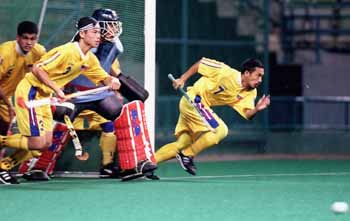
Australian Institute of Sports - Perth
or most upcoming Australian
hockey players, making the Australian Institute of Sport (AIS) hockey team is a stepping
stone to the making the grade for the Australian National Team. The city of Perth is home
to the Australian Institute of Sport's Hockey Unit and the Perth Hockey Stadium - the
proposed 2002 Women's World Cup site - serves as home base for the Australian men's and
women's National Teams.
The AIS teams consist of Senior, Development and Youth Squad members. The AIS team is
coached by David Bell, who played for Australia from 1975 to 1986, and was captain of the
team that won the 1986 World Cup in London.
The AIS played 6 matches with the Malaysian national team at the Bukit Jalil Stadium in
Kuala Lumpur from March 12 - March 18. The comprehensively beat the Malaysians,
winning 5-0, 0-2, 3-2, 3-1 and 2-0.
Independent of the AIS is the Perth-based Western Australian Institute of Sports (WAIS)
hockey team. Former Australian captain Mark Hager is the chief coach and former Australian
full back Stewart Carrunthers is the assistant coach of the team.
The WAIS team is a breeding ground of talent in the areas surrounding Perth. Promising
players get selected to the Perth Thunderstick squad to play in the National Hockey League
starting in May. They also have the freedom and the finances to plan their own tours.
Last month, WAIS entertained the Malaysian Juniors to four matches in Perth. The
Australians won the series comfortably, with the scores being 5-1, 5-0, a draw 2-2 and a
loss 0-3.
This month, a 17-member WAIS team played against the Project 2001 squad in Malaysia,
with the scores being 2-2 (Penang), 6-3 (Ipoh), 5-1 and 3-2 (Kuala Lumpur) in favour of
WAIS. In between, the WAIS hockey team also toured Japan, where they won 3 matches, drew 1
and lost 1 match.
The Malaysian Project 2001 squad is being prepared for next year's Junior World Cup
qualifier and will represent Malaysia in the South East Asian Games.
Photograph : S. S. Kanesan of The Star of Malaysia
|
| FIH Rules Change |
he Hockey Rules Board and the
Rules Advisory Panel met in London from February 25-27, marking the 100th meeting of the
Hockey Rules Board, which first convened on 23rd April 1900. In attendance for the first
time at a Rules Advisory Panel meeting was a representative of the FIH Athletes' Panel -
Pargat Singh of India.
A new rule has been introduced by the FIH on an experimental basis permitting players
to strike the ball with the edge of the rounded side of their sticks. The Rules Board has
made it mandatory for all national federations to implement the rule immediately.
The experimental rule (Rule 4a -- the stick) recognises 'the whole of the first face
and the edges of the rounded side' as 'the playing side of the stick'.
The FIH said playing the ball using the back edge of the stick had become common in
recent years and had proved to be quite spectacular. However, the practice had not been
accounted for previously in the rules.
The FIH has made its earlier mandatory experiment allowing completion of awarded
penalty corners at half-time and full-time after the time expires, into a rule.
A proposal for both the umpires to be permitted to officiate anywhere on the pitch was
also approved. Under current practice, having selected one half of the field, umpires do
not normally make calls within the 25 yard line area, and particularly the striking
circle, of the other umpire. This proposal still has to gain the consent of the FIH
Umpiring Committee.
Also approved was the Rules Board recommendation that no further Rules changes be made
prior to the 2000 Olympic Games in Sydney. Also, the Hockey Rules Board and the Rules
Advisory Panel will hold meetings twice a year, instead of only one, as is currently the
case.
The Hockey Rules Board will celebrate its 100th Anniversary in April 2000.
|
| The Oxford-Cambridge Game |
Photograph : Tom Hevezi of The Times
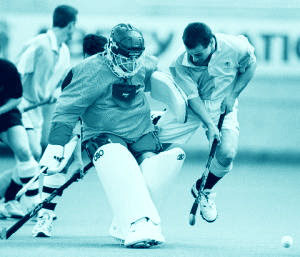
he annual hockey match
between the two venerated institutions Oxford and Cambridge is always a special event for
hockey afficionados. The event was held at Lords till 1991, then shifted to Reading in
1991, and moved to its present home at Milton Keynes in 1997.
The 99th edition of the Oxford-Cambridge match for the Deloitte & Touche trophy
ended in a 2-2 draw. Trailing 0-2, Oxford came from behind
with late second-half goals to force a draw. Cambridge still leads the series
45-37.
In the women's match that followed, Cambridge had to endure a second half onslaught
from Oxford before emerging 4-1 winners. Cambridge has won the women's match for the 5th
time in a row.
Among the foreign players on hand were Belgium Under-21 international Thierry Gruslin
of Cambridge and South African David Eadie, captain of Oxford. On the women's side, the
most exciting player on the field was Tammy Nancoo, the Cambridge defender, who
represented Trinidad and Tobago at the 1998 Commonwealth Games in Malaysia.
History buffs will remember that the first Indian team to win the Olympic Gold (1928 -
Amsterdam) was captained by Oxford blue Jaipal Singh, who joined the team from England.
Oxford plays in the First Division of the National Hockey League, while Cambridge plays
in the East League Premier Divsion. Oxford University has its own water-based artificial pitch at Iffley Road.
Not to be forgotten is the women's match between Oxford and Cambridge, first held at
Wimbledon Common in 1894. Since last year, the men's and women's matches have been staged
on the same day at the National Stadium, helping the women gain much-needed respectability
and adding prestige and atmosphere to the day.
|
| Hockey in the Pearl of Africa |
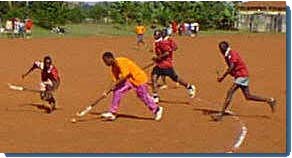
he 1999 training schedule in
Uganda kicked off on Saturday, March 6 at Lugogo Stadium, Kampala. Ladies Training is
carried out daily from 5 pm onwards. The Ugandan ladies team played host to Kenya for a
2-match series on the weekend of March 20/21. Uganda lost 0-8 and 0-7.
In May 1999, the Uganda Men's Hockey Team travels to Nairobi for its first National
Hockey team tour in over 25 years. Uganda will play a two-match series against the Kenyan
team - one of the top four teams in Africa.
Infocom, Uganda's leading Internet and Email provider, are sponsors of Ugandan hockey.
Goalkeeping kits for the Ugandan team are being sponsored by the New Zealand company Obo.
Hockey development in Uganda is in the able hands of Hockey Development Chairperson, Alison
Consterdine and Umpiring Chairman, Chris James.
"We need to get hockey going in the early stages of schooling. Already we have had
a couple of schools form clubs," says Alison. "The process might seem slow to
many, but a strong foundation in the primary schools is my priority and essential to good
growth."
"My priority is to get enough sponsorship money to resurface the murram
pitch and maintain it as a viable surface," says Chris James, Umpiring Chariman.
"Once we can show Ugandan businessmen that we are worth sponsoring, then we can
tackle the laying of an artificial pitch."
Chairman of Uganda Hockey, Arthur de Mello, took Ugandan cricket from
nothing to ICC membership, "and I am determined to achieve the same kind of results
for Ugandan Hockey," he says.
The last time Uganda played a full international match was in the 1972 Olympics, where
the final position of 5th was achieved. The Kenyan tour is part of a fully planned year of
National Team activities, culminating in the 7th All Africa Games in Johanessburg in
September 1999, in which Uganda Hockey is participating for the first time.
|
| Visitor of the Month |
his edition's Visitor of the
Month features an Olympic archive collector from Germany. Bernd Sommer writes:
I have a large Olympic archive (ca. 13,000 autographs and photographs).
Unfortunately, I do not have a lot of information about the great Indian hockey Olympians
(1936 - 1980). I would like to get in touch with these Olympians, and ask them for their
autographs and photographs.
In Germany I will be exhibiting my archives and speaking about the great Olympic
tradition of the Indian hockey. I'm a big fan of Indian hockey! Could you help me in this
quest?
Bernd Sommer, Postfach 07, D-39446 Loederburg, Germany
|
| A League of Their Own - Part I |
hat do Australia, England,
Germany, Holland, Spain have, that India and Pakistan do not. The answer is simple - a
National Hockey League, for both men and women, with professional teams, home and away
games, title sponsor, gate money and television contracts.
In Asia, Malaysia is the only country to have a National Hockey League and also a
Junior National Hockey League. The Singapore
Hockey Federation also has a men's and women's premier hockey league, but that would
be equivalent to the city leagues that exist in most metropolitan cities in India.
Even the island nation of Jamaica has its own Stamina Hockey Premier League (March 13 -
July 17, 1999).
14 teams participate in the Jamaican National Hockey League - Raiders United, Raiders
Suns, Revolution, Jamaica Defence Force, Kingston College Old Boys, G. C. Foster, Jamaica
College Strikers and Circus Circle in the men's category, and St. Andrew, Excelsior,
Tropics, Sharpe's Rebels, Shrills and G. C. Foster in the women's division.
As part of the opening ceremony of the league, there was a team parade, a fair, a
one-day hockey camp for children, and even donkey cart rides and kite flying competition
for the young and old alike. That's Jamaica for you!
When will the IHF wake up from its self-imposed slumber and create a framework for top
level hockey in India. Now that Doordarshan's Sports Channel has been inaugurated, there
can be no more excuses. Until that time, it can at least help top Indian players play in
the tough European and Australian leagues.
|
| A League of Their Own - Part II |
or the past 3 years, soccer in
India gots its own National Football League, sponsored by Philips in the first two years
and Coca Cola in the third year. Coca Cola paid Rs. 1.3 crores for the title sponsorship,
which was Rs. 30 lakhs more than what Philips paid the previous year.
The 1999 NFL winners will get Rs. 40 lakhs, the runners up Rs. 25 lakhs, the 3rd-placed
team Rs. 18 lakhs and the 4th-placed team Rs. 12 lakhs! Wow, what a bonanza for the
players. In fact, when Philips was the title sponsor, they used to give away television
sets and music systems for every single Man of the Match.
India's NFL has attracted lots of foreign players. 36 foreign players, most of them
from Africa, are now in the NFL. 10 of the 12 clubs in the NFL have foreign players. Only
Air India, because of company policy, and JCT, because of a financial crunch, do not have
foreign players. Churchill Brothers from Goa even has a foreign coach in Danny Mclennan of
Scotland.
The hottest property of the NFL, Baichung Bhutia, is currently negotiating with
Birmingham-based Aston Villa to join the English Premier League. The 21-year old East
Bengal striker is India's highest paid soccer player.
Though there are no live telecasts, STAR and Doordarshan show weekly highlights and
Goal of the Week.
Because of this constant media exposure to football, both in the media and on
television, the second edition of the South Asian Football Federation (SAFF) Cup has
already found a sponsor. National Football League title sponsors Coca Cola is also
sponsoring the SAFF Cup, which will have $100,000 in prize money, with the champions alone
earning $50,000. Doordarshan is supposed to telecast all matches live on the national
network.
The AIFF, basking in so much money, has decided to give a fax machine and Rs. 50,000 to
each state association to improve their infrastructure. This will be increased to
Rs. 1 lakh each in year 2000.
Now that's a success story of a league in India with the right ingredients of money,
glamour and media exposure. If the AIFF can successfully pull it off in soccer, in which
we are 110th in the world, why can't the IHF do a similar feat in hockey, where we are in
the top 5 in the world.
|
| Tailpiece |
 ndian sports officials have a
horrendous reputation of being freeloaders at any phoren sports meet. In the 1998
Bangkok Asian Games, there were 90 Indian officials, who had to share the 15 passes
alloted to the officials. ndian sports officials have a
horrendous reputation of being freeloaders at any phoren sports meet. In the 1998
Bangkok Asian Games, there were 90 Indian officials, who had to share the 15 passes
alloted to the officials.
Among these shameless officials was the Minister of State for Sports in Punjab, Nusrat
Ali Khan. The Union Government had refused permission to Khan to go to Bangkok stating
that it was not in consonance with the general guidelines related to foreign tours.
However, without waiting for the Union Government's clearance and approval, Khan left
the country on December 13. Later the state government asked Khan to cut short his visit
and return immediately to Punjab.
All in all, Khan stayed 50 hours in Thailand, all at Punjab government's expenditure.
His wife and sister-in-law accompanied him on his official visit. Khan did not meet a
single official connected with the Asian Games, nor did he enter any of the Asiad venues
as he did not have an entry pass.
Khan remained indoors for most of his stay in Bangkok. When last heard, he was planning
to submit his note on the information and knowhow acquired during his 50-hours indoor
tour. Khan's official reason for coming back abruptly was "Mr. Badal had telephoned
me and asked me to return as the party, the Akali Dal, was facing a serious crisis
following the revolt by Mr. Tohra."
We rest our case.
|