| India
Flatter to Deceive : Asia Cup (Men) |
 o not shed any more tears for
Indian hockey. From the time the IHF sacked the winning coach (M. K. Kaushik), the winning
goalkeepers (Ashish Ballal and A. B. Subbaiah) and dismantled a winning combination (Super
Six), the Indian hockey team has not won a single tournament. India's disgraceful 1999
record is given below: o not shed any more tears for
Indian hockey. From the time the IHF sacked the winning coach (M. K. Kaushik), the winning
goalkeepers (Ashish Ballal and A. B. Subbaiah) and dismantled a winning combination (Super
Six), the Indian hockey team has not won a single tournament. India's disgraceful 1999
record is given below:
| Month |
Event |
Venue |
Result |
| February |
5-Nation Invitational |
Cairo |
Lost in Final to Egypt |
| February |
Indo-Pak Series |
India, Pakistan |
Lost 3-6 to Pakistan |
| June |
India-Germany Series |
Germany |
Lost 1-3 to Germany |
| August |
India-South Africa Series |
South Africa |
Lost 0-3 to South Africa |
| September |
4-Nation Tournament |
Australia |
LAST out of 4 countries |
| November |
Asia Cup |
Kuala Lumpur |
Lost in Semis to Korea |
India had its worst ever 3rd place finish in the 1999 Asia Cup, which was held at the National Hockey
Stadium, Bukit Jalil, from November 18 - November 28. Only 7 members of the gold medal
winning Bangkok Asian Games team made it to the Indian squad for the Asia Cup. India's
results were as follows:
| Date |
Stage |
Match |
| Nov 18 |
Pool Match |
India beat Japan 3-1 |
| Nov 20 |
Pool Match |
India drew with Malaysia 1-1 |
| Nov 22 |
Pool Match |
India beat Hong Kong 5-0 |
| Nov 26 |
Semi-Final |
India lost to South Korea 4-5 |
| Nov 28 |
3-4 Placing |
India beat Malaysia 4-2 |
Korea won the tournament beating Pakistan 5-4 in the final. Korea thus
gained an automatic qualification for the 2002 World Cup, also to be held in Kuala Lumpur.
Korea, which has kept intact their Asian Games team, and their coach, has gone from
strength to strength this year. They came second in the 1999 Champions Trophy, and now
have won the Asia Cup, beating India and Pakistan en route.
How bad was India? Pakistan scored more than double the goals scored by India (39 goals
to 17 goals). One person - Sohail Abbas, scored almost as many goals (16) as the entire
Indian team. 23-year old Sohail Abbas equalled hockey great Hassan Sardar's record of the
most number of goals in a single Asia Cup tournament.
India did not figure anywhere among the awards. The Player of the Tournament and Player
of the Final was Seong Tae Song (Korea), the Most Promising Player was Rosalan Jamaluddin
(Malaysia) and the Top Scorer of the Tournament was Sohail Abbas (Pakistan).
Unless corrective steps are taken, the death knell has been sounded for Indian hockey.
At the turn of the century, we have only the ghosts of India's hockey past for comfort.
|
| Comeback Kids Korea |
 n the semi-final against India,
South Korea was trailing 3-4 late into the match. However, Korea scored 2 goals in the
last 10 minutes to storm into the final. n the semi-final against India,
South Korea was trailing 3-4 late into the match. However, Korea scored 2 goals in the
last 10 minutes to storm into the final.
In the final against Pakistan, South Korea was trailing 2-4 late into the match. Yet
again, Korea scored 3 goals in the last 20 minutes to win the Asia Cup.
A look at the Koreans shows that when the ball goes back into their circle, all the ten
players fall back. Even Pakistan is trying to adopt these methods. But the Indians refuse
to learn. Forwards like Baljit Singh Dhillon, Gagan Ajit Singh and Deepak Thakur, once
robbed of the ball, don't even fall back to regain the ball.
One incident highlights the stamina of the Koreans. Seong Tae Song, the best player of
the tournament, was hacked down in the Pakistan circle and by the time he got up, the ball
was travelling towards the Korean circle. But he ran back and before Pakistan forwards
could even try for a goal, he had reached his end. That's the fitness of the Koreans.
The goal that won Korea the tournament shows their endurance. The Koreans beat three
defenders and then tapped the ball into the circle. Totally out of breath, none of the
three Pakistani defenders even ventured back to help goalkeeper Ahmed Ahmed Alam, and
Seong Tae Song tapped in the winner.
Malaysia has learnt its lesson and is trying to get a full time trainer. Pakistan is
also trying to adopt similar techniques. It is time India learnt its lesson too.
|
| Fun With Numbers |
 his month's edition focusses on
the Asia Cup. India has never won the Asia Cup, with Pakistan and South Korea sharing the
spoils in each of the past 5 editions. his month's edition focusses on
the Asia Cup. India has never won the Asia Cup, with Pakistan and South Korea sharing the
spoils in each of the past 5 editions.
| Year |
Venue |
Winner |
Score in Final |
| 1982 |
Karachi |
Pakistan |
beat India 4-0 |
| 1985 |
Dhaka |
Pakistan |
beat India 3-2 (OT) |
| 1989 |
New Delhi |
Pakistan |
beat India 2-0 |
| 1993 |
Hiroshima |
South Korea |
beat India 1-0 |
| 1999 |
Kuala Lumpur |
South Korea |
beat Pakistan 5-4 |
Pakistan holds the following records in the tournament:
| Category |
Record |
| Maximum Goals Overall |
170 goals in 5 Asia Cups |
| Max Goals in Single Tournament |
51 goals in 1982 Asia Cup |
| Highest Individual Scorer (total) |
Hassan Sardar - 26 goals (3 hat tricks) |
| Highest Individual Scorer (single) |
Hassan Sardar - 16 goals (1982)
Sohail Abbas - 16 goals (1999) |
8-time Olympic and once world champion India have had a minimal impact
on the Asian hockey scene. Pakistan in the 60s, 70s and 80s, and South Korea in the 90s,
have wiped out almost all attempts by India to gain Asian hockey supremacy.
India's scorecard is as follows: Asia Cup - 0 victories in 5 attempts,
Asian Games - 2 victories in 11 attempts. The performance of Pakistan and
Korea for outstrips that of India.
|
| Money Matters |
 hat did it cost the Pakistan
Hockey Federation (PHF) when the Asia Cup was shifted from Lahore to Kuala Lumpur? Rs. 10
million in lost sponsorship and Rs. 3 million in additional expenditure, according to PHF
secretary Col. Mudassar Asghar. hat did it cost the Pakistan
Hockey Federation (PHF) when the Asia Cup was shifted from Lahore to Kuala Lumpur? Rs. 10
million in lost sponsorship and Rs. 3 million in additional expenditure, according to PHF
secretary Col. Mudassar Asghar.
The departure on November 14 of the 18-member Pakistan hockey team for the Asia Cup was
in jeopardy in view of the poor financial condition of the PHF.
Mudassar rushed to Karachi to meet President of Habib Bank Ltd., Shaukat Tareen, and
told him about the problem faced by PHF. Shaukat Tareen released an advance payment from
next year's annual sponsorship instalment, to the tune of Rs. 3 million.
Mudassar said that originally the Asia Cup was to be played in Pakistan and therefore
the expenses of lodging and boarding of the Pakistan team were not budgeted But with the
shifting of the venue to Kuala Lumpur the planning was seriously affected. "Had the
tournament been staged in Pakistan, the PHF could have generated and earned a sizeable
amount as sponsorships were already explored," he said.
|
| It's the Women's Turn Now |
he Hero Honda 4th Asia Cup
hockey tournament (women) will be held at the National Stadium, Delhi, from December 1 -
December 10.
The 6 countries taking part are China, India, Japan, Kazakhastan, Malaysia and South
Korea. The winners will qualify for the Women's World Cup to be held in Argentina in 2002.
Winger Sita Gussain, the lone player from Asia to be selected for the FIH World XI this
year, leads a spirited Indian side.
India's lone gold medal in the Asia Cup came in the first edition held at Kyoto (Japan)
in 1981. At least in that respect the Indian women have performed better than their male
counterparts, who have never won the Asia Cup.
The Indian team for the Asia Cup is as follows:
Helen Mary (GK), Amandeep Kaur, Mary Stella Tirkey, Sunita Dalal, Sita Gussain
(captain), Sumrai Tete, Kamala Dalal, Manjinder Kaur, Pritam Rani Siwach, Suraj Lata Devi,
Jyoti Sunita Kullu, Tingonleima Chanu (GK), Sandeep Kaur, Ferdina Ekka, Pakpi Devi,
Agnecia Lugun, Paulina Surin, Surinder Kaur
Chief coach : Gurdayal Singh Bhangu
|
| Olympic Qualifiers (Women) Draw
Announced |
he 10-nation Olympic qualifying
event for women will be held at Milton Keynes, England, from March 24 - April 2, 2000. The
top 5 nations will qualify for Sydney 2000. The pool groupings are:
| Pool A |
Pool B |
| Germany |
China |
| India |
Great Britain |
| Ireland |
Japan |
| Spain |
New Zealand |
| United States |
Russia |
The Indian women have to finish among the top two in their pool to
automatically qualify for Sydney, or at worst, finish third and go for the play-off for
the final qualifying place.
India has an uphill task as 3 teams are ranked higher than India - Germany, winners of
the bronze medal at the 1998 World Cup, Spain, 1992 Olympic champion and 8th-ranked USA.
The Indian women have not qualified for the Olympics since 1980. India finished last at
the 1998 World Cup.
The 5 teams that have already qualified for the women's competition at Sydney 2000 are:
| Country |
Criteria |
| Australia |
Host Nation
Olympic Champion
World Champion
Oceania Champion |
| Argentina |
Pan American Champion |
| Netherlands |
European Champion |
| South Africa |
African Champion |
| South Korea |
Asian Champion |
The Indian men's team has already qualified for the Sydney Olympics by
virtue of winning the Asian Games gold.
|
| Champions Trophy Soap Opera |
he International Hockey
Federation has confirmed that Pakistan (men) and South Korea (women) will not participate
in the 2000 Champions Trophy at Amstelveen, Holland. The official reason given was the
high cost involved in upping the number of teams from 6 to 7. That was a surprising reason
trotted out by the FIH because the new entrants - Pakistan and Korea - were to bear the
extra cost.
We would like to state the actual reasons which the FIH should have spelt out:
- Different standards for Germany and for Pakistan
European super power Germany came first in the 1997 Champions Trophy (Adelaide), last
in the 1998 Champions Trophy (Lahore), and hence was eliminated in the 1999 Champions
Trophy (Brisbane). Germany accepted elimination from the 1999 tournament with grace and
dignity, stormed back to win the 1999 European championship, and is all set for the 2000
Champions Trophy to be held in June at Amsterdam.
Note that Germany has a much stronger track record than Pakistan in the Champions
Trophy - having won the tournament a record 7 times. In contrast Pakistan has won once in
each of the last 3 decades - 1978, 1980 and 1994.
- Changing rules for the Champions Trophy (women) too
To justify Pakistan's inclusion as the 7th team in the 2000 Champions Trophy, the FIH
dragged in South Korea as the 7th team in the 2000 Champions Trophy. That way the FIH
could come up with a face-saving press release stating these changes were justified due to
"the importance of hockey in Asia." Incidentally, South Korea never even asked
to be included.
This arbitrary decision of the FIH would place extra financial and administrative
hardship on the host country Holland, and on the participating teams. The implications of
the 7-team field include increased playing days, increased financial burden, revamping of
the match schedule and possible difficulties with ticketing.
Never before had a 7th team been allowed to compete in the Champions Trophy tournament.
The FIH Global Task Force rejected Pakistan's request for inclusion. The Competitions
Committee also refused to contravene the rules. The FIH Executive Board also refused to
amend the rules. Finally, the FIH Council discussed the issue for 40 minutes before
agreeing to Pakistan's request for a backdoor entry.
Great hockey nations don't go around with a begging bowl. If Germany was eliminated
from the 1999 Champions Trophy, it is only fair that Pakistan be eliminated from the 2000
Champions Trophy. Hockey is as important to Europe as it is to Asia.
|
| Change of Guard in Pakistan |
 khtar Rasool Chaudhary,
president of the Pakistan Hockey Federation (PHF), has resigned from the office on
personal grounds. khtar Rasool Chaudhary,
president of the Pakistan Hockey Federation (PHF), has resigned from the office on
personal grounds.
“I do not want to stick to the post if I am not in a position to serve or support
the PHF or to raise funds, and I have taken this decision in the larger interest of the
game,” he said.
Akhtar served as the PHF President for 3 years and 3 months. Akhtar was elected
president first in 1997 and was faced with a financially crunched PHF, as well as a team
that was weakened by player revolts. Akhtar was re-elected to the post in August 1998, and
his tenure was to expire in 2002.
Akhtar had broken the tradition of having the head of Pakistan International Airlines
also serve as head of the Pakistan Hockey Federation.
Akhtar admitted that during his tenure Pakistan earned less victories than usual.
Pakistan is without any major world championship. Pakistan faces elimination from the 2000
Champions Trophy, having finished last in the 1999 edition. Pakistan also has to go
through the Olympic qualifiers in Osaka in March 2000, as well as the World Cup 2002
qualifiers.
Akhtar, a former Pakistan captain, and the best centre-half Pakistan has ever produced,
represented Pakistan in five successive World Cups from 1971 to 1982, winning 3 gold
medals and one silver.
|
| Triple Olympian Donates 1 Year's
Pension |
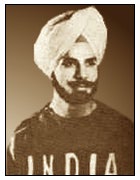
hree time Olympic gold
medallist Balbir Singh Sr. has donated an entire year's pension, Rs. 100,000, to his alma
mater, Dev Samaj Senior Secondary Boys School in Moga, Punjab.
"The purpose of this token donation is to encourage young and budding sportsboys
from the school. The entire amount will be put in a fixed deposit, and from the interest
accruing on it, an annual scholarship would be introduced for the outstanding sportsboy of
the school," he said.
The donation coincided with the centenary celebrations of his alma mater, which were
inaugurated by Punjab chief minister Prakash Singh Badal.
Balbir Singh Sr. retired as Director of Sports, Punjab government, in the early 1980s.
He is currently settled in Burnaby, in the Canadian province of British Columbia.
Excerpts from Balbir Singh Sr.'s famous autobiography, The Golden Hat Trick, has been
serialized on our Indian hockey web site.
|
| Sports Advertisement of the Month |
his month we debut with a new
feature - an advertisement in the print media that profiles a sports personality. Note
that the term 'sports personality' does not translate to a cricketing personality, at
least in countries outside India.
We debut with an advertisement featuring world record holder Michael Johnson.
The company that is running this ad campaign is Nortel Networks. Their advertising pitch
is : "What do you want the Internet to be?" Sprinter Michael Johnson replies,
"Something that can keep up with me."

|
| Visitor of the Month |
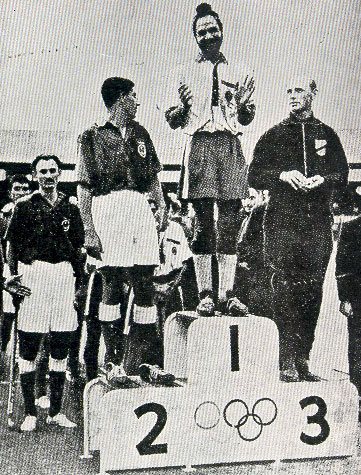
his edition's Visitor of the
Month is the son of the last surviving member of the 1936 Indian hockey team for the
Berlin Olympics. He has supplied a photograph of his father, Joseph Galibardi, which has
made it to this edition's Picture of the Month. You will find out what the great Jesse Owens had to say
about the 1936 gold medal winning Indian team.
|
| Media Matters |
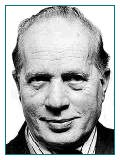
ell know hockey writer Sydney
Friskin died on November 26 at the age of 84. He was the hockey correspondent of The
Times (London) for 28 years. He never retired. His last report appeared in the paper on
the morning of his death.
Born in Rangoon on March 16, 1915, Sydney Emden Friskin was educated in India at St
Joseph's College, Bangalore, and Madras University. From there he embarked initially on a
teaching career in Madras (Chennai), going on to serve in the Army as an education officer
in the Second World War. It was during his army career that his interest in hockey began,
when he met Major Frank Reynolds, the England centre half.
After the war, Friskin worked in Calcutta from 1949 to 1968. He started with the Statesman
of Calcutta as a sports reporter and sub-editor. He went on to become sports editor of The
Times of India, then returned as sports editor to the Statesman. His
despatches from the 1962 Asian Games at Jakarta commanded widespread readership and
attention.
Eventually, Friskin decided to move to Britain, where he joined The Times as a
sub-editor, becoming the paper's hockey correspondent in 1971, with his first assignment
at hockey's first World Cup in Barcelona. He went on to cover 6 Olympic Games and 9 World
Cups.
His love and affection for hockey in India and Pakistan never diminished. He was a
regular contributor to the leading Karachi newspaper Dawn, and it gave him great
pleasure when he was asked to write the history of the first 50 years of Pakistan hockey.
His book on the subject Going For Gold: Pakistan at Hockey appeared in 1997.
Respected the world over, Friskin was the only journalist to receive the award of merit
from the FIH. Sydney Friskin is survived by his wife Gwen, to whom he was married for 42
years, and a son.
|
| PSB Win
Nehru Hockey Tournament |
he 36th Senior Nehru hockey
tournament was held at the National Stadium, Delhi, from November 14 - November 25.
Border Security Force (BSF), Sikh Regimental Centre - Ramgarh (SRC), Punjab Police, IHF
Juniors, Army XI, Karnataka XI, Punjab and Sindh Bank (PSB) and Punjab State Electricity
Board (PSEB) made the quarter-final grade.
Two Jalandhar-based teams, BSF and PSB, made it to the final. Their match results were
as follows:
| Stage |
BSF |
PSB |
| Quarters |
beat Punjab Police 4-2 |
beat Karnataka 5-1 |
| Semi-Final |
beat IHF Jrs 5-2 |
beat Army XI 4-2 |
In the final, PSB beat BSF 4-2 via the tie-breaker, after a 1-1 deadlock
in regulation time. In the tie-breaker, PSB converted four of its strokes after missing
the first one. Rajinder Singh's conversion of the fifth stroke signalled the PSB victory.
The victory helped PSB avenge its loss to BSF in last year's final. At the same time,
it also denied BSF its 8th triumph in Nehru hockey tournament, and its second succesive
title this season after the Surjit Singh memorial tournament.
The Union Minister for Culture, Youth Affairs and Sports, Mr. Ananth Kumar, gave away
the trophies. The winner and runner-up received Rs. 1 lakh and Rs. 50,000 respectively.
3rd placed team Army XI received Rs. 20,000, while the 4th-placed IHF Juniors were
presented Rs. 10,000. Christopher Ekka (BSF), Kamlesh Kumar (IHF Juniors), Prabhdeep Singh
(PSB) and Cyprian Aind (Army XI) were adjudged the best players and got Rs. 5,000 each.
|
| BSF Claim
Surjit Memorial Tournament |
he 16th Surjit Memorial Hockey
Tournament, sponsored by Indian Oil, was conducted at Jalandhar from November 9 to 18.
The following teams qualified for the 8-team Super League :
Last year's quarter-finalists : Border Security Force (BSF), Punjab
and Sindh Bank (PSB), Air India and Punjab Police.
Qualifying Rounds : Rail Coach Factory (RCF), Punjab State Electricity
Board (PSEB), Central Industrial Security Force (CISF) and Bharat Petroleum Corporation
Ltd. (BPCL).
The four semifinalists were as follows:
| Punjab and Sindh
Bank |
Border Security
Force |
beat PSEB
beat RCF 5-2
beat Punjab Police 3-2 |
beat CISF 2-1
beat Air India
beat BPCL 2-0 |
| Punjab Police |
Bharat Petroleum |
beat RCF
beat PSEB 5-1
lost to PSB 2-3 |
beat CISF 2-1
drew with Air India 2-2
lost to BSF 0-2 |
In the semi-finals, both BSF and PSB scored identical 2-1 victories over
Punjab Police and Bharat Petroleum respectively. Peter Tirkey scored the golden goal to
vault his team BSF into the final.
The stage was set for the two best teams in the final - 5-time finalist BSF and 9-time
finalist PSB. In an action-packed final, BSF retained the Surjit hockey title, defeating
PSB 3-2 in the tie-breaker, after being locked 1-1 in regulation time.
BSF right winger Shinu Harenz and PSB international Rajinder Singh had scored in the
regulation period. BSF goalkeeper Sarabjit Kumar was the hero of his team's victory,
saving 3 penalty-strokes in the tie-breaker.
The semi-finals and final were telecast live by Doordarshan on the National Network.
Akashvani Jalandhar broadcast ball by ball commentary of the final on the national hookup.
|
| How to Create a Sports League -
Attract Foreign Talent |
he best soccer players in the
world come to Europe to play professional soccer. The Italian, English, German and Spanish
leagues are the toughest in the world. Our best soccer talent, Bhaichung Bhutia, could
only make it to the Division II of the English League.
Before India's NFL started in 1997, only 5 foreign players played soccer in India -
Chima Okerie (Mohun Bagan), Chibuzor (Tollygunje), N. Lullu and Bernard Operanozie
(Mahindras) and Christopher (Dempo). After 3 years of the NFL, more than 30 foreign
players, most of them from Africa, are now in the NFL.
In its 3rd year, 10 of the 12 clubs in the NFL had foreign players. Only Air India,
because of company policy, and JCT, because of a financial crunch, did not have foreign
players. Churchill Brothers from Goa even had a foreign coach in Danny Mclennan of
Scotland.
The country-wise breakup of foreign players in India's NFL is as follows:
| Continent |
Country |
Players |
| Africa |
Nigeria |
14 |
| |
Ghana |
5 |
| |
Kenya |
2 |
| |
Sudan |
1 |
| Asia |
Sri Lanka |
4 |
| |
Kirgiztan |
3 |
| |
Bangladesh |
1 |
| |
Iraq |
1 |
| |
Nepal |
1 |
| America |
Brazil |
1 |
The All India Football Federation allows each team to sign 5 foreigners,
with only 4 eligible to play in a given game. Mumbai club Mahindra and Mahindra has sent
coach Hakim and manager Harish Rao to Jordan, Syria and UAE to spot talent. Agents in
Africa send biodata and video recordings of promising stars.
If lowly rated Indian football (110 in the world) can attract talent, there is
absolutely no reason why a National Hockey League in India would not attract international
talent from Pakistan, Korea and Malaysia and from other countries in the world.
A professional sports league with big international names (and a hefty TV contract)
could be one way to get the masses to fill the hockey stadiums. If in that process our
standard of hockey improves, so much the better.
|
| Birthdays This Month |
 |
| Balbir Singh Sr. Born: Dec 31, 1923 |
|
| Financial Woes of Australian
Women's Hockey |
omen's Hockey Australia (WHA),
the national body responsible for the world champion Hockeyroos, was almost forced into
provisional liquidation after losing a protracted legal case.
The WHA office in Sydney's Surry Hills were closed and the association's 8 full-time
staff members were sent home as the executive worked out how to pay the almost $1.2
million in compensation and costs awarded against it.
The devastating decision in the NSW Supreme Court was the result of a case brought by
Helen Jones and her company Edmund-Jones Pvt. Ltd. for unpaid commissions on sponsorships
they got for WHA with Telstra in 1989 and Qantas in 1994.
The court had awarded her $800,000 in compensation and almost $400,000 in costs. But in
an out-of-court settlement, Edmunds-Jones decided to settle for a much smaller amount to
prevent the liquidation of WHA.
Helen Jones, of Edmunds-Jones, said "We made a commercial decision to accept a
settlement rather than see the organisation (WHA) wind up. We decided to accept a lesser
amount to save WHA from liquidation."
Until the cheque is in the bank, Helen Jones will not disclose the amount of the
settlement but she did say it does not cover her legal costs.
The visibly relieved general manager of WHA, Gwen Ford, said that it would be business
as usual for the Australian women's team. The Hockeyroos travel to Couran Cove for an
end-of-season camp from November 29 to December 5. Their full-time program for the Sydney
Olympics begins in February when the squad assembles in Perth.
|
| Tailpiece |
 hina, who have stamped their
supremacy in almost all the major Olympic disciplines, are yet to find their feet in
hockey. Never mind the international level, even at the Asian level, they bring up only
the bottom half of the table. hina, who have stamped their
supremacy in almost all the major Olympic disciplines, are yet to find their feet in
hockey. Never mind the international level, even at the Asian level, they bring up only
the bottom half of the table.
China finished sixth at the 1998 Asian Games last year. China does not even figure in
the March 2000 Olympic qualifiers to be held at Osaka.
Coach Zhang Quingyu of China acknowledged the superior skills of the teams from the
Indian subcontinent. However, as far as physical structure and speed is concerned, the
coach believes that the Chinese team is on par with even South Korea.
Coach Zhang said, "'In India and Pakistan plenty of children play hockey. It is
not the case with China. We do not have enough youngsters playing hockey."
This factor was evident from the number of players who have made the Kuala Lumpur trip.
While the remaining eight teams have a list of 18 players, China`s squad consists of only
15. And, the composition is not homogenous. Basketball players, athletes and and even
soccer players make up the team.
For the record, China finished 7th in the Asia Cup.
Article Courtesy : Deccan Herald
|