| Now That The Madness Has Stopped -
Part I |
 his is what Indian cricket
superstar Sunil Gavaskar wrote in his syndicated column, on the media
hype generated by the Cricket World Cup in India: his is what Indian cricket
superstar Sunil Gavaskar wrote in his syndicated column, on the media
hype generated by the Cricket World Cup in India:
The English have switched off cricket after the exit of their team from the World
Cup. They can turn to football where they are struggling to qualify for the Euro 2000, and
if that does not come about then they can turn to tennis at Wimbledon which starts a day
after the cricket World Cup finishes, and if there is disappointment there then they can
talk about golf, then Grand Prix racing.
The beauty is that even though none of their sportspersons are in the top of any
sport, their media will pin their hopes on them and build them up till their exit, after
which they will whine and moan for a few days and then turn to the next sport.
Unfortunately for Indians, that is not the case for cricket is a passion to the
detriment of other sports and that has not been good, for other talented sportspersons
just do not get the exposure, leave alone the commercial opportunities that cricket gets.
The Bhupathi-Paes victory in the French Open may have got a few columns in the
media which is truly a pity for that is a fantastic achievement ....
There couldn't be a better elegy for our overrated, overpromoted and overpaid
cricketers, whom the television and print media have built up like gods. Look at the hours
and hours of coverage accorded by ESPN-Star to any form of first class cricket played
anywhere in the world. Look at the number of issues of Sportstar that have cricketers
(either Indian or foreign) on their cover.
Keep in mind that cricket is but a Commonwealth Game with less than 10 countries in the
entire world playing top quality cricket. Cricket can never become an Olympic sport, let
alone a truly global sport. First class cricket is played nowhere in the Americas barring
West Indies, nowhere in Europe barring England, nowhere in Africa barring South
Africa/Zimbwabe, nowhere in Asia barring the subcontinent, and finally Oceania.
Of these handful of countries playing cricket, India came sixth and last in the Super
Six. Meanwhile Jaspal Rana, Dhanraj Pillai, Paes-Bhupathi
and Vishwanathan Anand compete with the world's best and bring laurels to
the country. They are truly India's unsung sporting heroes.
|
| Now That The Madness Has Stopped -
Part II |
he huge hype generated on a
substandard Indian cricket team prompted this following article, which we picked off the
internet. This piece makes a reference to the ongoing conflict in Kargil. Note that around
200 Indian army jawans have died in battle, fighting at altitudes upto 17,000 feet, and at
temperatures hovering between -5 to -30° C.
An Indian Air Force flight lieutenant is paid Rs. 1200 flying
allowance per month. An Indian cricketer is paid Rs. 1 lakh to play
in a one-day international.
And no, the Indian jawan doesn't sport a cigarette maker's logo on his uniform when
representing his country. Instead he carries a 20 kg load of a week's ration, some
ammunition, and a 5.56 mm assault rifle.
If the IAF pilot dies, his family gets paid Rs. 2 lakhs. The man of
the match in each of the 41 World Cup matches got Rs. 2.1 lakhs.
A person in Bihar offered 111 coconuts (costing Rs. 500 total) and intends to offer Rs.
10,001 if India wins - in cricket, not in Kargil! Now that the Indian team came
last in the Super Six, will he offer that money to the Indian Army?
Flt. Lt. Ahuja was shot in cold blood and was cremated by his four year old son. The
headline in the newspapers the following day was about India's win over England to
(barely) qualify for the Super Six.
The least the Indian cricket team can do after ending up sixth in the Super Six is to
send all the rewards and match fee that they have earned from their failed World Cup
campaign to the Army Jawan Relief Fund.
|
| A Tale of 3 World Cups |
his is the story of 3 different
sports which England gave to the world - soccer, hockey and cricket. In the past 3
decades, there have been 9 editions of World Cup Hockey, 8 editions of World Cup Soccer
and 7 editions of World Cup Cricket. England, which gave birth to all 3 sports has not won
a single world championship in these 3 events over the past 3 decades.
We now examine the records of six hockey playing countries in World Cup Soccer, World
Cup Hockey and World Cup Cricket over the same period. The six countries are 3 from the
Commonwealth - India, Pakistan and Australia,
and 3 from non-Commonwealth countries - Germany, Holland
and Argentina. These elite 6 countries have won 17 of
the 24 World Cups at stake in soccer, hockey and cricket.
When we look at Commonwealth countries, Australia, India and Pakistan
have won a total of 10 world championships in cricket and hockey -
Pakistan with 5 titles, Australia with 3 and India bringing up the rear with 2.
| Decade |
World Cup Cricket |
World Cup Hockey |
| Decade of the 70s |
|
Pakistan - 2 (1971, 1978)
India - 1 (1975) |
| Decade of the 80s |
India - 1 (1983)
Australia - 1 (1987) |
Pakistan - 1 (1982)
Australia - 1 (1986) |
| Decade of the 90s |
Pakistan - 1 (1992)
Australia - 1 (1999) |
Pakistan - 1 (1994) |
When we look at non-Commonwealth countries in our
select group of hockey playing countries, Germany, Holland and Argentina have won a total
of 7 World Championships in soccer and hockey - Holland with 3 titles, Germany with 2 and
Argentina with 2.
| Decade |
World Cup Soccer |
World Cup Hockey |
| Decade of the 70s |
Germany - 1 (1974)
Argentina - 1 (1978) |
Holland - 1 (1973) |
| Decade of the 80s |
Argentina - 1 (1986) |
|
| Decade of the 90s |
Germany - 1 (1990) |
Holland - 2 (1990, 1998) |
|
| A Tale of 2 World Cups |
 ere we take a look at how often
India and Pakistan have met each other in World Cup Hockey and World Cup Cricket. ere we take a look at how often
India and Pakistan have met each other in World Cup Hockey and World Cup Cricket.
For cricket, the equation is simple - India met Pakistan 3 times over the 3 past World
Cups, and have beaten them all 3 times.
| Year |
Venue |
Stage |
Result |
| 1992 |
Sydney |
Round-Robin |
India - 216 / 7
Pakistan 173 all out |
| 1996 |
Bangalore |
Quarter-Final |
India - 287 / 8
Pakistan - 248 / 9 |
| 1999 |
Manchester |
Super-Six |
India - 227 / 6
Pakistan - 180 all out |
In World Cup Hockey, the two countries are equally balanced, having won
two and lost two.
| Year |
Venue |
Stage |
Result |
| 1971 |
Barcelona |
Semi-Final |
Pakistan 2 - India 1 |
| 1973 |
Amsterdam |
Semi-Final |
India 1 - Pakistan 0 |
| 1975 |
Kuala Lumpur |
Final |
India 2 - Pakistan 1 |
| 1986 |
London |
Last Position |
Pakistan 3 - India 1 |
The ultimate marketing fantasy - an India-Pakistan final in a World Cup,
happened only once. It was at the jam-packed Merdeka stadium in 1975, when master dribbler
Ashok Kumar, son of Hockey Wizard Dhyan Chand, scored the goal that give India its one and
only World Cup in hockey.
|
| India's
European Tour |
 n 18-member Indian team embarked
on a tour of Europe to play two 4-test series against Germany and Belgium. The results of
India's matches were: n 18-member Indian team embarked
on a tour of Europe to play two 4-test series against Germany and Belgium. The results of
India's matches were:
| India vs.
Germany |
| June 9 |
Frankfurt |
Germany 4
- India 1 |
|
|
| June 10 |
Bonn |
Germany 2
- India 1 |
Michael Born - 29, 45 |
Gagan Ajit Singh - 16 |
| June 12 |
Mayen |
Germany 2
- India 1 |
Hansel Topin
Emling Bjorn |
Daljeet Singh Dhillon |
| June 13 |
Mainz |
India 3 -
Germany 2 |
Gagan Ajit Singh - 5
Gagan Ajit Singh
Kamal Horo |
Kristoff - 24
Kopff - 29 |
| India vs.
Belgium |
| June 15 |
Brussels |
India 5 -
Belgium 3 |
Sameer Dad
Sameer Dad - 25
Gagan Ajit Singh (3)
|
Coudron - 30
Kholopov - 57
Joerni Beunen - 67 |
| June 17 |
Brussels |
India 3 - Belgium 3 |
|
|
| June 19 |
Brussels |
Belgium 7
- India 2 |
|
|
| June 20 |
Brussels |
India 4 -
Belgium 2 |
|
|
The sole Indian victory over Germany in the 4th test in Mainz is the
first time in 10 years that India has beaten Germany. That last win came during the 1989
Champions Trophy in Berlin. In the decade following that victory, India had lost all
matches to Germany except for 2 draws.
Team manager G. A. Siddique said that goalkeeping, where only Edward
Aloysius looked assured, and abysmal penalty conversion rate of 9%, were
the areas where India had to work hard in their build up to next year's Sydney Olympics.
So will K. P. S. Gill and Jyothikumaran bury their egos and bring back Ashish Ballal and
A. B. Subbaiah into the Indian team, or continue to be narrow-minded and ignore the 'Asiad
Six?'
The Indian team for the European Tour was as follows:
Mohammed Riaz (Captain), Edward Aloysius, B. C. Poonacha, Dilip Tirkey, Dinesh Naik,
Anurag Raghuvanshi, Baljit Singh Saini, S. S. Gill, Thirumal Valavan, Ramandeep Singh,
Navsher Singh, Bimal Lakra, Kamal Horo, Gagan Ajit Singh, Deepak Sonkhla, Sameer Dad,
Baljeet Singh Dhillon, Daljeet Singh Dhillon.
Officials: Harcharan Singh (Coach), C. R. Kumar, M. R. Negi, both
assistant coaches, Shivcharan Singh (doctor), G. A. Siddique (manager), J. N. Tyagi (head
of delegation).
|
| Australia win Champions Trophy
(Men) |
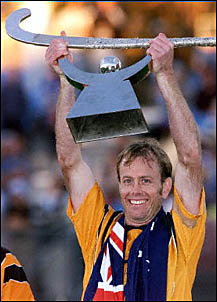
Photo Courtesy : Sydney Morning Herald
he 21st Men's Champions
Trophy and the 7th Women's Champions Trophy were held in Brisbane from June 10 - June 20,
1999. The Champions Trophy was hockey's biggest event in this non-Olympic and non-World
Cup year.
Every game of the Champions Trophy in Brisbane was televised in Australia by Channel 7.
That network will be the host broadcaster for the Sydney Olympic Games in 2000.
The men's final was contested between Australia and South Korea. Their road to the
finals was as follow:
| Australia |
South Korea |
| beat England 3-1 |
beat England 3-2 |
| beat Spain 2-0 |
beat Netherlands 3-2 |
| beat Netherlands 2-1 |
drew with Pakistan 2-2 |
| drew with South Korea 1-1 |
drew with Australlia 1-1 |
| lost to Pakistan 1-2 |
lost to Spain 3-4 |
In an exciting final, Australia defeated South Korea 3-1 to win the
Champions Trophy. Striker Stephen Davies scored two goals (23m, 52m), while Troy Elder
chipped in with one (33m). Seung Tae Song scored the lone goal for South Korea in the 62nd
minute.
Netherlands whipped Spain 5-2 to come 3rd. England beat Pakistan 4-3 in extra-time
through a golden goal to finish 5th. Germany will take the place of Pakistan in the
2000 Champions Trophy in Amsterdam.
The victory for Australia was its 7th Champions Trophy title. The Player of the
Tournament was Seung Tae Song of South Korea, who topscored with 7 goals.
|
| Australia win Champions Trophy
(Women) |
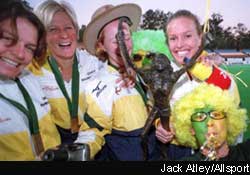
 orld and Olympic champions
Australia won their 5th consecutive Champions Trophy title. So tell me something new. orld and Olympic champions
Australia won their 5th consecutive Champions Trophy title. So tell me something new.
The women's final of the 7th women's Champions Trophy in Brisbane was contested between
Australia and Netherlands - a repeat of the 1998 World Cup finals. Their road to the
finals was as follow:
| Australia |
Netherlands |
| beat New Zealand 5-1 |
beat Argentina 3-0 |
| beat Germany 6-2 |
beat South Korea 3-2 |
| beat Argentina 4-2 |
beat New Zealand 2-1 |
| beat South Korea 6-0 |
lost to Germany 2-3 |
| drew with Netherlands 1-1 |
drew with Australlia 1-1 |
In the final, watched by an overflow crowd of 5,500, Australia defeated
Netherlands 3-2 to win their 5th consecutive Champions Trophy title. Under Charlesworth,
the Australians now have a record of 165 wins, 23 losses and 20 draws.
Australia started with a goal by Katrina Powell inside the first minute. Dillianne van
Den Boogard equalised for Netherlands in the 17th minutes off a penalty corner deflection.
Bianca Langham replied with a penalty corner goal for Australia in the 30th minute.
Seconds before half-time, Karlijn Petri equalised for Netherlands.
Netherlands did not get into Australia’s circle after half time. Katrina Powell
scored the winning goal for Australia in the 56th minute.
Germany beat Argentina 1-0 to come 3rd, while New Zealand outplayed South Korea 3-1 to
finish 5th. South Africa will replace South Korea in next year's Champions Trophy.
Natascha Keller of Germany was voted the Player of the Tournament.
|
| Money Matters |
he Australian Olympic Committee
has a medal incentive bonus program for Olympic athletes.
Australia's fourth place performance at the Utrecht World Cup earned the team $200,000
($12,000 for 16 players). Australia's win in the Champions Trophy earned the team $720,000
($45,000 for 16 players). In addition, there is a $5,000 stipend for
those based full-time at the Australian Institute of Sports' hockey headquarters in Perth.
Kookaburras high-performance manager Ray Dorsett said the players knew they were
playing not only for gold but also "their livelihood next year".
"This money means the 24-member squad can live full-time in Perth for 22 weeks
leading up to the Olympics without financial constraint. It's an incredible boost for our
boys."
Note that in India, the last player who asked for a match fee got kicked out of the
team. Some match incentive, this.
|
| Decline and Fall of Pakistan
Hockey |
he last 3 years have seen
Pakistan hockey down in the doldrums. We examine its performance in the recent World Cup,
Asian Games, Commonwealth Games and the Champions Trophy.
In 1997, Pakistan failed to qualify for the semi-finals of the Junior World Cup
in London. There the Indian team led by Rajeev Mishra came second, losing to eventual
champions Australia in a thrilling final. In 1998, defending champions Pakistan failed to
qualify for the semi-finals of the World Cup in Utrecht.
In the inaugural Commonwealth Games Hockey, also in 1998, Pakistan
failed yet again to reach the semi-finals. In that process, a unique Pakistani record was
lost, whereby they had won the inaugural hockey event of every major hockey championship
barring the Olympics.
The 1998 debacle was complete when Pakistan lost in the semi-finals of the Bangkok
Asian Games. This was the Games where India won the gold medals after 32 long
years. The loss by Pakistan meant that for the first time, they had to qualify for the
Olympics.
Now, in 1999, by coming last in the Brisbane Champions Trophy,
Pakistan has not qualified for the 2000 Champions Trophy in Amsterdam - the first time
ever that Pakistan doesn't get invited to this elite event. Pakistan has competed in each
of the previous 21 men’s Champions Trophy tournaments.
Former hockey stalwart Shahbaz Ahmed appealed to Prime Minister Nawaz
Sharif, patron of the Pakistan Hockey Federation, "to dismiss the existing
management, which is incompetent, and take drastic measures to save the future of the
Pakistan's national game."
Shahbaz singled out secretary Mudassar Asghar as his prime target, stating that
"he has been at the helm of Pakistan hockey for the last 6 years and has damaged
Pakistan hockey no end. If we do not take drastic measures, hockey will die in
Pakistan."
|
| The Tata
Junior National Hockey Championship |
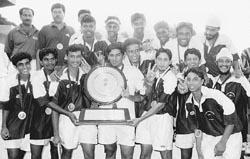
Photo Courtesy : The Hindu
he 30th Tata Junior National
Hockey Championship was conducted by the KSHA on the polygras surface at Akkithimmanahalli
stadium, Bangalore, from June 16 - June -. The Tatas showed their committment to Indian
hockey by sponsoring the event to the tune of Rs 20 lakh.
The tournament was originally scheduled to be held in Pune. However, the indifferent
attitude of the callous MHA officials prompted the IHF to shift the venue to Bangalore.
This was the first junior Nationals to be hosted by Karnataka.
4 teams stayed away from the championship - Border Security Force, Goa, Mizoram and
Railways, which left 32 teams to be divided among 8 pools in the league stage. The results
of the pool matches were as follow:
| Pool |
Winner |
Results |
| Pool A |
Punjab |
beat Pondicherry 2-1
beat Rajasthan 11-0 |
| Pool B |
Mumbai |
beat Himachal Pradesh 6-1
beat Hyderabad 9-0
beat Bhopal 4-2 |
| Pool C |
Punjab and Sindh Bank |
beat Madhya Pradesh 16-0
beat Chandigarh 1-0
drew with Orissa 2-2 |
| Pool D |
Karnataka |
beat Nagaland 5-1
beat Kerala
beat Maharashtra
drew with Services 3-3 |
| Pool E |
Tamil Nadu |
beat Madhya Bharat 8-1
beat Delhi 3-2 |
| Pool F |
Uttar Pradesh |
beat Manipur 4-0
beat SAIL 3-1
beat Andhra Pradesh 4-1 |
| Pool G |
Bengal |
beat Vidharba 17-0
beat Patiala 9-0
beat Haryana 4-0 |
| Pool H |
Air India |
beat Gujarat 13-1
beat Jammu & Kashmir 17-0
beat Bihar 14-0 |
In the quarter-finals, Mumbai ousted hosts Karnatak 8-6 via the
tie-breaker, while Punjab and Sindh Bank prevailed over Punjab by a solitary goal. Bengal
beat Tamil Nadu 1-0 through a golden goal by Iqbal Singh, while Air India ousted Uttar
Pradesh 2-1.
In the semi-finals, Mumbai beat Punjab and Sindh Bank after being down by 2 goals till
the last 2 minutes of the game. Vijay Alphonso of Mumbai scored both goals to tie the
score, after which Mumbai won in the tiebreaker 7-6. Air India made the grade with a
fluent 3-0 triumph over Bengal.
Air India beat Mumbai 3-1 to win their maiden Junior National Hockey title. Prabhjot
Singh sounded the board twice (28, 31) while Sanjeev Kumar struck the third goal for Air
India (49), after Mumbai shot into the lead with a 4th minute penalty converison by
Rabindro Singh. Earlier, Bengal finished third defeating Punjab and Sind Bank 2-1.
The sponsors Tatas presented the following 'best player' awards: Goalkeeper: B. K.
Chatri (Karnataka) ; full-back: Bikramjit Singh (PSB); forward: Deepak Thakur (Air India);
half-back: Viren Rasquina (Bombay); all-round: Prabhjot Singh (Air India) - who scored 20
goals.
In a touching gesture, Tatas also presented a purse each to former internationals -
Manuel and Thangaraj - who are both ailing and needy.
|
| Indian Women
u-21 Win USA 4-Nation Tournament |
4-Nation tournament was played
at Kean University, New Jersey from June 23 to June 27. Other teams taking part besides
hosts USA were England, India and Chile.
India losts its first match to England 0-1. However India came back strongly to beat
USA 5-1 in its second match. India then clinched its place in the final when it beat Chile
10-0 in its last match.
In the final against England, Surinder Kaur put India ahead in the 8th minute, before
Lisa Wooding equalised for England in the 46th minute. With the score tied at 1-1, the
game went into overtime. A goal in the first minute of extra time by Mamta Kharab steered
India to a 2-1 victory over England.
The Indian team was led by 18-year old Pushpa Pradhan. India was coached by P. P.
Anthony of SAI (South Centre), Bangalore. Haryana girl, Surinder Kaur, a member of the
Bangkok Asian Games silver medal-winning squad, emerged the highest scorer with five
goals.
The Indians, preparing for the Junior Asia Cup (September 1999) and the Junior World
Cup (February 2000), came for high praise for exhibiting delectable stickwork and precise
passing. The performance gives much hope for women's hockey in India, coming soon after
the seniors landed the Asian Games silver medal at Bangkok last December.
|
| How to Create a Sports League -
UFHL |

his is a continuing series on
the creation of sports leagues. The objective of this series is to stimulate the IHF top
brass to start exercising their minds and come up with innovative marketing, rather than
sit on their behinds and do cheap politicking. This month's series features the United
Airlines Field Hockey League (for women) in the USA, sponsored by United Airlines.
Structure : The United Field Hockey League is USA's only
non-collegiate national hockey championship for women. The league features six franchise
teams representing various regions of the eastern United States.
The teams are not divided by age group. As a result, high school standouts as young as
16, collegiate all-Americans as well as veteran U.S. Olympians can play together on the
same team.
A team can have a maximum of 6 US national team members, with the remainder of the
30-player rosters to be filled by open tryouts. There is a limit of one non-US citizen on
any team.
Teams :
| Team Name |
Zone |
Head Coach |
| Metro Rush |
NY, NJ, Delaware |
Beth Bozman, (Princeton Univ.) |
| New England Eclipse |
New England |
Wendy Anderson |
| Pennsylvania Pride |
Western PA |
Michele Finegan, (Lehigh Univ.) |
| Philadelphia Fury |
Philadelphia |
Lauren Fuchs, (Temple Univ.) |
| Southern Charm |
NC, GA |
Karen Shelton, (Univ. North Carolina) |
| Tidewater Tempest |
VA, MD |
Tess Ellis, (William & Mary) |
Open trials were held in May all over eastern United States for
selection to the teams. Player allocations from the u-16, u-20, and the senior reserve
teams filled up the balance of the 30 player rosters of each team. Of the 30 players, only
18 make the cut to participate in the league in June.
Schedule :
| Stage |
Date |
Site |
| Round Robin |
June 5-6 |
Univ. of North Carolina, Chapel Hill |
| Round Robin |
June 19-20 |
Springfield College, Massacheusetts |
| Final Four |
July 3 |
University of Maryland, College Park |
Tournament Results :
| Team |
June 5-6 |
June 19-20 |
| |
W - L - D |
W - L - D |
| Southern Charm |
3 - 0 - 0 |
2 - 0 - 0 |
| Philadelphia Fury |
1 - 0 - 2 |
0 - 1 - 1 |
| New England Eclipse |
1 - 1 - 1 |
1 - 0 - 1 |
| Metro Rush |
1 - 1 - 1 |
0 - 0 - 2 |
| Pennsylvania Pride |
1 - 2 - 0 |
0 - 0 - 2 |
| Tidewater Tempest |
0 - 3 - 0 |
0 - 2 - 0 |
The Final Four was to be held at the University of Maryland astro-turf
ground over the July 4th weekend.
|
| Mumbai Gets Its Astro-Turf
(Finally) |
fter years of waiting in vain,
the Bombay Hockey Association finally got its act together and got the artificial pitch
installed at the Mahindra Stadium. To celebrate the laying of the turf, the BHA organized
the BHA Hockey Championships.
The final was contested between Air India and Western Railway, with the former winning
the championship 3-2. Air India had advanced to the final beating Mumbai Port Trust, while
Western Railway had disposed off Rashtriya Chemicals and Fertilisers in the other
semi-final.
Air-India got their first goal through a penalty corner - Cornelius D'Costa selling a
dummy, and leaving the ball for Rajesh Chavan to push in. Western were quick to respond
with a goal in the 27th minute, with Dinesh Gupta deflecting a hit from Santha Kumar.
Air-India then took the lead for the second time in the match - Kishore Kumar's cross
from the right had Gavin Ferreira just tapping the ball in. Three minutes later, Anand
Sodkar's forward hit on the right was sweetly deflected in by Chander Pal for the
equalizer.
Air-India found their third lead, with Kishore Kumar diving and scooping the ball past
goalkeeper Alexander. This time Air India led for good, thus winning the first
championship on BHA's new turf.
|
| Media Matters |
he Royal Netherlands Hockey
Association has released a book "World Cup Hockey 1998" - a
128-page photo essay of the last World Championship at Utrecht. The photographs were taken
by Jeroen van Bergen - a popular Dutch photographer.
This is what S. Tyagarajan, Chairman - Hockey Commission, AIPS, and a respected hockey
writer had to say in his review of the book:
"Jeroen van Bergen, the cherubic Dutchman with a string of
cameras and huge lenses pulling him down from the shoulders, is a cynosure of the eyes in
any hockey competition. If a picture is worth a 1000 words, those from the frames of
Jeroen are worth 10 times more.
In a sport where literature is meagre, and photography reduced to a state of anemia
- confined to few newspapers and journals, the personality of Jeroen stands out as unique.
Every picture in the World Cup Hockey 1998 captures the spirit, style,
action of hockey in a myraid of colours. The hockey fraternity owes a debt of gratitude to
Jeroen van Bergen for his outstanding piece of work."
|
| Visitor of the Month |
n FIH Class 1 umpire from New
Zealand is this edition's Visitor of the Month. Jason
McCracken writes:
Great work for the site. I am a class 1 International Umpire and was umpiring at
the Asian Games as a neutral umpire from New Zealand. I umpired the semi-final that India
won and it was a teriffic match.
It is good to see India doing so well and I wish the IHF all the best in their
buildup to Sydney next year.
|
| Birthdays This Month |
 |
Dhanraj Pillai July 16, 1968 (31 years old) |
|
| Tailpiece |
ockey runs in the family of
German striker Natascha Keller, as the Keller dynasty of Berlin has won 5 Olympic medals
(2 Gold, 3 Silver) for Germany over the last 60 years.
Keller's grandfather, Irwin, won a silver medal at the 1936 Berlin Olympics; her
father, Carsten, won gold at the 1972 Munich Olympics and her brother, Andreas, won silver
in Los Angeles in 1984 and Seoul in 1988 before grabbing gold in Barcelona in 1992.
At the age of 21, Natascha gets a shot in next year's Sydney Games to add to the family
haul of 5 Olympic medals. Her team had finished 6th in Atlanta.
Natascha Keller smashed home the goal of the tournament in Germany's 4-0 drubbing of
Korea. Natascha fought her way past three defenders inside the circle before unleashing a
reverse stick goal which drew gasps of admiration from the crowd. Natascha, who scored 5
goals, was voted 'Player of the Tournament.'
|