| Pakistan Gets Most Favoured Nation
Status |
 n a shocking development, the
FIH Council has bended the rules to induct Pakistan as the 7th team for the next Champions
Trophy at Amstelveen. The Champions Trophy has thus been reduced to a private showpiece of
the FIH, where influence can get you in when required. The Champions Trophy has become
devalued. n a shocking development, the
FIH Council has bended the rules to induct Pakistan as the 7th team for the next Champions
Trophy at Amstelveen. The Champions Trophy has thus been reduced to a private showpiece of
the FIH, where influence can get you in when required. The Champions Trophy has become
devalued.
Pakistan was out of the Champions Trophy for the first time after finishing last in the
previous edition at Brisbane. The appeal to the FIH was based on the following :
- Pakistan performed poorly because of the new foot/ball rule
- Pakistan initiated the idea of the Champions Trophy in 1977
- Pakistan participated without a break for 22 years
It goes without saying that since Pakistan had also initiated the concept of the World
Cup in 1971, they can participate in the World Cup for ages to come.
Unluckily for India, the IOC does not tolerate such nonsense, so India cannot claim
that the 8 Gold Medals it won in this century would automatically qualify it for all the
Olympics to be held in the next century.
|
| A Tournament Without A Venue |
 rom India to Pakistan to
Malaysia, the saga of the Asia Cup venue goes on. rom India to Pakistan to
Malaysia, the saga of the Asia Cup venue goes on.
India were the original hosts for the 5th Asia Cup (men). The Asia Cup is essentially a
low-cost tournament, with the teams paying for their own airfare, board and lodging. Due
to bungling by the IHF duo of Gill and Jyothikumaran, the FIH named Pakistan as the hosts
instead.
Now due to the 'democracy by another name' situation in Pakistan (it is still not
officially termed as martial law), and with the Pakistan Hockey Federation President
Akhtar Rasool under detention, the Asian Hockey Federation (AHF) has named Malaysia as
hosts of the Asia Cup. 7 out of 10 countries had rejected Lahore as the venue, as per the
survey carried out by the AHF.
The Asia Cup will still be held from November 18 to 28, as originally scheduled, but at
the National Hockey Stadium in Bukit Jalil. This will be the first time Malaysia will host
the Asia Cup, which began 22 years ago.
But Pakistan officials, feeling that the AHF cannot make such a move without getting it
approved by the FIH, are pinning their hopes on the world body to reverse the decision.
Besides heavyweights Korea, Pakistan, India and Malaysia, the other teams participating
are Bangladesh, China, Hong Kong, Japan, Kazakhstan and Sri Lanka.
The winner of the Asia Cup would qualify automatically for the 2002 World Cup in Kuala
Lumpur. The other top four finishers would be selected for the World Cup qualifiers. At
the last Asia Cup in 1993 at Hiroshima, South Korea beat Pakistan 6-0 in the final.
Meanwhile, IHF President K. P. S. Gill has swallowed his pride and done what is good
for the country - recall Dhanraj Pillai and Mukesh Kumar for the Asia Cup. The preparatory
coaching camp is being held at SAI, Bangalore, from October 19 onwards.
|
| Field of Dreams : Part I |
 here are 20
artificial turf pitches throughout India. Nearly half of the nation's artificial turf
pitches are in northern India. Delhi and Bangalore are the only cities with 2 artificial
turf pitches. None of the hockey stadiums in India have floodlights! here are 20
artificial turf pitches throughout India. Nearly half of the nation's artificial turf
pitches are in northern India. Delhi and Bangalore are the only cities with 2 artificial
turf pitches. None of the hockey stadiums in India have floodlights!
The following is the list of stadia in India with artificial turf pitches:
| Region |
City |
Stadium |
Region |
City |
Stadium |
| North |
Amritsar
Delhi
Delhi
Jalandhar
Patiala
Chandigarh
Jammu
Lucknow
Ludhiana |
GNDU Stadium
National Stadium
Shivaji Stadium
Surjit Singh Stadium
SAI (North) |
West
South
East |
Bhopal
Gandhinagar
Mumbai
Pune
Bangalore
Bangalore
Chennai
Hyderabad
Imphal
Ranchi
Rourkela |
Aish Bagh Stadium
SAI (West)
Mahindra Stadium
Pimpri-Chinchwad
Akkithimmanhalli
SAI (South)
Radhakrishnan
Police Stadium
- |
Compared to the 20 artificial turf pitches in India,
there are more than 600 full-size artificial turf pitches in England
(including 70 double-pitch facilities). 300 of these
pitches were built in this decade itself.
In its last two major tournaments, England beat India to claim the
bronze medal in the 1998 Commonwealth Games, and beat Pakistan to finish 5th in the 1999
Champions Trophy. The outcome of the latter match was disastrous for Pakistan, who have
been (morally) eliminated from next year's Champions Trophy.
The Empire has indeed struck back, thanks in no small measure to its surfeit of
artificial turf fields.
|
| Field of Dreams : Part II |
n 1998 we had the Rabobank
World Cup hockey competition. This was followed by the Habib Bank
Champions Trophy. After our stirring Asian Games triumph, we had the Pepsi
Indo-Pak hockey tests for the Indian leg of the series.
The above concept of tournament naming rights can apply to stadiums too. In short,
Indian hockey needs more Mahindra stadiums, the only artificial turf
hockey stadium in India to be funded by, and named after a corporate sponsor.
That would be the only way we can fund large-scale deployment of artifical turf fields
in India. The present cost of an artificial turf field is $70 - $80 per
sq metre, for the 6000 sq metre area of a hockey field. The overall cost, including the
replacement of, or repairs to the old sub-base, can work out anywhere between Rs.
2 - Rs. 3 crores.
Professional sports leagues in USA have taken the concept of stadium naming rights to
heart, as is borne out by the following numbers:
| League |
Stadiums with
Naming Rights |
| National Basketball Association |
18 out of 29 (62%) |
| National Hockey League |
14 out of 30 (47%) |
| National Football League |
12 out of 31 (39%) |
| Major League Baseball |
11 out of 30 (37%) |
Those 55 stadiums with naming rights have pumped in money worth $2.2
billion into American sports. Some sample contracts are as follows:
| Sport |
City |
Stadium Name |
Contract |
| Football |
Washington DC |
FedEx Field |
$200 million over 27 years |
| Basketball |
Dallas |
American Airlines Arena |
$195 million over 30 years |
| Hockey, etc. |
Atlanta |
Philips Arena |
$182 million over 20 years |
| Baseball |
Phoenix |
Bank One Ballpark |
$66 million over 30 years |
It is to be hoped that more artificial stadia, with floodlights, will
spring up across India as a result of innovative financing based on corporate sponsorship.
Here's to Tata Stadium in Jamshedpur. How about a floodlit SAIL Stadium
in Rourkela. And to ITC Stadium in Calcutta - the one
major metropolis in India yet to have an artificial turf pitch.
|
| Media Matters |
 eports on the death of Inside
Hockey magazine have been greatly exaggerated. eports on the death of Inside
Hockey magazine have been greatly exaggerated.
The Delhi-based "Inside Hockey" magazine, which had mysteriously suspended
its operations after the 1998 World Cup, is now being revived by Mumbai-based Marine
Sports. Pargat Singh will continue to be the editor, and he will be
assisted by a galaxy of hockey stars like Jude Felix, Merwyn
Fernandes, Joaquim Carvalho, Mir Ranjan Negi
and Prabhjot Singh, all of whom have played the game at the highest
international level.
Hockey writers like Darryl Crasto (Times of India) and Errol D'Cruz (Indian Express)
will write about the players, the game and its development. Noted journalist Suhas Nair
(formerly of the Pioneer) will assist as the media co-ordinator.
Marine Sports will handle the publishing and distribution. They can be reached at The
Marine Sports Magazine Division, Post Box No. 7025, Mumbai 400 028.
|
| FIH 75th Anniversary Celebrations
(Men) |
he FIH World XI (men) played
world and Olympic champion Netherlands in Alexandria on October 27, as part of the FIH's
75th anniversary celebrations.
Netherlands comprehensively beat the World XI 4-1. A stunner of a penalty corner by
Remco van Wijk put the Netherlands ahead early in the first-half. The World XI struck back
through a penalty corner flick by Peter Milkovich.
In a space of two minutes, Karel Klaver turned the complexion of the match, striking
two goals for Netherlands, and in the final minutes, Teun de Nooijer put the finishing
touches to a great victory.
The World XI men's team was coached by Shiaz Virjee of Canada. 16
players from 12 countries made up the World XI. The lone Indian representative in the
World XI was Baljit Singh Dhillon, one of only 4 from Asia.
Earlier, Stephen Veen of the Netherlands (men) and Alyson
Annan of Australia (women) were elected the FIH Players of the Year for 1998.
Dhanraj Pillai and Pritam Rani Thakran were among the nominees. The Players of the Year
both hold Olympic, World Cup and Champions Trophy gold medals.
The 10-member voting panel comprised coaches, players, umpires and representatives of
the media. Judging criteria included skill, technique and championships won, leadership
qualities, impact on team performance, disciplinary record and involvement in hockey both
on and off the field.
The members of the World XI (men) were as follows:
| Continent |
Country |
Player |
| Africa |
Egypt |
Abdullah Magdi, Ashraf Shafiq |
| |
South Africa |
Greg Nicol |
| America |
Argentina |
Rodolfo Perez |
| |
Canada |
Mike Mahood, Peter Milkovich |
| Asia |
India |
Baljit Singh Dhillon |
| |
Malaysia |
Mirnawan Nawawi |
| |
Pakistan |
Sohail Abbas, Waseem Ahmed |
| Europe |
Belgium |
Marc Couldron |
| |
Germany |
Florian Kunz |
| |
Spain |
Juan Escarre, Pol Amat |
| Oceania |
Australia |
Damon Diletti |
| |
New Zealand |
Brett Leaver |
|
| FIH 75th Anniversary Celebrations
(Women) |
he FIH World XI (women) played
world and Olympic champion Australia in Alexandria on October 27, as part of the FIH's
75th anniversary celebrations.
In a see-saw match, in which the lead changed twice only to be tied again, the World XI
finally prevailed 4-3 over Australia.
Alyson Annan and Michelle Andrews opened the scoring for Australia. Britta Becker of
Germany and Pietie Coetzee of South Africa brought the two teams level at two apiece. Not
long after Pietie increased the lead, and it was then the turn of the Aussies to be under
pressure till Katrina Powell hit in the equaliser.
When a minute remained and when it looked as though a drawn verdict was on the cards,
Argentina's Karina Masotta scored the match winner.
The World XI women's team was coached by Sue Slocombe of England. 16
players from 9 countries made up the World XI. Sita Gossein of India was
the lone representative from Asia. Karen Brown, the world's most capped
player, was captain of the World XI team.
The members of the World XI were as follows:
| Continent |
Country |
Player |
| Africa |
South Africa |
Caryn Bentley, Pietie Coetzer |
| |
Zimbabwe |
Shelly Tate, Ilsa Coetzer |
| America |
Argentina |
Karina Masotta |
| |
USA |
Tracey Fuchs |
| Asia |
India |
Sita Gossein |
| Europe |
England |
Karen Brown |
| |
Germany |
Britta Becker, Natasha Keller, Heike Latch |
| |
Holland |
Carol Thate, Clarinda Sinnige, Dilliane Boogard |
| Oceania |
New Zealand |
Mandy Smith, Robyn Matthews |
|
| Zen and the Art of Korean Hockey |
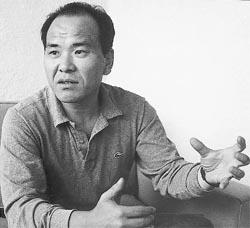
Kim Sang Ryul, Korea's National Hockey Coach
 ome words of wisdom from Kim
Sang Ryul, coach of the Korean team which finished with the silver medal in the
1999 Champions Trophy. Kim (44) was a student of Balkishan Singh at the National Institute
of Patiala, where Ryul studied the basics of hockey for about a year. Kim holds the Grade
I coaching certificate from the FIH. ome words of wisdom from Kim
Sang Ryul, coach of the Korean team which finished with the silver medal in the
1999 Champions Trophy. Kim (44) was a student of Balkishan Singh at the National Institute
of Patiala, where Ryul studied the basics of hockey for about a year. Kim holds the Grade
I coaching certificate from the FIH.
"Like many around the world, I am really worried about India's future in hockey. I
know your hockey so well. Why do you always change your coaches? No doubt, coaches make
mistakes, but for every mistake you'll change the coach. That, in my reasoning, is the
main fault with Indian hockey today.
Cedric, your Olympic coach, he was very, very intelligent, and alway
tried new strategies. In fact, I learnt many things from him. At that time all coaches
used to worry about Cedric's strategy. When I talk with foreign coaches, they all agree
Cedric is the best Indian hockey coach. But after Atlanta, Cedric was removed, and every
foreign coach is happy that the danger coach is out.
Also, I am a professional coach and am being well paid by the Korean Hockey
Association. I cannot disclose what I get for obvious reasons. But you must understand
that every coach is a professional and must be paid for his services.
I have not often seen an Indian coach watching a tournament where his team is not
involved. For instance, I was at Padua (Italy) watching the European Hockey Championship
where Germany, Holland, Spain, England, and several others played in a hectic competition.
But I did not see a single Indian coach there. If that is so how will you know the
strategies of other countries when you face them in a match.
I like Indian and Pakistani players because they are skillful and fast. What further
coaching do they need? All you need to develop are stamina and strategy,
just two things. That's all. Simple. If I take an Indian or Pakistani team, I will be very
happy because they are individually much better than the Koreans. Give your players to
me."
Article and photograph courtesy The Hindu
|
| Punjab
Police Claim Bombay Gold Cup |
he 38th Bombay Gold Cup was
conducted at the Mahindra Stadium from October 6 to 16. Mismanagement over the years by
the Bombay Hockey Assocation has resulted in this being only for the third time in this
decade that the Gold Cup was being held.
Leading the fray in the 1999 edition were 8-times champion BSF, and 4-times champions
Indian Airlines and Punjab Police. The IHF Juniors XI team was included at the behest of
IHF President K. P. S. Gill.
The four semi-finalists were as follows:
| Pool A |
Date |
Punjab Police |
Date |
Punjab and Sindh
Bank |
| |
Oct 11 |
beat Bhopal XI 8-1 |
Oct 10 |
beat Delhi XI 4-1 |
| |
Oct 12 |
beat Rail Coach Factory 3-1 |
Oct 13 |
beat Indian Airlines 4-1 |
| Pool B |
Date |
Bharat Petroleum |
Date |
Air India |
| |
Oct 8 |
beat Customs 4-2 |
Oct 8 |
beat Companeros 6-0 |
| |
Oct 10 |
walkover CRPF |
Oct 11 |
beat IHF XI 2-0 |
| |
Oct 12 |
beat Central Railway 1-0 |
Oct 13 |
beat Sikh Regiment 1-0 |
In the semi-finals, the teams from Punjab beat the teams from Mumbai.
Punjab and Sindh Bank trounced BPCL 4-1, while Punjab Police beat Air India 3-2 on a
Daljit Singh Dhillon hat-trick. In the final, Punjab Police beat Punjab and Sindh bank to
clinch their 5th Bombay Gold Cup title.
Baljit Singh Chandi (Punjab and Sindh Bank) was declared the Player of the Tournament.
Punjab Police received Rs. 1 lakh as the winnner's check, while Punjab and Sindh Bank got
Rs. 50,000. Punjab Police was managed by ex-Olympian Pargat Singh.
|
| Money Matters |
 hat will it cost the Malaysian
Hockey Federation (MHF) to host the 2002 World Cup in hockey? hat will it cost the Malaysian
Hockey Federation (MHF) to host the 2002 World Cup in hockey?
MHF deputy president Datuk Seri P. Alagendra has estimated the total cost of organising
the World Cup at $1.1 million. One of the components of the above cost is
the $132,000 hosting fee to be paid to the FIH (for what?).
The FIH has introduced what it calls "global sponsorships" for which it plans
to tap at least 4-5 major sponsors. The world body is expecting to raise 2 to 3
million dollars from such global sponsors.
MHF would get a 10% cut of the sponsorship raised by the FIH. The MHF will have to
raise the remainder of the money through local sponsorship and ticket sales. Note that all
TV rights rest with the FIH.
To increase revenue from ticket sales, the MHF is looking into the possibility of
laying an artificial turf at the Bukit Jalil soccer stadium (rather than its hockey
stadium) so as to allow a larger crowd to watch the World Cup matches. "We are hoping
to attract crowds between 80,000 and 100,000 for the World Cup," said Alagendra.
|
| Fun With Numbers |
his month's edition is based on
former coach Cedric D'Souza's enjoyable analysis titled "Euro Power," in his
regular column for Rediff.
Cedric observes that if we take the 3 important world hockey competitions - Olympics,
World Cup and Champions Trophy, the recent editions of these tournaments have all been won
by a European nation. The table below bears him out.
| Tournament |
Year |
Winner |
| Olympics |
1988
1992
1996 |
England
Germany
Netherlands |
| World Cup |
1990
1994
1998 |
Netherlands
Pakistan
Netherlands |
Champions
Trophy |
1995
1996
1997
1998
1999 |
Germany
Netherlands
Germany
Netherlands
Australia |
The only two exceptions to European domination in the above table is Pakistan
winning the 1994 World Championship in Sydney and Australia winning the
1999 Champions Trophy in Brisbane.
India does not figure in the above table at all. We have won only one major title in
each of the last 3 decades. India won the World Cup in 1975, the Olympic
Gold in 1980 and the Asian Games Gold in 1998.
|
| Visitor of the Month |
 n enquiry about the 1936 Indian
Olympic team translated into this edition's Visitor of the Month. Dean Palmer, who is from London, England, writes: n enquiry about the 1936 Indian
Olympic team translated into this edition's Visitor of the Month. Dean Palmer, who is from London, England, writes:
I was looking at your internet page for the 1936 Berlin Olympics. It mentioned that
92 year old Baburao Narasappa Nimal is the only living member of the 1936
Indian hockey team.
I was suprised by this as I work in London, England with a man named Neville Edmund
Galibardi, whose father Joseph Galibardi played in the 1936 Olympic team. I know that
Joseph is alive and well, and lives with his wife in East London.
Please do not hesitate to contact me if you have any other questions regarding this
matter. I hope that you can post this information on your internet site.
We have posted the changes in the Golden Moments section on our site. For the record : Babu Nimal passed
away on February 21, 1998.
|
| Star in the Making |
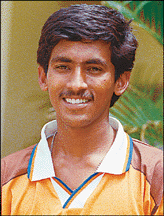
Photo by P. Samson Victor of Deccan Herald
n the recently concluded
8-nation junior tournament in Poland, 19-year old Arjun Halappa slammed in 7 goals. South
Korea, Poland and Egypt were the teams at the receiving end. The gifted playmaker of the
Bangalore-based Centre of Excellence (and earlier with the Sports Authority of
India), is making waves on the national scene.
His wristwork is mesmerising; his playmaking, innovative. But what sets him apart is
his effective use of the drag push. This skill is all self-taught. ''There was nobody who
really taught me the push," Arjun says. He learnt it from observing other players,
especially former international M. K. Prakash.
If his midfield performance is impressive, his display inside the rival 25-yard is
dangerous. The junior national championships in Bangalore in July is a stark pointer to
his playmaking skills. As captain of the Karnataka team and chief schemer, he bore the
responsibility of setting up opportunities for his forwards. He did that with elan,
helping the state squad reach the quarter-finals of the championship.
Arjun's debut for Karnataka was with the senior team in the National Games at Manipur
in February. His next sojourn was the senior nationals at Hyderabad in March. Then
followed the junior nationals which straightaway earned him the captain's badge.
Arjun's career has taken off impressively. His talent and hardwork have won him
rewards. However, many a battle has still to be won and many a corner still to be turned.
Going by his track record and the confidence he portrays, it should not prove too tough a
task.
Article by Vijay Michael Raj of Deccan Herald
|
| How to Create a Sports League -
Think Television |
he new president of the Board of
Control for Cricket in India, A. C. Muthaiah is a godsend to this already privileged
sport. He brings with him the clout and vision associated with being the vice chairman of
the $1 billion Southern Petrochemical Industries Corporation.
His first task was to put his signature on a 5-year telecast deal with Prasar Bharati
for all cricket in India. As part of contract, Doordarshan will cover 21 days of DOMESTIC
cricket live. With Doordarshan's reach of 540 million households, that will give a huge
boost to the domestic cricket scene.
ESPN-Star Sports has signed exclusive telecast rights with 6 test playing countries
from 2000 to 2004. In those 4 years, ESPN Star will give live telecast of any test or
one-day international that is played in Australia, England, New Zealand, South Africa,
West Indies and Zimbabwe. This deal was arranged through CSI.
As part of the contract, ESPN will telecast 729 DAYS of cricket, which includes 525
days of test cricket and 204 one-day internationals. Imagine 2 years of sports programming
between 2000 - 2004 devoted to cricket. ESPN Star will launch a major marketing blitz
entitled Cricket Mania 2000 to kick off this 4-year deal.
In USA, the 1999-2000 NBA season started on November 2. A total of 259 GAMES will be
shown live on television. NBA's fledgling sister league, the WNBA, had its own
mini-television schedule of 38 live telecasts during its 1999 season.
| League |
Network |
Games |
League |
Network |
Games |
| NBA |
TNT |
68 |
WNBA |
Lifetime |
11 |
| |
NBC |
58 |
|
NBC |
11 |
| |
TBS |
42 |
|
ESPN |
10 |
| |
HTS |
55 |
|
HTS |
6 |
| |
WB |
21 |
|
|
|
| |
WGN |
15 |
|
|
|
The day the IHF comes up with an annual domestic/international
league/tournament schedule, with a multi-network television contract, with a breakup of
which games are telecast live/tape delayed, just like BCCI, just like ESPN/Star, just like
NBA/WNBA, we will know that Indian hockey has arrived.
Until then the federation and the game will continue to wallow in mediocrity.
|
| Birthdays This Month |
 |
| Dilip Tirkey Nov 25, 1977
|
|
| Tailpiece |
 ockey may be played by 110
countries over the world, it may have been an Olympic sport since the first decade of this
century, but as far as the South Asian Federation (SAF) Games are concerned, hockey just
does not exist. ockey may be played by 110
countries over the world, it may have been an Olympic sport since the first decade of this
century, but as far as the South Asian Federation (SAF) Games are concerned, hockey just
does not exist.
Hockey, the national game of both India and Pakistan, was not included in the 1999 SAF
Games held at Kathmandu. Hockey has been ignored even for the next edition of the games at
2001 at Peshawar.
For any discipline to get the nod from the SAF executive committee, a minimum of 4
votes are needed. Hockey managed only 3 - India, Pakistan and Bangladesh. The other 4
countries - Sri Lanka, Nepal, Bhutan and Maldives turned down hockey.
As for Indian Olympic Association Suresh Kalmadi, he was lobbying for kabaddi to be
included in the SAF Games, to ensure its continued presence in the Asian Games. Kalmadi
even offered to host the 1999 SAF Games in India if kabaddi was in threat of being dropped
in Kathmandu. Note that it was Kalmadi who sold the concept of cricket to the Commonwealth
Games.
That hockey needed to be lobbied for, and failed to get included, only show the sorry
status of India's national sport.
|