February 2000 Bulletin

Photograph of the Month


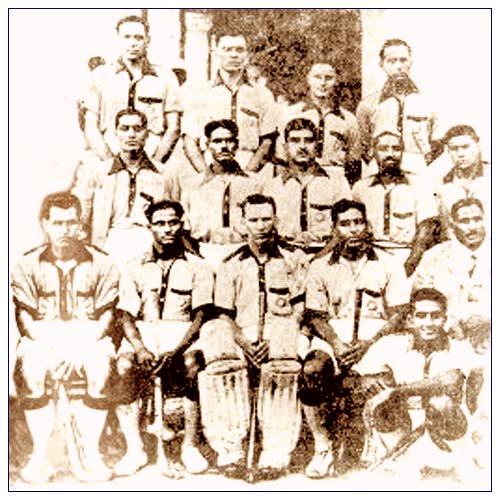
In this Olympic year, we now highlight the 1932 Indian Olympic hockey team.

Hockey Kings Arrive Today.
They will be accompanied by their many wives.
There are two lions in the team

The Los Angeles sport writer, way back in 1932, was wrong about the wives (whether one or many), though he was right about the lions. There were indeed two - Roop Singh and Gurmeet Singh.

Another report in a Los Angeles daily said: "All the colour, glamour and pageantry of Rudyard Kipling's India might well have found its incarnation in the personnel of the Indian team which is to represent the land of Mahatma Gandhi. So agile are the members of the team that they can run the full length of the hockey field, juggling a small wooden ball with the flat of a hockey stick."

The first group of Indian sportsmen to ever visit the United States was the Indian hockey team for the 1932 Olympics. India retained the Olympic Gold it had first won in the 1928 Amsterdam Games. The scores were:

Result Goal Scorers (India)
India beat Japan 11-1 Dhyan Chand - 4
Gurmeet Singh - 4
Roop Singh - 3
India beat USA 24-1 Roop Singh - 10
Dhyan Chand - 8
Gurmeet Singh - 4
Richard Carr - 1
Eric Penninger - 1

The 1932 Olympic hockey matches spawned a couple of records that stand till this date. The biggest score in an international hockey match is the 24-1 victory of India over the USA, played on August 11, 1932. The record for the most number of goals scored in a single hockey match belongs to Roop Singh, who slammed in ten goals in the 24-1 rout of USA.

The finest tribute to the Indian hockey team was by the Los Angeles sports journalists who voted the team's showing in the Olympics as "the most outstanding exhibition of skill in any sport."

1932 Olympic Hockey Champions

Photo Courtesy : Wills Book of Excellence

Sports Advertisement of the Month


Within 2 years of turning professional, Tiger Woods became the number one golfer in the world and was voted the Associated Press Male Athlete of the Year.

Tiger Woods had a phenomenal year in 1999, winning 8 tournaments and earning a record $6.6 million. To date Tiger Woods has won 15 tour titles and counting. A golf prodigy, if ever there was one.

For over 75 years, from 1924 to the present, Wheaties have a tradition of featuring sports stars on their cereal boxes. The latest superstar to join the club - the incomparable Tiger Woods.

Tiger Woods on the Wheaties Box

Visitor of the Month


Godfrey D'Souza is this edition's Visitor of the Month. This was Godfrey's feedback to the Indian hockey website:

The Balbir Singh Sr. Photo Gallery is indeed excellent. However,I must mention that the captain of the 1928 team was not Jaipal Singh. He was studying in England at the time and was the captain in the first two pool matches.

The actual nominated captain was Broome Eric Penniger from Delhi and subsequently Lahore, and who was captain of Punjab and Northern Railway. He captained India in the semi final and the final and was the centre half of the team.

I believe credit should be given to this player who subsequently played under Lal Shah Bokhari in the 1932 games, and although selected for 1936, could not play on account of leave problems. The record should be straightened. It was a home grown player like Penniger who captained India and not a product of English Hockey called Jaipal Singh.

Thank you,
Godfrey D'Souza


Media Matters


Going for Gold

Going for Gold

The definitive book on the history of Pakistan hockey, Going for Gold was written by Sydney Friskin. In fact, there is no other publication on hockey in Pakistan, except for the occasional newspaper columns. The book was commissioned by Oxford University Press as part of its Jubilee Series on the 50th year of Pakistan's creation.

It took 4 Olympics for Pakistan to get its first gold medal (1960). After that, Pakistan went on to win 2 more Olympic Golds and 4 World Cup titles during its golden age of hockey.

The book gives interesting tidbits like the origin of the World Cup back in 1971, when Pakistan offered to host the tournament, pay the air fare and hotel accomodation for all, as well as donate the trophy. However, that was the year of the Bangladesh Liberation War. Pakistan did not approve of an Indian team playing on its soil, so the venue had to be shifted to Barcelona, where Pakistan eventually won the tournament.

Friskin also writes about first Junior Asia Cup, where Pakistan beat Macao 55-0! Macao went on to lose to South Korea 0-30 and to India 0-32.

There are only 2 pages devoted in the entire book to women's hockey in Pakistan, as there is nothing really to talk about. Women's hockey has suffered through apathy, neglect and even hostility, as the author points out.

Sydney Friskin passed  away last year.

Money Matters


Let's learn from cricket. That's the mantra we will follow for this edition's Money Matters section. Specifically we look at Performance Incentives and Revenue Sharing, concepts that are alien to Indian hockey.

Performance Incentives

Because Australia won the test series against Pakistan (3-0), the series against India (3-0) and the Carlton and United Triangular Series (against India and Pakistan), the Australian Cricket Board (ACB) gave a performance bonus of A$ 2 million to the team.

This was agreed upon before the series itself, in a written contract. Players don't have to demand it, or fight for it. It is theirs by right, if they perform.

Indian hockey, in contrast, seems to believe in performance disincentives. For example, what the Indian hockey team got after the Asian Games gold was the chopping of chief coach Kaushik and the sacking of the Super Six. Indian hockey got derailed due to the ego problems of one man - Kanwar Pal Singh Gill.

Revenue Sharing

Under the payment system signed between the ACB and the Australian Cricketers Association, players receive 20% of all cricket income up to $60 million and 25% of anything above that. ACB's 1999 revenues exceeded $70 million. Hence the players got a total of A$ 14.5 million, to be shared proportionately by the national and state players.

In comparison, there is no match fee for Indian hockey players. Coaches do not have any contract and are hired and fired based on the mood swings of K. P. S. Gill. And yes, the last player who demanded match payments got sacked. So beware.

Fun With Numbers


Railways holds a unique record in Indian hockey. They have won a total of 18 women's national hockey championship. All 18 of them were won in a row from 1980. Women's hockey in India has not known any champion apart from the Railways in the past two decades.

The only comparable record in Indian domestic team sports is the 14 successive Ranji Trophy championships won by the Mumbai cricket teams around the decade of the 70s.

How to Create a Sports League


This month we shall talk about the richest sports league in the world - the National Football League (NFL) of USA.

Television

The NFL has the biggest TV contract in all of sports - an 8-year $17.6 billion contract for the rights to show its weekly games. The contract is so huge that it took four television networks - Fox, CBS, ESPN and its parent company ABC to meet the amount of the contract.

The first Super Bowl of the new millenium was held on January 30, 2000. ABC had a total of THIRTY TWO cameras for this one game, played on a field similar in size to a hockey field.

Advertisers for this year's Super Bowl paid $2.2 million for a 30 second spot - that's more than $73,000 for each second of advertising time. The NFL has the highest television ratings of any sport in the US.

League Structure

The NFL had humble origins. On September 17, 1920, eleven owners met at Canton, Ohio to form the National Football League. The franchise fee for each team was $100.

Presently, the NFL has 31 teams. It is like any other exclusive, rich (and snooty?) club. 24 out of the 31 team owners have to approve if a new franchise is awarded, or if any of the existing teams is sold to a new owner.

The league has a full-time commissioner and is headquartered in New York. Each team has a president and a general manager to look after its day to day operations. Most teams own the stadiums in which they play.

The latest two NFL teams that were bought had a price tag of $530 million (Cleveland Browns, 1998) and $800 million (Washington Redskins, 1999). Only the venerable Manchester United, the English soccer club, was sold at a higher price of $1 BILLION dollars (1998).

Sharing the Wealth

All teams get an equal split of the NFL's $2.2 billion/year television contract. That means each team gets around $71 million in television money.

Teams also get a share in gate receipts - 66% to the home team and 34% to the visiting team. Revenues from luxury boxes and club seats are not shared.

This was the balance sheet of a typical NFL team (Green Bay Packers) for the fiscal year ending March 31, 1998 (all figures in millions of dollars):

Revenue Expenditure
Television and Radio $42.5 m Player Salaries $48.4 m
Gate Receipts $20.5 m Administrative Costs $24.2 m
Merchandizing $10.8 m Taxes $4.3 m
198 Luxury Boxes $4.3 m Game-day Expenses $2.0 m

Players

Players are picked from an annually televised college draft, where the best university football players of the nation are chosen. The team that finished last during the season gets to choose first and the league champions get to choose last. This ensures that over a period of time, some measure of parity is achieved.

The average salary of an NFL player is close to $1 million per year. There is a full-fledged NFL Players Union and the players are given a guaranteed share of the team revenues. 63.5% of a team's gross revenues has to go back as player salaries. This contract is valid till 2004, when a new collective bargaining agreement would be signed.

To protect small-market teams, there is also a salary cap of $57.28 million for each team. This would prevent the high profile teams with the most revenues from getting the best players by offering them higher salaries.

Closing Thoughts

For our administrators, look at a sports league as an investment in the game. It may take an entire decade or a generation before it gets profitable, but the seeds would have been sown for a system that will churn out good quality players.

A National Hockey League in India is eminently possible. All it needs is the will, guts and vision to achieve the goal.

Birthdays This Month
Kunwar Digvijay Singh 'Babu'

Born : Feb 2, 1922

Died : Mar 27, 1978

Harpreet Singh Mander

Feb 25, 1973

(27 years old)