| Bihar
Government's Hell Hole of Hockey |
Courtesy Manoj Prasad of The
Indian Express
 f
you ever wondered why there is no Indian women's hockey team in the Sydney
Olympics, look no further than the Bihar Centre for Women's Hockey in
Ranchi. f
you ever wondered why there is no Indian women's hockey team in the Sydney
Olympics, look no further than the Bihar Centre for Women's Hockey in
Ranchi.
Established in 1976 to identify and groom potential national-level
women hockey players, this hockey centre is a symbol of everything that is
wrong in Indian hockey.
For 25 women, barely into their teens, life at the hockey
centre is a nightmare. The young players are lodged in stinking, leaking,
mosquito-infested rooms, fed on meagre rations, and compelled to share
beds due to lack of cots.
The kitchen is a breeding ground for flies, mosquitoes, cockroaches and
snails. The utensils used to cook food are covered in a thick coat of
carbon. And the centre's four toilets, all of which have doors missing,
stink.
All the 25 inmates fled the centre last month. The
desperate authorities managed to persuade 20 of them to return, though none of them
has come back convinced.
The bankrupt Bihar government, which allocates a mere Rs. 650 per
inmate per month, couldn't release even that during the last fiscal year
(1999-2000). The reason for the non-release of the funds is shocking.
"We had no money to pay bribe to the babus there, hence no money was
allocated to us for this year,'' says an accountant of the hockey centre.
Former India vice-captain Savitri Purti, once a resident of the centre,
directs her ire at corporate offices. "Anywhere else, e.g., in Korea
or Australia, the expenses for food, lodging and clothing of the potential
hockey players of their countries are sponsored by corporate bodies. In
our country, there are no sponsors for sports other than cricket, and a
fund-starved state government like Bihar cannot do much.''
Despite all the hardships the players endure, the centre has produced 2
India vice-captains and half-a-dozen internationals in its almost quarter
century of existence. Pushpa Pradhan, Masira Surin, Edlin Kerketta and
Anita Ekka, who participated in the junior national women hockey coaching
camp at Chennai this month, are current inmates of the centre.
While the rest of their compatriots will be playing for Olympic glory
in Sydney, the players lodged in the Bihar Centre for Women's Hockey will be
struggling for basic amenities like food and lodging.
As one of the inmates, who would remain anonymous said, "It is
better to live on the streets than lead a life of hell here.''
|
| Sydney
Olympics Hockey -
Indian Team |
 he
16-member Indian hockey team was selected at the Olympic training camp at
Murwillumbah, near Brisbane. IHF president K. P. S. Gill announced
the team after a selection committee meeting comprising Gill, manager K.
Jyotikumaran and coach Vasudevan Baskaran. The members are: he
16-member Indian hockey team was selected at the Olympic training camp at
Murwillumbah, near Brisbane. IHF president K. P. S. Gill announced
the team after a selection committee meeting comprising Gill, manager K.
Jyotikumaran and coach Vasudevan Baskaran. The members are:
Goalkeepers : Jude Menezes and Devesh Chauhan
Full-Backs : Dileep Tirkey, Dinesh Nayak and Lazarus Barla
Half-Backs : Baljit Singh Saini, Sukhbir Singh Gill, Mohammed Riaz,
Thirumal Valavan and Ramandeep Singh (captain)
Forwards : Mukesh Kumar, Dhanraj Pillai, Baljit Singh Dhillon,
Sameer Dad, Deepak Thakur and Gagan Ajit Singh
Officials : Coach: V. Bhaskaran, Assistant Coach: Harendra Singh, Manager: Mr. K.
Jyothikumaran, Doctor: Dr. P. K. Ramesh.
The six who have been dropped from the squad are Edward Aloysious, Len
Ayyappa, Arjun Halappa, Jagan Senthil, Bimal Lakra and Prabjot Singh.
These six players will stay on in Australia through the course of the
Olympic tournament.
|
| Sydney
Olympics Hockey - India's Prospects |
Excerpts from an interview of V. Bhaskaran
Taken by S. Mageswaran of The
Indian Express
 hat
is your assessment of each team in our group? hat
is your assessment of each team in our group?
Bhaskaran : "We have played all of them before with varied performances,
and with varied results. Everything depends on minimising mistakes.
ARGENTINA (Sep 17): This is the most important match in our schedule. This is our first match
and they have surprised us in crucial matches on earlier occasions. They adopt
football-like tactics, but with minimum mistakes, we can start on a winning note.
A win here would be a morale-booster.
AUSTRALIA (Sep 19): The strongest team in our group. On home turf, they are the hot
favourites. India has played Australia often, and thus we are aware of each other's strengths
and weaknesses. We have a couple of surprises for them, though.
SOUTH KOREA (Sep 21): We beat them in the Asian Games. We lost narrowly at the World
Cup and Asia Cup. Quick passing and swift counter attacks are the Koreans' forte. Our
boys have been trained to counter the Korean flair.
SPAIN (Sep 23): We played them last in January (India lost 3-5). We had just begun our
preparations and they were a full side then. Their style is a casual one. But they commit
very few mistakes. We should not get frustrated if we don't get goals. We should have
patience.
POLAND (Sep 26): I am not taking them lightly. They have had a couple of good results in the
qualifiers (at Osaka). They have come through the hard way. I don't expect the Poles to
attack. We should get some early goals and build on them."
|
| Indian Team to use
Pakistani Sticks |
n a rare partnership between two sworn enemies, India's
Olympic hockey team will play with Pakistani-made hockey sticks at the Sydney
Olympics.
The Indians will discard their traditional wooden equipment made by
stick manufacturers in Jalandhar, to play with the one-piece graphite sticks made in the northern Pakistani town of
Sialkot.
Each member of the Indian hockey team will carry a graphite stick to Sydney, besides a few wooden
ones to be used mainly for practice.
Due to tight finances, the Indians players are using the "B-grade" graphite stick, the
inferior of the two brands available in the market. A "B-grade" stick costs around Rs.
6,500 while the price of an "A-grade" stick is around Rs. 8,000.
The grip and the feel, two important aspects of choosing a stick, have appealed to the
players. "It has the power and is not heavy," said midfielder Mohammed Riaz, who led
India on the tour of South Africa last year. "But if you get hit on the body, it will hurt
badly."
Another advantage of the graphite stick is that it lasts much longer than the wooden one.
"If used properly, it can last up to five years," said Mukesh Kumar.
|
| Olympic Flashback -
Leslie Claudius |
Article courtesy Rohit Brijnath of Rediff
n a land whose sporting
history would fit into a thin book, he remains a quiet, dignified reminder of the truly heroic.
In a land of 1 billion people, where a single Olympic medal of any hue in Sydney would
send us into paroxysms of delight, the somber man will never tell you that he has four.
Gold in 1948, gold in 1952, gold in 1956, and silver in 1960.
The London Times wrote of him once, "Hockey is not worth seeing if he is not playing".
Leslie Claudius, the saint of the right-halves, was, and is, a man amongst men.
Claudius haunts me. Not because Sydney beckons and we're back to genuflecting in front
of our personal Gods and praying desperately for a medal. It is more because we live in
strange times, when sport has been stained by corruption, when possessing a hefty
bank balance is the preferred virtue to sweating in the morning.
It is a time of excess, when humility is a weakness, when rewards are never
personal and fulfilling, but arrive in the form of a sponsor, when men use statistics to
glorify individual achievements.
I yearn for a simpler time, when a country boy named Claudius, from a small Railway
Colony in Bilaspur, bent his back every evening over a stick till he eventually ruled the world.
And this is how it happened.
In the days of the Bengal-Nagpur Railways (BNR), Kharagpur was quite a hockey centre, so big that they had two teams for the Beighton Cup.
One day, Claudius was watching from the sidelines fellow Anglo Indians Dickie Carr,
Joe Galibardy and Carl Tapsall, each one an Olympic gold
medallist.
Carr came up to Claudius and barked, "YOUNG 'UN, YOU WANT TO PLAY?"
Claudius, not believing his luck, said "Yessir, yessir." They had
to saw 3" off his stick as he was so short.
Every day Claudius came for practice, and every day the Olympians showed him
their techniques, and every day when they were all gone, he stayed back at the practice ground, alone for
4 hours, bringing his technique to perfection. In 15 days, Claudius was in the first team.
This embrace of the work ethic became the Claudius signature. If he was impressed by
Keshav Dutt's body swerve, he would not just politely applaud, he would practice it,
hour after hour, till he could do it as well.
Once, he so bemused the legendary K. D. Singh 'Babu' with his
tackles that Babu told him, "Tu bahut chalu hain, how come you stop me
everytime."
In his prime, spanning a period of 4 Olympics from 1948-1960, Leslie
Claudius owned the right-half position in Indian hockey.
|
| Olympic Flashback -
Joginder Singh |
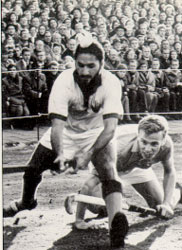
Photograph Courtesy : Wills Book of Excellence
 n August
31, India's best known right-in, Joginder Singh 'Gindi', retired from
South-Eastern Railway after 36 years of distinguished service. n August
31, India's best known right-in, Joginder Singh 'Gindi', retired from
South-Eastern Railway after 36 years of distinguished service.
Two days before, on the occasion of National Sports Day, a benefit
match was played between Railways XI and Army XI at Delhi. The match was
organised by the Jawaharlal Nehru Hockey Tournament Society on August 29,
which is the birth anniversary of hockey wizard Dhyan Chand. Earlier, the
statue of Dhyan Chand was garlanded in the premises.
A handsome purse of Rs 6.5 lakh was presented by Union Sports Minister
Sukhdev Singh Dhindsa to the ailing Olympian. Sixty-year old Joginder Singh,
who suffers from kidney failure, is undergoing dialysis thrice a day, seven days a
week, while awaiting a kidney transplant.
Joginder first made his mark playing for Delhi Schools in the national
schools championships from 1954 to 56. He then played for Khalsa Blues in
the local league, and for Delhi in the Nationals until 1959.
Joginder was part of the Indian team that won silver at
the 1960 Rome Olympics, silver at the 1962 Jakarta Asian Games, and gold at the
1964 Tokyo Olympics. After the Tokyo
gold-medal winning effort, the dazzling right winger was named the finest hockey player of the world by the English
press. Joginder played for India between 1959 and 1967.
Paying Joginder a tribute at the presentation ceremony, former
president of the Indian Hockey Federation, Ashwini Kumar, recalled the
1964 Olympic final against Pakistan where Gindi repeatedly tore through
the rival defence.
"Joginder was unstoppable. The rival full-backs used all methods
to stop him. They tried to obstruct him, then resorted to pulling his
shirt and crowding but to no avail."
Joginder, whose stickwork is still folklore among his contemporaries,
says, "I still remember how an unfortunate bounce of the ball cost us the gold in Rome. Now
artificial turf is the truest surface. I find no reason why our ball skills should
decline. Why should we falter in stopping dead a push during a penalty corner?"
Joginder regrets the lack of competition in the present-day Indian
hockey. "For the 1960 Rome Olympics, we had seven right outs. Everyone of them deserved a place in the
final eleven. No one was inferior to the other. The difference in class was wafer-thin.
So we were always trying to upgrade ourselves, to outdo the other," recalls
Joginder.
On the fall in standards of Indian hockey over the years, Joginder
said, "There is virtually no hockey left in our schools and therein
lies the cause of India's decline. How many schools have qualified
coaches?"
Modesty is a way of life with Joginder. He has no regrets. "I am happy with what I have
got. I served my country as best as I could, and I think I did a good job."
For the Indian hockey contingent, his message is, "I wish the boys all the luck.
Put an end to wasted chances. It really makes the country proud when the national anthem
is played during the award-giving ceremony at the Olympic Games."
|
| Dhanraj
in the German Hockey Media |

Magazine courtesy Uli Meyer
and Ewald Gehrmann
he
July issue of Deutsche Hockey Zeitung featured an article on
Dhanraj Pillai. It was titled, "Das wird mir in Sydney sehr helfen,"
with the byline "Fur Indiens, Dhanraj Pillai war das Kapitel
Bundesliga eine Lehrstunde - und eine Hilfe fur das olympische Turnier
2000."
The photographs caption was "Dhanraj Pillai im Trikot der
indischen National-mannschaft und des Bundesligisten HTC Stuttgarter
Kickers."
We are waiting for the German to English translation of the above text
on Dhanraj Pillai aka Boris Becker aus Bombay.
|
| Romance in Hockey -
How Mukesh Kumar Got Hooked |

Article by A. Joseph Anthony
of The Hindu
t
all started with a water balloon thrown on a women's hockey team member by
a compatriot from the men's team. This was during the 1998
Commonwealth Games at Kuala Lumpur.
The (unintended) target was Nidhi Khullar, who was out of her room
hanging some wet clothes to dry. Her fury fell on Mukesh Kumar, who just
happened to be looking out from his 12th floor room in the Commonwealth Games village.
Nidhi called Mukesh 'uncouth.' Mukesh responded
with a rare display of aggression. When light dawned on Khullar as
to the true villains of the piece (Tirkey and Subbaiah), she sought to mend fences with
Mukesh.
The persistence of the Indian
women's team's outside-right paid off one evening, after the teams had dinner,
followed by a cultural programme at the Commonwealth Games village. Mukesh relented
when he saw she
was truly apologetic. The balcony-to-balcony chats bridged the 'divide' and they
became good friends once again.
Shortly after the Commonwealth Games came the Asian Games at
Bangkok. Subbaiah shared Mukesh's room and Mary Stella, Nidhi's. The roommates
rose to the role of match-makers, but despite their best efforts, not much headway was
made.
When the relationship became known to coach Kaushik, who accompanied Nidhi's
parents on pilgrimages to Vaishnodevi almost every year, he pledged to do the
needful for Mukesh. True to his word, Kaushik won over the parents. In Nidhi's
traditional family circle of Punjabi origin, the green signal from relatives was also
required.
Then the STD phone calls began between Hyderabad, Mukesh's hometown, and
Gorakhpur, Nidhi's native
place. For the 15-day period of courtship, Mukesh ran up a phone bill of Rs. 27,000,
and Nidhi, Rs. 9000.
D-day finally arrived on January 24, 1999. Friends from the hockey fraternity -
both men and women - were in attendance at the wedding. Festivities included hiding the
bridegroom's shoes in exchange for which the bride's
sisters demanded Rs. 5000.
A reception followed in Hyderabad. Turning up to greet
the couple were K. Vijaya Rama Rao, former Director of the CBI, T. Jesudanam and
H. J.
Dora, Vice Presidents of the Indian Hockey Federation, and many players.
What started as a water balloon fight finally turned into a marriage! Mukesh Kumar, the first sportsperson from Andhra Pradesh to be a triple
Olympian, had finally met his match.
|
| Indian Junior Team
Finishes Second |
 4-Nation
tournament was held at Poznan, Poland, to help prepare the Polish team for
the Sydney Olympics. India sent its junior team to the tournament,
which featured hosts Poland, Egypt and Belgium. 4-Nation
tournament was held at Poznan, Poland, to help prepare the Polish team for
the Sydney Olympics. India sent its junior team to the tournament,
which featured hosts Poland, Egypt and Belgium.
In their opening encounter on August 17, India went down to Poland 1-2
despite leading 1-0 at the break. They fared better in their second match,
ousting Egypt 3-1.
Belgium were beaten 2-0 by the young Indian bunch in the subsequent
encounter, which gave India a berth in the final.
Poland proved a tough task in the title round, and India went
down 1-3 in the final.
The Indian team was accompanied by assistant coach and trainer Saju
Joseph.
|
| Orissa
Wins Junior National
Championships (Women) |
he
32nd Junior National Championships (women) was held at the Mayor
Radhakrishnan Stadium in Chennai from August 24 - August 31. The
federation issued a directive that junior players who had also played in
the previous Senior Nationals would not eligible for the junior
championships.
The quarter-final lineup was as follows: Tamil Nadu (Pool A), Orissa
(Pool B), Punjab (Pool C), Karnataka (Pool D), Chandigarh (Pool E), Bihar
(Pool F), Uttar Pradesh (Pool G) and Kerala (Pool H).
Bihar entered the quarter-finals without playing any match. This was
because they got two back-to-back walkovers when both Rajasthan and
Vidharbha did not show up.
The following were the results in the knockout stages:
| Stage |
Results |
| Quarter-Finals |
Orissa beat Punjab 2-0
Bihar beat Kerala 6-0
Uttar Pradesh beat Chandigarh 3-2
Karnataka beat Tamil Nadu |
Semi-Finals
(August 30) |
Orissa beat Karnataka 3-1
Bihar beat Uttar Pradesh 6-1 |
FINAL
(August 31) |
Orissa beat Bihar 3-2
(Tie-breaker) |
Regulation time and 15 minutes of extra-time failed to resolve the
goalless deadlock in the keenly fought final. In the tie-breaker, Mukta
Praba Barla, skipper Sarita Ekka and Sunita Ekka scored for Orissa, while
only Guddi Kumaria and Fulmani Soy succeeded for Bihar. Most of the Orissa
players are from the Sports Authority of India, Rourkela Centre.
For the third place, Karnataka edged out Uttar Pradesh 4-3, on the
strengths of Sindhu Koppa's hat-trick and skipper Kumari's match winner.
|
| Taking
Responsibility for your Actions |
 lashback
to the Utrecht World Cup in 1998. Captain Dhanraj Pillai was
visibly unfit, yet the team doctor, team management and Dhanraj
collaborated to make sure he made the Indian team. The result was a
disastrous World Cup for India, which eventually finished 9th. lashback
to the Utrecht World Cup in 1998. Captain Dhanraj Pillai was
visibly unfit, yet the team doctor, team management and Dhanraj
collaborated to make sure he made the Indian team. The result was a
disastrous World Cup for India, which eventually finished 9th.
Fast forward to year 2000, the year of the Sydney Olympics.
After a 6-week battle to overcome a back injury, Sue Chandler, the
Great Britain captain, admitted defeat and withdrew from the Olympic
squad. She was replaced by Mandy Nicholson, while Pauline Stott, of
Scotland, took over the captaincy.
"I've done all I can to be fit but I'm not, and I needed to
make a decision," Chandler said. "It was dragging on and it
wasn't fair on Mandy or Pauline."
|
| Tailpiece - The
Veerappan Effect |
he abduction of
matinee idol Rajkumar by sandalwood smuggler Veerappan in Bangalore had a
trickle-down effect on the Indian hockey team's preparations for the
Sydney Olympics.
Security was strengthened at the KSCA Stadium clubhouse in Bangalore
where the Indian hockey team was staying. The Olympic camp ended 2 days
earlier, on August 2, instead of August 4. The two-day selection trial to
pick the 22 probables was cancelled.
The players dispersed to their respective locations across the country,
even as riots broke out in Bangalore. IHF secretary K. Jyothikumaran failed
to reach Bangalore in time as transport links were cut off.
After a week's breather, a rescheduled training programme brought the
probables to Delhi on August 10, ahead of schedule. The nation's capital
does not have a good turf, so the players had to use a lot of caution
while practising on a tattered and uneven turf.
The stress, therefore, was on physical conditioning, interrupted by visits to the official draper to give
uniform measurements.
Regular training commenced only when the Indian team reassembled in
Brisbane, Australia, which is where the final 16 got selected.
|