| Commonwealth
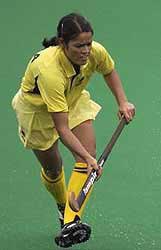
Women's Hockey - India Win the GOLD! |
 |
 |
| Seeta Gusain |
Mamata Kharab |
 n what
was an improbable sequence of victories in an upset-filled tournament,
India beat England 3-2 off a golden goal to win the Commonwealth Games
women's hockey tournament. n what
was an improbable sequence of victories in an upset-filled tournament,
India beat England 3-2 off a golden goal to win the Commonwealth Games
women's hockey tournament.
The English and Indian women's hockey teams have been playing each
other since 1953, and England has never lost to India in nearly half a
century of play. India, who are Asian Games and Asia Cup silver
medallists, chose the Commonwealth championship game to record their
historic first ever victory over world nos. 5 England. This is the second consecutive
time that England has lost in the Commonwealth Games women's hockey
final.
This is the first time any Indian hockey team has
won a medal at the Commonwealth Games. This was the first victory outside
Asia of the Indian women's hockey team.
Earlier, world nos.
17 India upset world nos. 6 New Zealand 2-1 to storm into the final. In
the other semi-final, England shocked Australia
2-1 to earn the right to meet India.
In a prior quarter-final match against South Africa, it seemed all over for the Indian women's team.
Going into the game, South Africa had scored 16 goals to India's 3 in
their 3 matches. And by half-time, South Africa had already scored 3 goals
with none scored by India.
But in an amazing comeback, India scored 3 goals in
the second half, including two in the last 8 minutes of the game, to first
tie the game. Then, Jyoti Kullu scored a golden goal, the first golden
goal of the entire tournament, to steer India into the semifinals.
India has an ongoing 3-game winning streak against South Africa. In the
inaugural women's Champions Challenge held in February 2002 in Johannesburg, India beat South Africa 1-0
(on Feb 10) and again 1-0 (on Feb 17) to deny South Africa the bronze medal. This latest 4-3 victory in the
Commonwealth Games now denied South Africa a place in the semi-finals.
This
was the second consecutive time that South Africa failed to make it to the
semi-finals of the Commonwealth Games women's hockey tournament.
In its road to the gold medal, India's match results were as follows:
| Stage |
Date |
Result |
Goal
Scorer - India |
| League |
July 26 |
beat Canada 1-0 |
Suman Bala Saini (44 m) |
| July 28 |
lose to New Zealand 1-3 |
Jyoti Sunita Kullu (16 m) |
| July 29 |
draw with England 1-1 |
Suman Bala Saini (23 m) |
| Quarters |
July 31 |
beat South Africa 4-3 (GG) |
Pritam Rani Siwach (46 m)
Jyoti Sunita Kullu (62 m, 77 m)
Suman Bala Saini (65 m) |
| Semis |
Aug 1 |
beat New Zealand 2-1 |
Jyoti Sunita Kullu (34 m)
Mamata Kharab (62 m) |
| FINAL |
Aug 3 |
beat England 3-2 (GG) |
Mamata Kharab (21 m, 78 m)
Seeta Gusain (30 m) |
Beating strong powers like South Africa, world nos. 6 New Zealand and
world nos. 5 England bodes well for the young Indian team. May the Indian women's hockey
players also get the recognition, support and incentives that are usually given to their male counterparts.
The members of India's gold medal winning team were as follows:
Goalkeepers: Tingoleima Chanu, Helen Mary
Full backs: Amandeep Kaur, Suman Bala Saini, Kanti Baa
Half-backs: Seeta Gussain, Sumrai Tete (left-half), Suraj Lata
Devi (captain), Masira Surin
Forwards: Pritam Rani Siwach, Manjinder Kaur, Sanggai Ibemhal
Chanu (right-out), Mamata Kharab, Jyoti Sunita Kullu, Pakpi Devi, Saba
Karim Anjum
Standbys: Deepika Murthy, Pushpa Pradhan, Manju and Adline Kerketta
|
| Commonwealth
Men's Hockey - Aimless, Pointless and Ultimately Useless |
f you thought
that the Commonwealth Games men's hockey competition was going to showcase the
best talent in the former British Commonwealth, you would be sorely
mistaken. Instead, the tournament organisation committee, with the
connivance of the FIH, has decided to get into the charity business.
How else can you explain the presence of minnows like Barbados and
Wales, at the expense of last edition's finalist Malaysia and last
edition's semi-finalist India.
Look at the results suffered by Barbados - a 1-10 thrashing at the
hands of South Africa, a 0-13 mauling in the hands of South Africa, a
Commonwealth record 1-20 loss to Australia and a 0-7 loss to Wales to
finally put an end to their misery. 50 goals conceded in 4 matches
by Barbados! Is this hockey or a charity contest?
There was absolutely no logic in having a Commonwealth region for the
Americas (consisting of just 1 country Canada), and another Commonwealth
region for the Caribbean (West Indies). By that token, why couldn't we
have a Commonwealth region called South Asia, and a Commonwealth region
called Southeast Asia?
A fairer policy would have been to choose 1 country between Canada and
Barbados, and 1 country between India and Malaysia. That way, you would
have preserved the diversity of the competition without sacrificing
quality.
Ultimately, the Commonwealth Games men's hockey competition got reduced
to a 5-nation hockey tournament, with Barbados, Wales and Canada making up
the numbers on the basis of geography, not on the basis of hockey.
Australian coach Barry Dancer commented, “I think it’s pretty
disappointing that the qualification process means that India and
Malaysia, who are two of the top 10 teams in the world, can’t be here.”
Dancer said the competition in Kuala Lumpur in 1998 was enhanced by the
presence of both India and Malaysia. “I think we should have a rule that
allows the best teams in the Commonwealth to play.”
No wonder some Indian fans demanded a refund on their tickets, saying they were deprived of watching
quality hockey.
"Whoever made these rules is an idiot," said Manchester resident Avtar Singh, angry that he and thousands of Asian immigrants in this industrial city were deprived of a mouth-watering clash between India and Pakistan.
"We waited in the hope that the organisers would finally see sense and take India in at the last minute.
Now I want my money back, and I know many of my friends do too," he said.
If there is one way to turn off potential hockey fans, it is by having
matchups like Australia vs. Barbados. In contrast, an India vs. Pakistan
matchup at Manchester would have triggered a huge amount of fan interest and
media coverage.
The FIH has failed miserably to replicate the fantastic fan
turnout and high television ratings of the 1998
Commonwealth Games hockey competition in Kuala Lumpur.
There is only one way to set things right at the FIH - get rid of the
Eurocentric old bags at the helm of world hockey, and increase the number
of young talented administrators from the non-European continents.
|
| Indian Airlines
Regain Muruguppa Gold
Cup |

India's Dynamic Duo of Dhanraj and Mukesh - Photo
courtesy The Hindu
 he 80th All-India
Madras Cricket Club -Murugappa Gold Cup hockey tournament
was held at the Mayor Radhakrishnan Stadium, Chennai, from July 11 to 20.
The tournament was inaugurated by Mr. M. M. Venkatachalam, Director of the
Murugappa Group. he 80th All-India
Madras Cricket Club -Murugappa Gold Cup hockey tournament
was held at the Mayor Radhakrishnan Stadium, Chennai, from July 11 to 20.
The tournament was inaugurated by Mr. M. M. Venkatachalam, Director of the
Murugappa Group.
Going by the team composition, you can say that hockey in India is
being sustained by the public sector companies. 8 of the 12 teams in the
competition were from the public sector viz. Air India, All- India Customs and Central Excise,
Bharat Petroleum, Indian Airlines, Indian Oil, Indian Post and Telegraph, Indian
Railways and Oil and Natural Gas Commission. Where are the private sector
giants like Tatas, Birlas, Mahindras and Reliance in the field of hockey?
Back to the tournament at hand - Indian Airlines and Karnataka made it to the final, with the following match
results:
| Stage |
Date |
Karnataka |
Date |
Indian
Airlines |
| League |
July 11 |
beat ONGC 3-2 |
July 13 |
beat Indian Oil 4-2 |
| |
July 14 |
beat Air India 3-2 |
July 15 |
beat Indian Posts 7-3 |
| Quarters |
July 16 |
beat Indian Railways 4-0 |
July 17 |
beat Bengal 2-0 |
| Semis |
July 19 |
beat ONGC 2-1 |
July 19 |
beat Indian Oil 3-1 |
In the final played on July 20, Indian Airlines regained the Muruguppa
Gold Cup by defeating Karnataka 3-1. The winners, who had an impressive
lineup of 5 Olympians (Ashish
Ballal, Mukesh Kumar, Mohammad Riaz, Dileep Tirkey and Lajarus Barla), and
1 contract player (Dhanraj Pillai), led 2-1 at half-time.
Dhanraj Pillai, Virender Singh and Ravinder Singh scored for Airlines,
while Karnataka's goal came off a Sandeep Michael - Arjun Halappa move.
Dhanraj Pillai was declared the Man of the Final and also the Forward
of the Tournament. Arjun Halappa (Karnataka) was selected the Midfielder
of the Tournament, while Anurag Raghuvanshi (ONGC) was selected as the
Defender of the Tournament.
Champions Indian Airlines won Rs. 60,000 while Karnataka had to settle
for the runners-up prize of Rs. 40,000.
The final was telecast live by Doordarshan (Sports Channel), with the telecast being sponsored by Servo Indian Oil.
Stick2Hockey.com
reports that the broadcast quality not upto standard. Umpire Satinder Sharma
handed out the yellow card 3 times, but none of the incidents leading to them were shown. The awards
ceremony was not shown (unlike cricket's award ceremonies and post-award
sound bites from the players) and instead was replaced by a repeat
telecast of a weightlifting tournament from last year!
|
| Dhanraj Pillai Jumps
Ship from Mahindras to Indian Airlines |
 ahindra's
loss is Indian Airlines's gain. Khel Ratna Dhanraj Pillai, who toiled in the
wilderness as a junior officer with Mahindra and Mahindra (Mumbai) for the last
9 years, will join Indian Airlines (Delhi) as an assistant manager with a five-figure
salary (> Rs. 20,000 per month).
The switch was considered inevitable ever since Mahindras decided to
disband its hockey team and instead concentrate on football. ahindra's
loss is Indian Airlines's gain. Khel Ratna Dhanraj Pillai, who toiled in the
wilderness as a junior officer with Mahindra and Mahindra (Mumbai) for the last
9 years, will join Indian Airlines (Delhi) as an assistant manager with a five-figure
salary (> Rs. 20,000 per month).
The switch was considered inevitable ever since Mahindras decided to
disband its hockey team and instead concentrate on football.
Dhanraj had twice earlier played for Indian Airlines on a contract
basis - in the 2001 Raghavendra Itigi Cup in Bangalore, and in the just
concluded Muruguppa Gold Cup in Chennai.
Airlines' coach Merwyn Fernandes told Asian Age that the papers
for hiring Dhanraj have been forwarded to the Indian Airlines Sports
Control Board. Though the board has a policy of recruiting only young
players, they made an exception in the case of Dhanraj Pillai.
Harinder Singh, coach of the national u-21 side, as well as a talent scout and
the manager of the Indian Airlines team, is believed to have masterminded Dhanraj's recruitment.
Dhanraj Pillai has also announced that he will retire from
international hockey after the Busan Asian Games in September/October, where India will be defending its title.
He will continue to play for either foreign clubs or his new employer Indian Airlines.
"I would like to retire happily, without any regrets, after the coming Asian Games in Korea," Pillai said.
"I am still receiving offers from clubs, especially European clubs, asking me to play for their teams.. but let's see," said Pillai who has been the central figure in almost all the Indian victories in the recent past, including the
1998 Asian Games in Bangkok.
|
| International Hockey
Star Gets Own Multimedia Website |

 hanraj
Pillai does not have his own website. Neither does Sohail Abbas of
Pakistan. However, the first ever player-specific hockey website is alive
and kicking at vaninaoneto.com.
Vanina Oneto is the sharp-shooting forward of Argentina's women's hockey team. hanraj
Pillai does not have his own website. Neither does Sohail Abbas of
Pakistan. However, the first ever player-specific hockey website is alive
and kicking at vaninaoneto.com.
Vanina Oneto is the sharp-shooting forward of Argentina's women's hockey team.
The website is not in English, but in Argentina's national language
Spanish. The website has Flash animations, background music and
photo galleries. The site is sponsored by Nike and a private
company.
Vanina even made it to the 2002 Sports Illustrated swimsuit edition. This is
what Sports Illustrated wrote:
Vanina Oneto has helped turn hockey into the women's equivalent of
soccer in Argentina. During the Sydney Olympics, las Leonas (the
Lionesses) roused Argentinians out of bed at 4 in the morning for live
telecasts of their games.
Oneto is known for displaying her feelings on the field. She and
the rest of las Leonas screamed, cried and rejoiced at each pivotal
play, stirring their country to feel every emotion with them. Somewhere
along the way, field hockey in Argentina was transformed from a sport
that little girls play to one that grown up men watch.
When the Australian national team visited last April for a 4-match
series, 18,000 fans showed up with drums in their hands and songs in
their throats. Vanina has become accustomed to police escorts, adoring
fans who approach her on the streets, and the shooting of television
endorsements.
|
| National
Game Match Reports in the National Language |
f an
Argentinian hockey fan can read hockey match reports in Spanish, and if a
hockey fan in the Netherlands can read match reports in Dutch, why can't
an Indian hockey fan gets his match reports in Hindi?
If Lucknow-based Suresh Dixit has his way, Hindi
language readers can get updated Asian Games match reports of India's
national game in India's national language.
Suresh, who has covered the World Cup (Kuala Lumpur-2002 &
Utrecht-1998), Olympics (Sydney-2000), Asian Games (Bangkok-1998) and the
Champions Trophy (Chennai-1996), is looking for a sponsor in order to
cover the 2002 Asian Games, to be held in Busan, Korea, from September 29
- October 14.
During the 2002 World Cup, Suresh interviewed Els Breda Vriesman,
President of the FIH, Khalid Khokar, manager of the Pakistani team, and
Jorge Lombi and Sohail Abbas, the joint top-scorers of the World Cup. All
these interviews were published in Hindi.
In India, many Hindi language magazines have folded even as English
language magazines have flourished. Sapthahik
Hindustan, the national Hindi weekly of the Hindustan Times group, Dharamyug,
the national Hindi weekly of the Times of India group, Dinaman and Khel
Khiladi have all disappeared from the scene.
As a result, Suresh has written primarily for Hindi language newspapers
like Punjab Kesari, Rajasthan Patrika, Dainik Jagran,
Swatantra Bharat (Lucknow), Dainik Bhaskar (Madhya Pradesh)
and Sanmarg (Kolkata). Suresh has also contributed to English
publications like The Times Of India, Hindustan Times and World Hockey
(London). Suresh has made frequent
appearances on Akashvani-Lucknow
as a sports analyst.
Suresh
is originally from Jhansi, the land of Hockey Wizard Dhyan Chand. Suresh
was close to Dhyan Chand during the last ten years of his life. Suresh
conducted an interview of the Wizard for Sapthahik Hindustan, and has written a book - Dhyan
Chand Aur Hockey.
Suresh,
who is a manager with State Bank of India, can be reached at MMIG-48,
Sector A, State Bank Colony, Sitapur Road Scheme, Lucknow 226020, U.P., India.
|
| Junior Hockey Player
Dies During Training |
 unior India hockey player Jasbando Singh died while training at the Air India
National Hockey Academy in New Delhi. 18-year-old Jasbando Singh collapsed during a practice session at the
Dhyan Chand National Stadium on July 1, and was rushed to Ram Manohar Lohia hospital, where he died two days
later. unior India hockey player Jasbando Singh died while training at the Air India
National Hockey Academy in New Delhi. 18-year-old Jasbando Singh collapsed during a practice session at the
Dhyan Chand National Stadium on July 1, and was rushed to Ram Manohar Lohia hospital, where he died two days
later.
Jasbando, who had joined the academy last month, had skipped training sessions for
3 days during the last week of June because of fever. He rejoined the camp on July 1 after having recovered. But as fate would have it, that turned out to be the last day for him at the academy.
Air India Academy manager Ramesh Nambiar said that Jasbando was rushed to the hospital after he lost consciousness.
Jasbando was shifted to the ICU after a scan and blood tests indicated that his condition was serious.
"The doctors' best efforts were in vain," Nambiar said.
The doctors suspected that the young player died of meningitis, apparently the result of a bout of malaria which had afflicted him two months
ago.
Jasbando's body was taken to his home town in Manipur on July 5 for the last rites.
Budding centre-half Jasbando was a member of the Indian sub-junior team which toured Singapore last
year.
|
| Real-Time Video
Analysis of Hockey |

his year's
junior national championship in Darwin, Australia, saw use of SportsCode
- hockey's first real-time video analysis system.
Video footage was relayed from a camera in the grandstand via miniature transmitters to performance analyst Troy Baker on the bench, allowing him to capture and review it as the game
was going on.
“What we have done is allow the play to be analysed as it happens,” said Baker.
“In the past, you would have to wait until half-time in a hockey match before being able to examine aspects of a game like an opposition’s defensive pattern.”
“With this new technology, if a team has a penalty corner, the coach can analyse the opposition’s defence and alter his/her team’s attack accordingly in time for the next penalty corner,” he said.
While watching a game, the coach “labels” the video as it is brought into the computer, in the process effectively setting up a database of incidents from the game.
As soon as the game is finished (or even at half-time, if desired), the coach can
request a selection of the information that has been labelled – e.g.,
“Show all shots on goals taken by us,” or “Show all penalty corners
taken against us.” The SportsCode system will then instantly play back the selected
instances on the computer screen, without having to manually search
through various video tapes.
SportsCode also has split-screen and video overlay capabilities. One
can create highlight reels on individual players. One can move
forward or backward in 10-second increments.
The use of SportsCode real-time analysis in hockey is being spearheaded
by Sydney-based New South Wales Institute of Sport (NSWIS), whose head
hockey coach, Larry McIntosh, served as a video analyst for the Australian men’s hockey team
in the 2002 World Cup.
NSWIS is a Global Testing Centre of SportsCode, and has been working
with this product for the past 3 years. They system can be quickly
customised for all 26 sports at the Institute, be it diving, cricket, hockey, water polo or
football, each of which gain to benefit from this cutting-edge video
analysis tool.
SportsCode is being used globally by Manchester United (English Premier League),
Orlando Magic (NBA), the Korean World Cup football team and New South
Wales Cricket team to enhance individual and team performance.
SportsCode requires an Apple G4 800 Powerbook or Desktop (iBook or iMac),
with a minimum of 256 MB RAM and 20 GB hard disk. Recommended peripherals
include a VST Firewire hard drive (30/75GB) and a Panasonic, Sony or Canon
digital video camera.
|
| Indian
Hockey Probables Get
Commando Training |
anesar, 50
kms from New Delhi, is the site of the National Security Guards (NSG)
Black Cat commando training centre. Trainees are deputed to this Gurgaon,
Haryana based institution from central defence organisations like Border Security Force, Indo-Tibetan Border Police, Rapid Action Force
and Central Reserve Police Force.
For a few days in late June / early July, an unusual group was deputed
for commando training - the 28 probables of India's national hockey team.
The purpose of their training was to improve killer instinct, increase risk-taking abilities,
become physically stronger and to increase endurance.
The plan was the brainchild of IHF president K. P. S. Gill, who himself used commando operations extensively during his Punjab Police
days.
“Playing just hockey sometimes becomes monotonous. So we thought of giving the boys a tough fitness session, before moving on to other camps,” said chief coach Rajinder Singh.
The grueling regime began at 6 am with jogging and stretching, followed by circuit
training and then obstacle training - where the probables had to clear 26 commando-level obstacles every day in a specified time.
The players then had a 40 minute yoga session, followed by a workout in the gymnasium and then swimming. Evenings
were spent in weight-training and various kinds of sports ranging from handball to hockey.
The players found the regimen difficult initially. They even faked injuries to avoid training.
But by the end of the course, the players had become believers.
“The whole exercise has toughened us mentally. It has also improved our reflexes,”
said veteran defender Dileep Tirkey. Budding penalty corner expert Jugraj Singh
added, ‘‘We can confront tough situations now.”
“The NSG instructors made us realise that we’re the best in the country and the youngsters look up to us as role models,” said
Prabhjyot Singh.
Based on the success of this unusual camp, the coaches feel that this
should be an annual affair. In fact, they even felt that other sports could
avail of such camps.
September will see 2 important tournaments for coach Rajinder Singh's
team - the Champions Trophy and the Asian Games (where India is the
defending champion). It would be interesting to see whether the killer
instinct learned in this camp will translate itself to success on the
hockey field.
|
| Photograph
of the Month |

Photograph Courtesy : The 1928 Olympics
Official Report
he Photograph of
the Month for August features the 1928 Olympic gold medal winning Indian hockey
team. This is the earliest known photograph of any All-India hockey team.
This photograph was taken at Amsterdam on May 17, 1928, after India trounced Austria 6-0 in its Olympic debut.
The accompanying text on the India - Austria Olympic clash is excerpted from Hockey's
Grand Slam by Clary Miller.
The Austrians had seen the Indian team play against the Dutch in
the practice matches, and realised that their main task against India
would be in the defence. Therefore, they played 4 half-backs and 3 backs
soon after the start of the game. In the circumstances, India did well
to score three goals in each half.
The Austrians were inclined to indulge in rough tactics, for it
was a new experience to them to be tricked so often by their agile and
elusive opponents. Playing in their unaccustomed formation, the
Austrians soon became ragged, and it was only by the sheer weight of
numbers that they kept the Indian forwards out.
Dhyan Chand scored all the 3 goals in the first half,
dashing in and out like a will of the wisp. After the interval, Dhyan
Chand scored his fourth goal. The fifth was scored by Shaukat Ali,
who gave a brilliant display of stickwork. The last goal was scored by Maurice
Gateley, giving India a 6-0 victory.
|
| Money Matters |


 akistan's
national hockey team has secured sponsorship from LG Electronics for the rest of
the 2002
hockey season.
The sponsorship deal was announced by Mr. Pervez Akhtar, Chief Executive Officer
of New Allied Electronics, and will cover the 4-Test series in Spain
(July), Commonwealth Games (July/August), Champions Trophy
(August/September) and finally, the Asian Games (September/October).
akistan's
national hockey team has secured sponsorship from LG Electronics for the rest of
the 2002
hockey season.
The sponsorship deal was announced by Mr. Pervez Akhtar, Chief Executive Officer
of New Allied Electronics, and will cover the 4-Test series in Spain
(July), Commonwealth Games (July/August), Champions Trophy
(August/September) and finally, the Asian Games (September/October).