| The World Cup is Won
on the Playing Fields
of Europe |
 n
2001, Argentina won the Junior World Cup in football. In less than an year
from that triumph, two-thirds of the Argentine team were playing
professional football in Europe. n
2001, Argentina won the Junior World Cup in football. In less than an year
from that triumph, two-thirds of the Argentine team were playing
professional football in Europe.
In 2001, India won the Junior World Cup in hockey. In less than an year
from that triumph, not a single junior player is playing professional
hockey in Europe, or anywhere else in the world.
In the opening game of the 2002 World Cup Football between Senegal and
France, most of the players did not even play in their own country. While
the
bulk of the Senegalese team played in France (Lens), the bulk of the
French team played in England. This illustrates the financial clout of
the clubs in the European football leagues, where national boundaries are
immaterial, and players gravitate to the clubs
that reward them the most for their skills.
The world's richest football clubs in the world are all based in
Europe. The top 5 clubs in terms of annual revenue are as follows:
| Club |
League |
Country |
Revenue |
| Manchester United |
Premier League |
England |
£184.8 m |
| Real Madrid |
La Liga |
Spain |
£163.6 m |
| Bayern Munich |
Bundesliga |
Germany |
£144.7 m |
| AC Milan |
Serie A |
Italy |
£141.7 m |
| Juventus |
Serie A |
Italy |
£139.7 m |
In 2002, world champions Brazil had 3000 of its players in various
professional football leagues abroad, across all grades and divisions. In 2002,
India had exactly 3 players in foreign hockey leagues - Jude Felix
(Racing Club de France, Paris) and Dhanraj Pillai / Len Ayyappa (Arthur
Andersen Sports Club, Kuala Lumpur). That's a factor of 1000 difference!
Except for Dhanraj, none of India's 2002 World Cup hockey team members
played for a foreign club. In contrast, 8 of Brazil's starting 11 of their
World Cup football team play abroad, as can be seen from the following table:
| Country |
Team |
Player |
| Italy |
AC Milan |
Roque Jr. |
| |
AS Roma |
Cafu, Emerson |
| |
FC Inter Milan |
Ronaldo |
| Spain |
FC Barcelona |
Rivaldo |
| |
Real Betis |
Denilson |
| |
Real Madrid |
Roberto Carlos |
| Germany |
Bayern Leverkusen |
Lucio |
The wealth gap between Europe and the football player producing
factories of Africa and South America will ensure that for years to come,
the cream of world football will earn their living in Europe.
If Senegal is filled with football schools who train youngsters who
eventually end up in the European football leagues, why can't the hockey
academies of India produce talented youngsters who eventually end up in the
European hockey leagues?
If Waseem Ahmed of Pakistan, Chua Boon Huat of Malaysia and Song Seung
Tae of South Korea can all play professional hockey in Germany in 2002,
why is not a single Indian playing professional hockey in Germany?
If New Zealand's Ken
Robinson, Bevan Hari and Simon Towns can play professional hockey in England
in 2002, why is not a single Indian playing professional hockey in
England?
If Argentina's Jorge Lombi, Maximiliano Caldas and Fernando Zylberberg
can play professional hockey in Netherlands in 2002, why is not a
single Indian playing professional hockey in the world famous Dutch hockey
league?
Recognising that the babus, clerks and other file-shufflers of the IHF
cannot provide for them, the Indian players should be more proactive and
apply on their own to the hockey clubs of Europe. Till India and Pakistan
come up with professional, world-class national hockey leagues of their
own, the battle for world hockey supremacy will be won on the playing
fields of Europe.
|
| Why Can't the Indian
Hockey Players Get Match Fees? |
n modern day
professional sports, it is unreasonable and unwise to expect players to
play for free for their country. Why doesn't the IHF give match fees to
the players, and a paid contract to the coach, and then hold them
accountable for their results on the field. Where is the alleged 3-year Rs. 3-crore
sponsorship deal with Castrol ending up in?
To look for role models, the blokes in the IHF need to just check with
their suave and sophisticated counterparts in the Indian cricket board (BCCI).
After studying contracts in Australia, England and South Africa, the
working committee of the BCCI came up with the following proposals:
| Incentive |
Category |
Amount |
| Annual Fees |
A1 Category of Players |
Rs. 75 lakhs/year |
| (for top 20 players) |
A Category of Players |
Rs. 60 lakhs/year |
| |
B Category of Players |
Rs. 30 laksh/year |
| |
C Category of Players |
Rs. 15 lakhs/year |
| Match Fees |
Test Matches |
Rs. 2.25 lakhs/test |
| |
One-Day Internationals |
Rs. 1.80 lakhs/ODI |
| Bonus |
Beat Higher Ranked Team |
100% of match fee bonus |
| |
Beat Lower Ranked Team |
50% of match fee bonus |
| |
Lose to a Team |
50% of match fee reduced |
Assuming that 1 Indian cricketer is worth 100 Indian hockey players in
financial terms (due to the huge sponsorship amounts in Indian cricket),
can the IHF give a least 1/100 of the amount that the BCCI proposes to
give to the
cricketers. For example, can the IHF give an annual retainership of Rs.
75,000 to the top 20 Indian hockey players in the country?
We do not know of any profession where the person works for free. The
same applies to modern day professional sports - the
principle in question being payment to be given for services rendered.
It is simple, it is fair, and it is the right thing to do.
|
| Learn from Scotland
- Reward the Players, Not the Officials |
 pektra
Systems is the title sponsor of the Scottish Hockey Union's domestic
hockey league. Bank of Scotland is the title sponsor of the Scottish team
for the Commonwealth Games. pektra
Systems is the title sponsor of the Scottish Hockey Union's domestic
hockey league. Bank of Scotland is the title sponsor of the Scottish team
for the Commonwealth Games.
As part of their commitment to hockey in Scotland, Spektra Systems and
Bank of Scotland held their first-ever awards dinner at the Apex International Hotel, Edinburgh,
to recognise and honour Scotland's best players, clubs and coaches.
The awards were as follows:
| Award |
Winner |
| Team of the Year |
Westcoast Western, Glasgow |
| Men's Player of the Year |
Mike Leonard, Grange Edinburgh |
| Women's Player of the Year |
Sue Gilmour, Grange Edinburgh |
| Overall Coach of the Year |
Terry Stephens, Waverley |
| Men's Coach of the Year |
Duncan Low, Grange Men |
| Women's Coach of the Year |
Wendy Justice, Glasgow Western |
| Boy's Coach of the Year |
John Stapleton, Hillhead |
| Girl's Coach of the Year |
Denise Christie, Ross High |
| Grassroots Coach of the Year |
Elaine Brierly, Giffnock |
This begs a question to the IHF - why is there is
not a single award for India's best men and women's player of the overall
domestic season, or for the best junior players, or for the best coaches,
or for the best clubs?
Cannot the IHF set aside even 5% of its supposed 3-year Rs. 3-crore
sponsorship deal with Castrol to award India's best players. If required,
the IHF can send a reduced number of freeloaders on foreign trips, and utilise the
money thus saved to award players at the end of India's domestic season.
The nail-chewing, file-shuffling babus at the helm of the IHF need to
open their eyes a bit and see how the rest of the sporting world gives
financial incentives to the players.
|
| Learn from Malaysia
- Focus on Junior Hockey Development |
 he Malaysian
Hockey Federation (MHF) has announced the schedule of the National Junior
Hockey League. Sponsored by health drink maker Milo and Admiral
Apparel, the MHF-Milo-Admiral league will run from June through August. he Malaysian
Hockey Federation (MHF) has announced the schedule of the National Junior
Hockey League. Sponsored by health drink maker Milo and Admiral
Apparel, the MHF-Milo-Admiral league will run from June through August.
22 teams from all over Malaysia signed up for the junior league, a
record number of entries for a league that first started in 1995. That
means a total of 440 top u-19 players will have the opportunity to show
their talents in a nationwide league. The teams have been divided into two
pools, with matches to be held on 8 different
venues.
The MHF even had to turn down a foreign team (Singapore 2004 Project Team)
due to the overwhelming response. The league will have a 2-week break in
August to accommodate the national u-18 squad, which will be taking part in
a junior hockey festival in Poland.
A point to note is the financial incentives being given in the junior
league, which are as follows:
| Amount |
Category |
| RM 110,000 |
RM 5,000 Participation Bonus to Each
Team |
| RM 22,000 |
RM 200 For Every Match Won |
| RM 15,000 |
RM 7,500 to Each Pool Winner |
| RM 25,000 |
Awarded to League Champion |
Now let's take the case of India, the defending Junior World Cup hockey
champions. Why is there no Junior National Hockey Championship listed in
the 2002 Indian hockey calendar? It was last held 16 months ago, in
February 2001, in Chennai. Where is the forum for the juniors to compete
with each other on a national level, before graduating to the senior ranks?
If the IHF does not want the 2001 Junior World Cup victory to be termed
a fluke, it better start taking junior hockey development seriously.
Otherwise, that victory will be attributed to our juniors rising up the
world ranks despite the system, not because of the system.
If not a nationwide junior hockey league like Malaysia, at least let
the IHF get the junior national hockey championship going. It is not a
favour being done to Indian hockey, it is their duty to conduct the annual
nationals. That's what they have been elected for - to
promote hockey in India, not to watch the rest of the hockey world pass us
by.
|
| Pakistan
Ex-Olympic
Captain Gets 7 Years Rigorous Imprisonment for Theft |
he long arm of
the law spares no one. Mansoor Ahmad, the goalkeeper
who saved a penalty stroke in the final and won the 1994 World Cup for
Pakistan, was sentenced to 7 years in jail and fined Rs. 20 lakhs (US
$33,250) for stealing 1.087 tonnes of silver worth
Rs. 97 lakhs (US $161,254) from a Pakistan Customs warehouse back in
August 2001.
Mansoor Ahmad, who was even awarded one of Pakistan's highest
sports honours, the Pride of Performance, was remanded for 1 week in custody by
the Regional Accountability Bureau in August 2001, suspended as the
national u-16 coach by the Pakistan Hockey Federation in 2001, and has now
been sentenced by an Accountability Court to 7 years rigorous imprisonment in 2002. Mansoor will have to
serve jail time of an additional 30 months if he cannot pay the Rs. 20
lakhs fine.
Mansoor, 33, captain of the Atlanta Olympics hockey squad, represented Pakistan in hockey from 1986 to
1998.
|
| India Lose to USA In
Women's World Cup Qualifier |
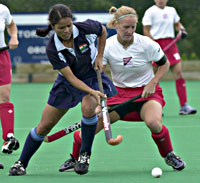 |
 |
| India - USA World Cup Playoff - Photographs
Courtesy Adrian Kerry |
 fter
9 months of rescheduling and postponements, the 3-game playoff between
India and USA for the final World Cup spot was held at Cannock Hockey
Stadium, Cannock, England, from June 22 to June 25. fter
9 months of rescheduling and postponements, the 3-game playoff between
India and USA for the final World Cup spot was held at Cannock Hockey
Stadium, Cannock, England, from June 22 to June 25.
After opening the series with two ties, India lost to USA in the
final match and failed to qualify for the Women's World Cup to be held
this November in Perth, Australia. The scores were as follows:
| Date |
Result |
Goal-Scorers
- India |
Goal-Scorers
- USA |
| Jun 22 |
India 1 - USA 1 |
Mamata Kharab (10 m) |
Tracey Fuchs (51 m) |
| Jun 23 |
India 1 - USA 1 |
Sita Gossein (48 m) |
Tracey Fuchs (22 m) |
| Jun 25 |
USA 3 - India 1 |
Jyoti Sunita Lullu (19
m) |
Tracey Fuchs (36, 49 m)
Kelli Gannon (38 m) |
India and USA have met 4 times this year, and India could not beat them
even once. Tracey Fuchs scored 4 goals in the 3-match playoff, and is the
player most responsible for taking the US to the World Cup. Tracey is a veteran of
2 Olympic Games and 3 World Cups, and has played in a US-record
219 internationals.
With the win, USA secured its 6th consecutive trip to the Women's World
Cup over the past two decades (1983 - 2002). In that same time period,
India qualified only twice for the Women's World (in 1983, when it
finished second last, and in 1998, when it finished last).
With its past consistent record on its side, and backed up by results
on the field, USA emerged deserving candidates over India to qualify for
the 2002 Women's World Cup.
|
| India Finish Second
in 4-Nation Tournament (Women) |
 |
 |
| Mamata Kharab (l) and
Papkidevi - Photographs Courtesy Adrian Kerry |
4-nation pre-Commonwealth hockey tournament (men, women) was held at the
Belle Vue Hockey Centre, Manchester, from June 14 to June 16. The Indian
team participated in the women's edition, with the following results.
| Date |
Results |
Goal
Scorers - India |
| June 14 |
India 4 -
Scotland 1 |
Jyoti Sunita Kullu (2)
Pritam Rani Siwach
Manjinder Kaur |
| June 15 |
India 1 -
Ireland 0 |
Mamata Kharab |
| June 16 |
England 3 -
India 2 |
Pritam Rani Siwach
Papkidevi Nagasepam |
In their last match, India was leading England 2-0 with only 10 minutes
to go, and 2-1 with only 2 minutes to go. Amazingly, even as time was running
out,
England slammed in goals in the 69th and 70th minutes to win
the match, and the tournament.
Had India just drawn with England, they would
have won the 4-nation tournament on better goal average. A small consolation
for India was Pritam Rani Siwach being voted the Player of
the Tournament.
The English and Indian women's hockey teams have been playing each
other since 1953. In a unique record, the England women's team has never
lost a match to India.
|
| India Finish Second
in 4-Nation Tournament (Men) |
double-leg
4-nation men's hockey tournament was held at Pines Stadium, Adelaide and State
Hockey Centre,
Melbourne, between May 30 and June 9. The participants were Australia
(world #2), South Korea (world #4), Malaysia (world #8) and India (world
#10).
Interestingly, all four countries were in the same pool at the 2002 World Cup.
India had lost to all 3 countries in the World Cup, falling 1-2 to Korea, 2-3
to Malaysia and 3-4 to Australia. Coming into the tournament, India had not won a match against Korea and Malaysia in their last five encounters.
In fact, India had not won against South Korea since their triumph in the
Asian Games final 4 years ago.
Under new coach Rajinder Singh, India recalled 5 players who did not play in the World Cup - Gagan
Ajeet Singh, Bimal Lakra, Vikram Pillai, Dinesh Nayak and Sameer Dad.
India, which came 2nd in both legs of the tournament, had the following
match results:
| Venue |
Date |
Results |
Goal
Scorers - India |
| Adelaide |
May 30 |
Australia 4 - India 0 |
|
| |
June 1 |
India 3 - Malaysia
0 |
Daljeet Dhillon
Jugraj Singh
Prabhjyot Singh |
| |
June 2 |
India 4 - Korea
3 |
Daljeet Dhillon (2)
Gagan Ajeet Singh (2) |
| Melbourne |
June 5 |
Malaysia 3 -
India 2 |
Jugraj Singh
Gagan Ajeet Singh |
| |
June 6 |
India 2 - Korea
0 |
Gagan Ajeet Singh
Daljeet Dhillon |
| |
June 8 |
Australia 2 - India 1 |
Jugraj Singh |
| FINAL |
June 9 |
Australia 6 - India 0 |
|
Australia showed their class by winning all 7 of their matches in the
double-leg tournament. India came 2nd, Korea 3rd, while the young
Malaysian team, which lost 6 of their 7 matches, brought up the rear.
The difference between the Australian offence and India's offence was
very wide, with Australia scoring 12 goals to only 1 goal by India in 3
matches played between them.
The Indian team was as follows: Devesh Chauhan (goalkeeper), Dileep Tirkey
(captain), Jugraj Singh, Dinesh Nayak, Sukhbir Singh Gill, Vikram Pillai, Bimal Lakra, Ignace Tirkey, Viren
Rasquinha, Prabhodh Tirkey, Tejbeer Singh, Daljeet Singh Dhillon, Deepak Thakur, Gagan
Ajeet Singh, Prabhjyot Singh and Bharat Chetri.
|
| Photograph
of the Month |

Photography Courtesy : 1948 Olympian, the late
Patrick Jansen
he Photograph of
the Month for July features the 1948 Olympic gold medal winning Indian hockey
team.
The photograph and the text extract below is taken from the book Hockey's
Grand Slam by Clary Miller.
Over 25,000 spectators watched the 1948 Olympic hockey final
between India and Britain, played at Wembley. India's passing completely
bewildered the British side.
The chief failure of the British defence was the inefficient
marking of the Indian wing players, who broke through time and again.
Captain Kishan Lal at outside-right was outstanding in the forward line.
The two goals scored by India in the first half were the result of good
passes by Kishan Lal.
India went on to beat Britain 4-0, with the goal scorers being Balbir Singh Sr. (2), Pat Jansen and Tarlochan Singh Bawa.
The Indian XI that played in the final was as follows : Leo Pinto
(goalkeeper), Randhir Singh Gentle, Keshav Dutt, Amir Kumar, Maxie Vaz,
Kishan Lal (captain), K. D. Singh 'Babu' (vice-captain), Balbir Singh
Sr., Pat Jansen and Lawrie Fernandes.
|
| Money Matters |


 akistan's
Ministry of Finance has agreed to a proposal by the Pakistan Hockey Federation
(PHF) to convert the Rs. 160 million allocated to procure 5
artificial turf pitches into a grant, thereby enabling the PHF to purchase as many turfs as possible in the given amount.
akistan's
Ministry of Finance has agreed to a proposal by the Pakistan Hockey Federation
(PHF) to convert the Rs. 160 million allocated to procure 5
artificial turf pitches into a grant, thereby enabling the PHF to purchase as many turfs as possible in the given amount. nly 4
countries in Asia play men's cricket at the international level - India,
Pakistan, Bangladesh and Sri Lanka. Only 2 countries play women's cricket
at the international level (India, Sri Lanka). Apart from the Indian
subcontinent, cricket is a minor participatory sport in all other Asian
countries.
nly 4
countries in Asia play men's cricket at the international level - India,
Pakistan, Bangladesh and Sri Lanka. Only 2 countries play women's cricket
at the international level (India, Sri Lanka). Apart from the Indian
subcontinent, cricket is a minor participatory sport in all other Asian
countries.