| US
Women's
Team Flees India Without Informing Hosts |
 he
United States of America's women's hockey team reached New Delhi on the
night of May 21
for the 3-match playoff with India to decide the last World Cup berth.
In an abrupt turnaround, they left India after 4 days without playing a
single match, and without informing the Indian Hockey Federation (IHF). he
United States of America's women's hockey team reached New Delhi on the
night of May 21
for the 3-match playoff with India to decide the last World Cup berth.
In an abrupt turnaround, they left India after 4 days without playing a
single match, and without informing the Indian Hockey Federation (IHF).
This unilateral departure of the American women's team was based on a
travel advisory issued by their State Department. Fair enough. The point
to note, however, is the sequence of events prior to the departure.
If the Americans did not inform the other two parties involved (FIH and the IHF) before
their withdrawal, then this amounts to a walkover. If the Americans took only
the FIH into confidence, but not the IHF, it is still a walkover, in
addition to being a case of exceptionally bad manners. In any case, the penalty for
unilaterally abandoning a series is a walkover.
In what may add to the stereotype of the self-absorbed American,
the US officials failed to show up at the previously scheduled press
conference on May 25 noon, and the team did not show up for the previously scheduled practice
match on May 25 evening. The IHF had just announced its team and captain
for the series, when it learnt - from the press - that the US team was on
its way out on May 25 night.
Two observations on the American team's behaviour during their 4 days
in India are given below:
The media-sensitive Americans : Journalists were not allowed to go near the ground and mingle with the players.
Commented an ESPN television crew member, "This is first team in India
that has refused a shoot for ESPN."
The privacy-conscious
Americans : When the Indian women's team members wanted to watch the US team's practice, the
Americans objected, and the Indian management had to ask their players to
leave.
General disclaimer - the US team had every right to be avoid the media
and have practice sessions in private. Though these actions may not endear
them to the host, the US team had come to win the last World Cup berth,
not some popularity contest.
Having said that, note that around the same time this circus was happening in
Delhi, the Brazilian World Cup football team landed in Ulsan, Korea, for their
practice sessions. What a refreshing contrast they presented to the dour
American field hockey team.
The Brazilians held 2 practice sessions daily at Ulsan's Mipo field,
with dozens of uniformed police all along the pitch's perimeter, their backs to
the players and eyes fixed straight ahead. Hundreds of journalists from
the press and television were present to scrutinize, photograph, videotape
and critique every stretch, sprint and scrimmage. Brazil's TV Globo had
anchors patrolling the sidelines and filing live reports on the team's
practice sessions.
And the US team could not spare even a 5-minute sound bite for the
American network ESPN!
Back to the issue at hand. As the 7th-placed team in the World Cup qualifier, India has
the legal right to choose the venue. This right cannot be waived to suit
the convenience of the FIH or the US. Why should the Indian federation
have to lose the critical home-field advantage, in addition to whatever
little sponsorship
money, television rights fees and ticket revenue they would get, by agreeing to play at a
distant, cold, neutral venue?
Do not attempt the mistake of clubbing the India-US series with some
other tournament like the Champions Challenge (Johannesburg) or the
4-Nation Tournament / Commonwealth Games (Manchester) in the name of practicality and
cost-savings since the officials will already be there. It is
important to have the correct mindset that the 3-match playoff series, for the
final World Cup slot, is an FIH event in its own right.
|
| Brazilian Football
And Indian Hockey - Two Contrasting Empires |
 f
Brazil is the home of artistic soccer, India is the storied home of hockey
domination. A World Cup Football competition without 4-time champions
Brazil is as unimaginable as an Olympic hockey competition without 8-times
champions India. f
Brazil is the home of artistic soccer, India is the storied home of hockey
domination. A World Cup Football competition without 4-time champions
Brazil is as unimaginable as an Olympic hockey competition without 8-times
champions India.
If Brazilian football has its Pele, Zico and Falcao, Indian hockey has
its Dhyan Chand, Babu and Balbir Singh. Physical and tactical football is
as alien to the Brazilian player as the defensive and possession-based
European style of hockey is to the Indian player.
Played like a dance and followed like a religion, the mechanical
British games of football and hockey were transformed into a joyous
celebration of samba and bhangra by generations of Brazilian and Indian
legends in their respective sports.
However, there are a few crucial differences between Brazil's national
game and India's national game.
Money : In 1998, shoe manufacturer Nike signed a 4-year $160
million sponsorship of the Brazilian national team. This was continued
with a $120 million sponsorship of the Brazilian team for the 2002
Football World Cup and beyond. Simultaneous with the sponsorship, Nike released television
advertisements in 42 countries starring players like Ronaldo (Brazil) and
Luis Figo (Portugal).
In contrast, the 1998 Indian World Cup hockey team had no sponsors
while the 2002 World Cup hockey team had one sponsor - Castrol. There were
no multi-national shoe companies using hockey stars to endorse their
products for either of the World Cups.
Fan Support : In 1998, both the Football and Hockey World Cups
were held in Europe - in Paris and Utrecht respectively. While 30,000
revelers from Brazil descended on France for Coupe de Monde 98, less than 300
fans from India travelled to Holland to support their team for the World
Cup.
Foreign Leagues : In 1990, 160 Brazilian football players had
signed lucrative contracts to play in foreign football leagues. A decade
later, in 2001, the number had jumped up to 738 Brazilians playing abroad.
For 2002, Brazil has 3000 of its players in various foreign
professional football leagues, across all grades or divisions. In 2002,
India has exactly 3 players in foreign hockey leagues - Jude Felix
(Racing Club de France, Paris) and Dhanraj Pillai / Len Ayyappa (Arthur
Andersen Sports Club, Kuala Lumpur). That's a factor of 1000 difference.
Except for Dhanraj, none of India's 2002 World Cup hockey team members plays
for clubs abroad. In contrast, most players of the Brazilian football team
for the
2002 World Cup play abroad, as can be seen from the following table:
| Country |
Team |
Player |
| Italy |
AC Milan |
Roque Jr. |
| |
AS Roma |
Cafu, Emerson |
| |
FC Inter Milan |
Ronaldo |
| Spain |
FC Barcelona |
Rivaldo |
| |
Real Betis |
Denilson |
| |
Real Madrid |
Roberto Carlos |
| Germany |
Bayern Leverkusen |
Lucio |
Television : For the 2002 Football World Cup, Brazil's TV Globo has sent
150 commentators, statisticians, journalists and technicians for the
event. TV Globo's transmission of Brazil's first practice session
drew a 50 rating (half of Brazil's 160 million population tuned in).
Brazil's president even authorized a shift in the official working hours
so that Brazilians could watch their first round games at 6 am, 8:30 am
and 3:30 am local time.
In contrast, the 2002 Hockey World Cup was a non-event on Indian television,
which is so dominated by cricket and foreign sports. Indian television
viewers are more exposed to American football, American
basketball (NBA) American college basketball (NCAA), American golf, European soccer, New
Zealand rugby, Formula One car racing and ten pin bowling, than to hockey.
A young sports fans in India is more likely to see Tiger Woods on
television than triple-Olympian Dhanraj Pillai.
All of the above goes to show that in India, hockey is the national
game only in theory. Simply by terming hockey our national game does not
translate into corporate sponsorship, huge fan following, television
exposure, or a lucrative league structure - all critical ingredients of
the Brazilian success story, but sorely missing in the dying sport of
Indian hockey.
|
| Football's 'Black
Pearl' Pele And Hockey's 'Wizard' Dhyan Chand |
 |
 |
| Stamp of 'Black Pearl' Pele |
Stamp of Dhyan Chand |
n
this year of both the football and hockey World Cups, it is interesting to
compare the careers of the game's greatest players - Pele in football and
Dhyan Chand in hockey.
We start with their names. In both cases, the sports world knows of
them by names different from their given names. Pele's real name was Edson
Arantes do Nascimento, while Dhyan Chand was actually Dhyan Singh; he got
his nickname Chand due to his habit of playing under the moonlight.
Pele dropped out of school at the age of 10, while studying in the 4th
class. Dhyan Chand terminated his education after completing his 6th
class.
Young Pele used to play barefooted in the streets of Bauru, Brazil, not
with a ball, but with a sock filled with rags. Young Dhyan Chand used to
play barefoot in Jhansi with a branch of a date palm tree for a stick,
and with a ball made of old rags.
The promising player Pele came under the wings of coach Waldemir de
Britto, who trained him in the techniques of the game for 4 years. Dhyan
Chand's first coach and his biggest influence was his Subedar, Major Bhole
Tiwari, who laid the foundations of Dhyan Chand's game for 4 years between
1922 and 1926.
In 1958, at the age of 18, Pele was hired by the Santos Club. In 1922,
at the age of 16, Dhyan Chand was inducted into the Army as a Sepoy in Delhi's First Battalion of the Brahmin Regiment.
Pele helped Brazil win 3 World Cup tournaments - in 1958, 1962 and
1970. In Pele's first World Cup in 1958, Brazil beat hosts Sweden 5-2 in
the final with Pele scoring 2 of Brazil's goals. Brazil's football team
was heralded as the magicians of football.
Dhyan Chand helped India win 3 Olympic hockey tournaments - in 1928,
1932 and 1936. In Dhyan Chand's first Olympics in 1928, India beat hosts
Holland 3-0 in the final with Dhyan Chand scoring 2 of India's goals.
India's hockey team was heralded as the magicians from the east.
In Pele's last World Cup in 1970, he helped Brazil beat Italy 4-1 in
the final. In 1970, at the age of 30, Pele became the most adored hockey
player in the world. After the 1970 World Cup, Italian clubs were offering
upto 2 million dollars to his club Santos to lure Pele away to Italy. The
offers were refused.
In Dhyan Chand's last Olympics in 1936, he helped India beat Germany
8-1 in the Olympic hockey final. In 1936, at the age of 31, Dhyan Chand
became the most adored hockey player in the world. After the 1936 Berlin
Olympics, the German Fuehrer Adolf Hitler offered Dhyan Chand a post in his Army to
lure him away to Germany. The offer was politely refused.
In Mexico City, a street was named after Pele to commemorate his
performance in the 1970 World Cup. In Vienna, a sports club built a statue
of Dhyan Chand to commemorate his 1936 Berlin Olympics performance.
The statue had four hands and four hockey sticks, because they said no
ordinary man with two hands and one stick could play so well!
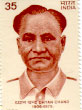
The Government of Brazil issued a postage stamp in Pele's honour. The
Government of India issued a commemorative postage stamp and a First Day Cover
in December 1980 in honour of Dhyan Chand. He remains the only Indian hockey player to have a stamp in his
honour.
Football fans in Brazil's neighbour and arch-rival Argentina try to
project Diego Maradona (with one World Cup victory) as the game's greatest
player. Hockey fans in India's neighbour and arch-rival Pakistan try to
project Shahbaz Ahmed (with one World Cup victory) as the game's greatest
player.
Knowledgeable fans in either sport summarily reject, discard and throw
away such comparisons. Pele in football and Dhyan Chand in hockey remain
the all-time greats of their respective sports.
|
| Mukesh Kumar of Golf
vs. Mukesh Kumar of Hockey |
ndian sports
has a Mukesh Kumar in golf, and a Mukesh Kumar in hockey. In 2001, golf's Mukesh Kumar pipped Vijay Kumar to become the Indian Golfer of the
Year. In 2001, hockey's Mukesh Kumar was voted the Player of the
Tournament (Bombay Gold Cup, January), was appointed Indian team captain (Azlan Shah Cup,
August), and led his team
Indian Airlines to the final of many tournaments (e.g., Lal Bahadur Shastri Tournament,
December).
For all their efforts in their respective sports, golf's Mukesh
Kumar made Rs. 18 lakhs in 2001 by playing in 24 events in the Professional Golfers Association
of India (PGAI) Tour. On the other hand, hockey's triple-Olympian Mukesh Kumar
did not make even Rs. 18,000 from the game during the year 2001.
A successful golfer in India can make 100 times the money a successful
hockey player can make. So why should any youngster take up hockey in
India?
No Grade I hockey tournament in India (Beighton Cup, Bombay Gold Cup, Murugappa Gold
Cup, Nehru Hockey Tournament, etc.) offers more than Rs. 2
lakhs to the 16-member winning team.
In
contrast, the 24 events in the PGAI circuit have a total prize money of
Rs. 2.5
crores and supports more than 100 full-time professional golfers!
In November 2001, two tournaments were held in India's capital Delhi.
The Honda Siel PGA Championship at the Delhi Golf Club had a total
prize money of Rs. 30 lakhs. A week after this tournament ended,
the prestigious Nehru hockey tournament was held in Delhi. The total prize
money was Rs. 4.5 lakhs - a factor of 7 difference.
In the next five years, the PGAI wants to send at least 3 Indians to the European Tour and a couple to the US.
In contrast, the IHF has not bothered about placing a single Indian player
in the European or Australian leagues, let alone coming up with a
professional hockey league of its own.
The golf boom in India is a creation of the media, by the media, for the media.
The advent of satellite television, with its US-centric sports
programming, has brought foreign golf into India's living rooms. As a
result, people know more about Tiger Woods
of USA than many a top Indian sportsperson. With increased exposure
on television came the corporate world and the sponsorship money.
So if a budding sportsman has a choice of playing golf or hockey, it
will be no surprise if he or she opts for golf. And the fault for this
lies with the Indian Hockey Federation for not making hockey as
financially lucrative as other sports in India such as cricket, tennis, golf and football.
The IHF's lack of vision and foresight can be seen from its following
sorry record:
- No Annual Player Awards for the Domestic Season
- No Yearly Calendar of Tournaments With Dates/Venues
- No Kind of Player Statistics Maintained Whatsoever
- No Federation Website or even Monthly Newsletter
- No National Hockey League (Jr./Sr./Men/Women)
- No Paid Professional Coaches Hired on Contract
|
| Punjab National Bank
Sets Up Hockey Academy in Delhi |
 unjab
National Bank (PNB) is setting up a hockey academy in the nation's capital
for juniors of the 8-10 standards. It will operate from Shivaji Stadium to
begin with, till it has its own land to lay a synthetic turf, probably in
Gurgaon. unjab
National Bank (PNB) is setting up a hockey academy in the nation's capital
for juniors of the 8-10 standards. It will operate from Shivaji Stadium to
begin with, till it has its own land to lay a synthetic turf, probably in
Gurgaon.
It will be a residential academy and the trainees will be paid a fair
amount as stipend. PNB will also arrange education for the trainees in good public
schools.
At the press conference announcing this venture, the bank's chairman and managing director S. S. Kohli
said that the academy was conceptualised by former India hockey greats
like Ajitpal Singh and Harbinder Singh.
The groundwork for the new academy has already been done, according to
Kohli, and it will start functioning in a couple of months. It will be
managed professionally by senior officials of the bank, with an executive
director heading the management team. A set of high-profile coaches and
sports medicine experts and doctors will form its brains trust.
Kohli said that the bank plans to seek affiliation for the academy with
the Indian Hockey Federation, similar to what other public-sector
undertakings have done.
|
| Air India Win
The Centennial Agha Khan Cup |

Air India Win the 100th Agha Khan tournament
Photograph
Courtesy Jewella C Miranda of Rediff
he
100th Agha Khan hockey tournament, sponsored by Bharat Petroleum, was held at the
Bombay Gymkhana grounds, Mumbai, from May 7 to May 18. The tournament was
being revived after 7 years.
16 teams were invited for the tournament, of which 8 made it to the
league stage. Punjab and Sindh Bank pulled out at the last minute due to
"a number of injuries". They were replaced by South-Central Railway,
Hyderabad.
Prior to their first match, Punjab Police showered rose petals on the
spectators as their way of winning over Mumbai fans. They wanted to make
up for the trouble they caused the last time they played this tournament,
when the crowd had stormed the field to protest Punjab Police team's rough
play.
Air India and Punjab Police made it to the final with the following match results:
| Date |
Air
India |
Punjab
Police |
| May 9 |
beat Rail Coach Factory 4-0 |
beat Indian Navy 4-1 |
| May 11 |
beat Mumbai Customs 2-1 |
|
| May 12 |
|
drew Western Railway 2-2 |
| May 14 |
beat Western Railway 2-1 |
beat Mumbai Customs 3-2 |
| May 16 |
drew Punjab Police 1-1 |
drew Air India 1-1 |
| May 17 (semis) |
beat ONGC 4-1 (tie-breaker) |
beat Indian Airlines 2-1 (golden
goal) |
In the final played on May 18, defending champion Air India (Mumbai)
beat Punjab Police (Jalandhar) 2-1 to win the 100th Agha Khan hockey tournament. All the
goals came in the first half.
The airmen took the lead in the 7th minute when forward Roshan Tete latched on to a pass from Tushar Khandekar to find the mark.
In the very next minute, centre-forward Devinder Kumar increased the lead
after a one-two passing bout with Kishore Kumar.
In the 27th minute, Punjab Police pulled one back off a penalty-corner shot
by defender Jaskaran Singh. But that was as far as the policemen could get.
Earlier, in the match for the third position, Indian Airlines beat Oil
and Natural Gas Commission (ONGC) 4-2.
The winning team picked up a cheque for Rs. 1,25,000 and a trophy,
while runner-up Punjab Police went home with Rs. 75,000. Third placed
Indian Airlines got Rs. 50,000, the fourth placed team ONGC won Rs.
25,000, while Western Railway bagged the Fairplay Trophy (only 2 green
cards in the tournament) and Rs. 25,000.
The following awards were given:
| Award |
Player |
Team |
Prize |
| Player of the Tournament |
Anil Aldrin |
Air India |
Rs. 30,000 |
| Best Goalkeeper |
Jagdish Ponappa |
Indian Airlines |
Rs. 12,500 |
| Best Fullback |
Anil Aldrin |
Air India |
Rs. 12,500 |
| Best Midfielder |
Balwant Singh |
Punjab Police |
Rs. 12,500 |
| Best Forward |
Brojen Singh |
Indian Airlines |
Rs. 12,500 |
| Player of the Final |
Davinder Kumar |
Air India |
Rs. 7,500 |
| Most Promising Player |
Nitin Kumar |
Air India |
Rs. 5,000 |
| Best Penalty Hitter |
Jaskaran Singh |
Punjab Police |
Rs. 5,000 |
This is the second consecutive tournament win for Air India, who won the Bombay
Gold Cup last month.
|
| Indian Airlines Win
the All-India Kodagu Cup |
he
6th All-India Kodagu Tournament for the Chief Minister's Cup was held at
Madikeri in Coorg, Karnataka, from May 1 to May 7. The tournament was
organised by the Kodagu Hockey Association.
Air India and Central Industrial Security Force dropped out of the
tournament at the last minute, much to the displeasure of Tournament Director
A. S. Bawa.
Teams that took part were Indian Airlines, Karnataka XI, Southern
Railway, Kodagu Hockey Association and Combined Coorg XI.
Indian Airlines met Karnataka in the final played on May 7, with Indian
Airlines winning 1-0 off a penalty corner goal by Roshan Madappa at the
stroke of half-time.
The Indian Airlines team was managed by their goalkeeper and
ex-international A. B. Subbaiah. Indian Airlines walked away with the winner’s purse of Rs. 75,000 and a rolling trophy, while Karnataka XI had to be satisfied with Rs 50,000.The following special prizes were
awarded:
| Award |
Player |
Team |
| Best Forward |
P. T. Aiyappa |
Karnataka XI |
| Best Half-back |
Bipin Thimmaiah |
Karnataka XI |
| Best Full-back |
Lajarus Barla |
Indian Airlines |
| Best Goalkeeper |
M. K. Sharanu |
Kodagu Hockey Assn |
| Player of the Tournament |
Brojen Singh |
Indian Airlines |
Prior to the commencement of the match, Mr. Kumar Appachu, President of the Kodagu Hockey Association, made a strong plea for getting a synthetic surface for the hockey stadium at
Madikeri.
To which former India captain and Executive Director of the Sports Authority of
India (South), M. P. Ganesh, assured that an artificial turf field would be laid in
Madikeri in the current fiscal year.
|
| All-Railway
Final in the Obaidullah Khan Gold Cup |
he
63rd All-India Obaidullah Khan Gold Cup hockey tournament was held at the
Aishbagh Stadium in Bhopal, Madhya Pradesh, from May 23 to May 31. The tournament was
organised by the Bhopal Hockey Association.
The tournament is held here every year in the memory of Obaidullah Khan, who was the elder brother of
the erstwhile Nawab of Bhopal, Hameedullah Khan.
Four local teams - Bhopal Municipal Corporation, Bharat Heavy Electricals,
Amir Club and Central Railway participated in the tournament.
Tournament coverage was patchy in the Indian media. Western Railway (Mumbai)
and Northern Railway (Delhi) met in the final, with the following match
results.
| Date |
Western
Railway |
Northern
Railway |
| May 22 |
drew Madhya Pradesh Police 0-0 |
|
| May 23 (replay) |
beat Madhya Pradesh Police 3-0 |
|
| May 27 |
|
beat ONGC 5-3 (tie-breaker) |
| May 29 (semis) |
beat Southern Railway 2-1 |
beat |
The semifinals and the final were to have been telecast live
on Doordarshan Sports.
|
| Photograph
of the Month |
Photography Courtesy : 1932 Olympian Dickie
Carr
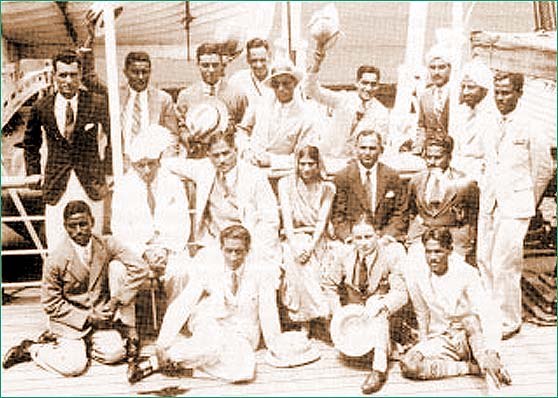
he Photograph of
the Month for June features the 1932 Indian hockey team en route to Los
Angeles to defend their Olympic hockey title.
The 16-member Olympic team played a couple of practice matches in India before
heading to Ceylon (Sri Lanka). In two matches played in Colombo, the Olympic team beat
All Ceylon XI 20-0 and 10-0.
Wrote one newspaper on the first match, "Perfection is perilous, for it
tempts the gods. For once, even the god of weather
paid tribute to the genius of the Indian players. Rain clouds, which had
threatened to ruin the game, vanished into the blue, and thousands of spectators
spent a happy hour marvelling at the incomparable artistry of the Indian
team."
From Colombo, the Indian team set sail for Singapore on the
N. Y. K. Haruna Maru on May 30, 1932, two months before the start of the
Olympics. It took one week to reach Singapore. During the onward journey to Hong
Kong, many players fell ill due to the rough weather.
From Hong Kong, the team sailed on to Tokyo, Honolulu and finally reached San Pedro. The
5-weeks long
journey to Los Angeles was finally complete.
|
| Money Matters |



 ince 1996,
India has been regularly invited for the 4-nation double-leg tournaments
in Australia. These quadrangulars have been held at Cairns, Brisbane, Sydney, Melbourne, Canberra and Perth.
ince 1996,
India has been regularly invited for the 4-nation double-leg tournaments
in Australia. These quadrangulars have been held at Cairns, Brisbane, Sydney, Melbourne, Canberra and Perth.