| Coach Cedric D'Souza
Fired as India's Coach |
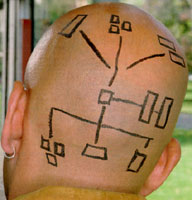
Cedric's Strategies Were Too Theoretical?
 oach
Cedric D'Souza has gone down in history as the first ever coach to
be fired in the middle of a World Cup hockey tournament. Heckled and abused by sections of Indian fans, a tense looking D'Souza
had to even ask for police security after India's loss to Malaysia. oach
Cedric D'Souza has gone down in history as the first ever coach to
be fired in the middle of a World Cup hockey tournament. Heckled and abused by sections of Indian fans, a tense looking D'Souza
had to even ask for police security after India's loss to Malaysia.
Call him what you
will - pompous, arrogant, theoretical, or simply naive, Cedric made some
critical blunders which led to his eventual dismissal:
- Cedric withdrew India from a pre-World Cup warm up tournament
featuring 3 Sydney Olympics semi-finalists - Netherlands, Australia and
Pakistan, who, between them, have won 8 of the 9 World Cup tournaments
held so far.
Going into the World Cup, India lost a golden opportunity to see how
they match up against teams belonging to the Elite Six.
- Cedric's alternative was a 3-week coaching camp in solitary
splendour in Chennai, using simulation of match situations during training, extensive video sessions and detailed study of opponents.
All that is very good, but is only meant to be complementary to actual
match practice.
- Though acknowledged as a leading hockey tactician, Cedric failed to realise that match competition has become an
inseparable part of modern coaching. Defending World Cup champions Netherlands came from half a world away for the
same warm up tournament that India declined to go. Despite winning 34
of 36 matches prior to the World Cup, Germany still decided to play
warm up matches against Belgium, South Africa and Spain. In preparation for the World Cup, South Africa played
9 test matches in 3 weeks - 5 against Germany and 4 against England,
winning only 1 of those 9 matches.
- Dropping Gagan Ajeet Singh, captain of India's Junior World Cup
team, was never satisfactorily explained by Cedric, except saying that
'it was in the team's best interest.' As former captain Ajitpal Singh said in his newspaper
column, 'Gagan is an asset in the striking circle and at no stage did I expect him to be axed.
Those who are responsible for it owe the hockey-loving public an explanation. Is this the reward for such a fine show at Hobart?'
- The Cedric D'Souza corollary to the Rolling Substitution Rule states
that one can substitute ad infinitum, ad nauseam. So much so that
there were 30 substitutions during the India - Malaysia match. On one
occasion during the India - Korea match, 5 players stood on the centre-line,
each holding a number ready to go in. Cedric probably got confused with ice
hockey, where due to a smaller playing area, and less number of
players, and faster speed of the puck, these kind of en masse
substitutions take place. Adopting such an alien model to hockey greatly
disturbs the player's flow. This was coaching at its worst. Cedric got
a taste of his own medicine when he himself was 'substituted' by his
deputy C. R. Kumar. After all, if a person is not performing, is it
not right that he gets substituted? Or does that rule apply only to players?
You cannot trade top-quality match practice with Powerpoint presentations and classroom
sessions. This is the single biggest lesson that Cedric D'Souza and Indian
hockey can take from this disaster of a World Cup.
Cedric's legacy in Indian hockey will be coaching India to its
worst ever finish in the Olympics (Atlanta-8th), its lowest ever world
ranking (14th-Edinburgh World Cup Qualifier), and the only coach in World
Cup history to be fired midway during the tournament.
|
| K. P. S. Gill
and Jyothikumaran Equally Accountable for India's Showing |
 uccess has many
fathers, failure has none. 4 months ago, when India won the Junior World
Cup, IHF president K. P. S. Gill and IHF secretary Kandaswamy
Jyothikumaran were quick to take credit, stating that the world
title was due to the focus and exposure
given to juniors and sub-juniors by the IHF, under their visionary
guidance. uccess has many
fathers, failure has none. 4 months ago, when India won the Junior World
Cup, IHF president K. P. S. Gill and IHF secretary Kandaswamy
Jyothikumaran were quick to take credit, stating that the world
title was due to the focus and exposure
given to juniors and sub-juniors by the IHF, under their visionary
guidance.
Now, when India has a disaster of a World Cup campaign, why is the same
Gill-Jyothikumaran duo not owning up responsibility for the debacle.
There is only one scenario where Gill and Jyothikumaran can be absolved
of any blame - that is if they had appointed Cedric on a paid contract
(Cedric was coaching on a honorary capacity), with a performance guarantee
clause, and most important - given him full freedom to select a team with
absolutely no interference from the federation. This is how Paul Lissek
coaches the Malaysian team.
However, Gill and Jyothikumaran had a major say in hockey matters
concerning team selection and exposure tours and preparations. In fact,
six people selected this team - IHF president Gill, IHF secretary
Jyothikumaran, government observer Syed Jalaluddin Rizvi, selection committee member Prithviraj, and
team manager K. G. S. Alva. Six signatures were put on the team list. Then
why is Cedric alone to blame?
We have had 8 coaching changes in the past 8 years under the Gill-Jyothikumaran
regime.
| Year |
Coach |
When
Fired |
| 1994 |
Cedric D'Souza |
1996 Atlanta Olympics |
| 1997 |
Harcharan Singh
V. Bhaskaran
Pargat Singh |
Short-term assignments |
| 1998 |
V. Bhaskaran |
1998 Utrecht World Cup |
| 1998 |
M. K. Kaushik |
1998 Asian Games (Gold) |
| 2000 |
V. Bhaskaran |
2000 Sydney Olympics |
| 2001-02 |
Cedric D'Souza |
2002 World Cup |
| 2002 |
C. R. Kumar |
? |
How come it is always the coach's fault, but never the fault of
bureaucratic administrators like Gill and Jyothikumaran.
Was Cedric fired or was he advised 'rest' with his deputy taking over
for him. Why is the IHF beating around the bush? Will any self-respecting
human accept such a situation?
If Cedric has been advised rest, let us apply the same criteria to Gill
and Jyothikumaran. Let these hockey administrators have some 'rest' and
let their deputies take over for them. After things cool down, they can
come back to their old posts. See how ridiculous this sounds.
If they can take credit for India's Junior World Cup victory, they
should also own up responsibility for India's failure in the 2002 World
Cup. Otherwise, Gill and Jyothikumaran.are no different from common breed
politicians, short-sighted, narrow-minded, obsessed with keeping their
posts, and having morals that belong to the gutter.
|
| IHF has become a
Police Raj - Aslam Sher Khan |
 lympian
Aslam Sher Khan hit out at IHF President K. P. S. Gill, accusing him of
favouritism in the choice of both players and officials. lympian
Aslam Sher Khan hit out at IHF President K. P. S. Gill, accusing him of
favouritism in the choice of both players and officials.
The Olympian alleged that out of 35 members of the IHF working committee,
50% - 60% of the members were retired IPS officers, and none is an
Olympian. The IHF has become a hub for retired IPS officers because they
would back Gill in the elections, since Gill is also a retired IPS
officer, Aslam Sher said.
Giving an example to back his claim, Aslam said that retired IPS officer
P. N. Chaturvedi was appointed president of the Bhopal Hockey Federation
even though he never played the game.
Alleging favouritism in the choice of players by Gill, the Olympian
pointed out that 75 players from Punjab had been given international
exposure in the recent past, while there was hardly any representation from Madhya
Pradesh.
Aslam Sher alleged that Punjab's players were benefiting at the expense
of players from Bhopal, Mumbai and Chennai. He was particularly critical of the selection of
the team for the 2002 World Cup.
"Among the 22 players, there is not even a single player from Bhopal. This could mean either there are no talented players left in the city
of Bhopal, or they are being discriminated against by the
federation."
Aslam Sher demanded a white paper on the activities of the IHF during
Gill's tenure, accusing it of not being transparent in its financial
dealings. "The federation has an annual income of Rs. 3 crore, but no accounts are being maintained."
|
| World Cup Opening
Ceremony Sans Spectators |
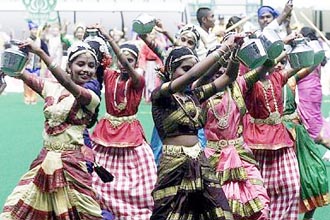
Photograph Courtesy : The
Star of Malaysia
 he
opening ceremony of the 10th World Cup depicted Malaysia's rich heritage
of culture and tradition. The ceremony, which lasted 90 minutes, was
telecast live by RTM. The highlight was a presentation by the
Culture, Art and Tourism Ministry, and a drum fiesta soon after the
march-past by the teams. he
opening ceremony of the 10th World Cup depicted Malaysia's rich heritage
of culture and tradition. The ceremony, which lasted 90 minutes, was
telecast live by RTM. The highlight was a presentation by the
Culture, Art and Tourism Ministry, and a drum fiesta soon after the
march-past by the teams.
The march past saw just officials, with the players staying away, perhaps
due to the fact that six matches were to be played following the opening
ceremony.
However, because the opening ceremony was scheduled for mid-afternoon, when the heat and humidity
would be at its peak, the 15,000-seat National Stadium remained empty for
most of the ceremony.
The tournament was declared open by the Malaysian Hockey Federation (MHF) president, Sultan Azlan Shah.
Other dignitaries present at the ceremony included Sports Minister Datuk Hishammuddin
Hussein and
FIH president Els van Breda Vriesman.
|
| Hockey
Features in Sports Illustrated's Annual Swimsuit Issue |
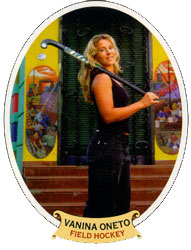
ports
Illustrated, America's premier sports weekly, comes out with an annual
swimsuit issue, that is, well, not exactly about sports, but definitely
well illustrated. One of the damsels featured in this year's issue was Vanina
Oneto, the sharp-shooting forward of Argentina's women's team. This is
what Sports Illustrated wrote:
Vanina Oneto has helped turn hockey into the women's equivalent of
soccer in Argentina. During the Sydney Olympics, las Leonas (the
Lionesses) roused Argentinians out of bed at 4 in the morning for live
telecasts of their games.
Oneto is known for displaying her feelings on the field. She and
the rest of las Leonas screamed, cried and rejoiced at each pivotal
play, stirring their country to feel every emotion with them. Somewhere
along the way, field hockey in Argentina was transformed from a sport
that little girls play to one that grown up men watch.
When the Australian national team visited last April for a 4-match
series, 18,000 fans showed up with drums in their hands and songs in
their throats. Vanina has become accustomed to police escorts, adoring
fans who approach her on the streets, and the shooting of television
endorsements.
"I don't want to open my eyes. I want this all to continue.
Being part of making hockey grow in Argentina is great, and I want to
make it grow, grow and grow as much as I can."
|
| European
Monopoly Of The FIH Not Good For Hockey |
 t is
high time
that the FIH have a rotating president from each continent. The FIH, with
its present headquarters in Brussels, has become too Euro-centric in its
policies. Five examples are given below where Asian countries have got
short-changed by the FIH in the past year. t is
high time
that the FIH have a rotating president from each continent. The FIH, with
its present headquarters in Brussels, has become too Euro-centric in its
policies. Five examples are given below where Asian countries have got
short-changed by the FIH in the past year.
- The men's Champions Challenge tournament was moved from India to
Malaysia mainly because of objections from European participants. So was the case
with the women's Champions Challenge, which had to be moved from India to
South Africa.
- The India-USA playoff for the last Women's World Cup berth has been
moved from New Delhi to Brussels, despite the
original agreement that India gets to choose the venue of the playoff
series. Who decides that it is unsafe to play in India? The English
and Zimbabwe cricket teams have been for weeks in India without
problems. The US State Department has not issued any advisory against
travel to India. Seven months after the September 11 terrorist
attacks, why does the FIH feel that New Delhi not a safe venue to play?
- The 2002 World Cup has for the first time allowed 18-member teams,
mainly due
to the heat (over 30º Celsius), and humidity (70% - 100%) in Malaysia during the tournament. This is again to suit
the European teams, for Asian, Australian and African teams will have
lesser problems with the weather. When tournaments are held in European countries
in colder conditions, there is no talk of having 18-member teams, as the
Europeans are not unduly affected.
- Among the nominations for the 2001 FIH Male Player of the Year, not a single player from Asian powerhouses
Pakistan, India and Korea was nominated. Among the nominations for the
2001 FIH Young Male Player of the Year, India finds itself shut out,
despite winning the Junior World Cup in Hobart in October 2001.
- The Second Commonwealth Games hockey competition will be held in
Manchester, England in July. Two Asian teams have got shut out of the
tournament - Malaysia, runners up in the previous edition, and India.
Barbados and Wales, where hockey is one of the minor sports, get to
play in their stead. What kind of value will be there in a
Commonwealth hockey tournament that excludes the most populous country
of the Commonwealth, and which has hockey as its national sport?
The FIH seems to be living in an ivory tower of its own, away from the
realities of global hockey. It is time to change this Euro-centric
mindset. It is time for dynamic hockey officials from Asia, Africa, Oceania and
America to break the European monopoly for the top positions of the FIH.
|
| Indian and Pakistani
Hockey Books Released |
he
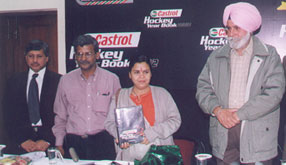
Castrol International Hockey Year Book 2002, written by the Delhi-based freelance journalist,
K. Arumugam, was
recently released in Delhi. Sports Minister Uma Bharati was the chief
guest at the book-release function, which was held at the Constitution Club.
Ravi Pisrody, Vice-President (marketing) of the sponsors Castrol India
Ltd., reaffirmed his company's efforts to rekindle public interest in the glorious game of hockey.
This is the first international edition of the hockey yearbooks,
previous versions of which were devoted to Indian hockey. The 2002 year
book consists of two sections - 'Global Glory', and 'Inside India',
covering international and Indian hockey respectively, and spanning the years 2000 and 2001.
Complete profiles of India's men and women Junior World Cup teams, as
well as around 200 photographs embellish this sleek 176-page hard bound book.
The international launch of the book was done by Els Van Breda Vriesman, President of
the FIH, at an informal gathering of journalists during the 10th World Cup
in Kuala Lumpur.
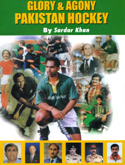
Across the border, the Urdu book Pakistani Hockey - Beesween Sadi Mein,
written by journalist Sardar Khan, has
come out with its English-language equivalent entitled Glory & Agony - Pakistan Hockey.
The book takes a comprehensive look at Pakistan's record in the Olympic Games,
World Cup, Champions Trophy, Asian Games and Asia Cup competitions.
Pakistan's participation in various international tournaments has been separately dealt with. The National
Hockey Championship winners roll of honour gets special treatment. There's
even a chapter on Pakistan's fledgling women's hockey efforts.
The book' cover is a collage of various photographs, dominated by Pakistan's world class drag flick ace Sohail
Abbas. This book has been brought out by Hassan Zai Publications, and costs
Pakistani Rs. 600 (USD 20).
|
| General Musharraf
Rewards Pakistan Hockey Players |
f
the IHF can be called a Police Raj, filled with retired IPS officers, the
PHF is more like an Army Unit, with the top four positions all being held
by Army personnel.
The present manager of the team is Brigadier Khalid Khokhar. The
secretary of the PHF is Brigadier Mussarat Ullah Khan. The president of
the PHF is the Chairman of the Joint Chiefs of Staff, General Mohammad Aziz.
The patron-in-chief of the PHF is General Pervez Musharraf, the military
ruler of Pakistan.
Pakistan's national hockey team called on General Musharraf after winning a
6-nation hockey tournament at Kuala Lumpur in January. Musharraf shook hands with each of the Pakistan blazer-attired 16 players,
and gave them a cash award of Rs. 1 lakh each.
"Never give up, should be your battle cry on the playing field," Musharraf urged the players, and hoped
that they would bring more laurels to the country by winning the World Cup.
"Even if you are 0-3 behind, you should keep your nerve and fight to the
last."
General Musharraf also said that a new sports policy would be
implemented in Pakistan, whereby office-bearers of sports federations
will be barred from holding office for more than two terms of four years
each. This would mean that a fairly large number of officials would have to pack up and go.
"Policies are meant to be implemented and there should be no ambiguity in this regard," Musharraf made it clear.
That is one policy that K. P. S. Gill of the IHF would be happy not to
get implemented in India. He is in the beginning of his third consecutive
4-year term as the president of the IHF.
|
| India Get Bronze in
Women's Champions Challenge |

he inaugural
Nashua Mobile Women's Champions Challenge was held at the Randburg Hockey Stadium, Johannesburg, South Africa, from February 9 to 17.
The 6-nation tournament featured England, India, South Korea, South Africa, USA and Russia,
all ranked in the top 15 in the world.
Nashua Mobile is making its mark in sponsoring South African sports. It
is a broadcast sponsor of test cricket on Supersport, communications provider to Western Province
rugby, co-sponsor of the Kournikova / Coetzer tennis series, and
co-sponsor of the Nelson Mandela Golf Invitational.
India's match results in the Champions Challenge were as follows:
| Date |
Result |
Goal
Scorers (India) |
| Feb 9 |
India 3 - England 3 |
Jyoti Sunita Kullu (2)
Pritam Rani Siwach |
| Feb 10 |
India 1 - South Africa 0 |
Jyoti Sunita Kullu |
| Feb 12 |
India 1 - USA 1 |
Sanggai Ibemhal Chanu |
| Feb 13 |
South Korea 3 - India
2 |
Mamta Kharab
Jyoti Sunita Kullu |
| Feb 15 |
India 3 - Russia 2 |
Jyoti Sunita Kullu
Suman Bala
Sanggai Ibemhal Chanu |
| Feb 17 |
India 1 - South Africa
0 |
Suman Bala |
England won the Champions Challenge, beating South Korea 2-1 in the
final. England thus qualified for the Women's Champions Trophy, scheduled
to be held at Macau, China, from August 23 to September 1 this year.
India, who were led by Tingonlima Chanu, did well to finish with the
bronze. India beat hosts South Africa twice, and lost only one match in the
entire tournament.
A coaching camp in preparation of the upcoming playoff against the US in
Brussels, will commence at National Institute of Sports, Patiala, on March 1.
The winner of this playoff will get the last available spot for this
November's Women's World Cup in Perth.
|
| Two Indians in the Running for Player of the Year
Award |
he
2001 Player of the Year Awards will be announced during the 10th Men's World Cup in Kuala Lumpur.
There are 4 award categories - Player of the Year (Men, Women) and the
Young Player of the Year (Men, Women).
India does not have any nominations in 3 of the 4 categories. However, Sanggai
Ibemhal Maimom Chanu
and Mamata Kharab have been nominated in the category Young Player of the
Year - Women.
Previous award winners are as follows:
| Year |
Male
Player of the Year |
Female
Player of the Year |
| 1998 |
Stephan Veen (NED) |
Alyson Annan (AUS) |
| 1999 |
Jay Stacy (AUS) |
Natascha Keller
(GER) |
| 2000 |
Stephan Veen (NED) |
Alyson Annan (AUS) |
Chanu and Kharab are both members of India's u-21 team. They had turned in
impressive performances in the women's World Cup qualifier, held in France
in September 2001. Chanu was the unanimous choice of the coaches and media
as the 'Young Player of the Tournament'.
Pakistan's Kashif Jawwad is in the running for the Junior Player of the
Year. It is a surprise that India, the 2001 Junior World Cup champions, does
not have a single nomination in the Junior Player of the Year - Men
category. The IHF could have put forward the name of Deepak Thakur
(top-scorer of the 2001 Junior World Cup), or skipper Gagan Ajeet Singh or
forward Prabhjyot Singh or penalty corner find Jugraj Singh for the Junior
Player of the Year nomination.
The judging will be based on overall skill level of the players, their ability to lead a team,
and the role they play as ambassadors of the game of hockey.
|
| Punjab and Sindh
Bank Win the Dhyan Chand Cup |
he Chhatrapati Shivaji All-India hockey tournament for the
Dhyan Chand Cup was held at Shivaji Stadium, Delhi, from January 29 to
February 5. Punjab
and Sindh Bank won the tournament, beating Indian Oil Corporation
2-1 in an exciting final at Shivaji Stadium.
Parminder Singh scored the first goal in the 6th minute, while Baljeet Singh Chandi
scored the second in the 66th minute. The runners up reduced the margin in the last minute through
Lakhwinder Singh.
Parminder was adjudged the best player of the tournament, and received a cash prize of Rs. 5,000.
|
| Photograph
of the Month |
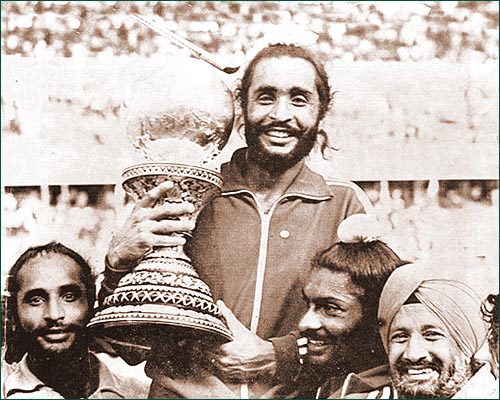
Photograph Courtesy : World Hockey
(Oct 1974 - July 1975)
he Photograph of
the Month features India's victory in the 1975 World Cup in Kuala Lumpur.
This remains India's only world title, and also the only World Cup final
between India and Pakistan in any sport.
Balbir Singh Sr., manager of the victorious 1975 team, looks back on
those heady days. This has been excerpted from an article by V.
Sudarshan in Sportstar's World Cup Special issue.
A quarter of a century has passed but memories linger, some pleasant and others
bitter. In those days, the IHF had been disbanded, and the game was
being administered by the IOA.
The IOA appointed me as the director of the camp, and the late K. D. Singh
'Babu' as the chief coach. I was in USA when I was told to cut short my leave and
return home. After Babu regretted his inability to take up the assignment due to domestic reasons, the IOA made me director-cum-chief coach.
The coaching camp was held on the campus of the Punjab University, Chandigarh.
A newly constructed girl's hostel was given as the residence for the
trainees. This being in front of another girl's hostel across the road, some girls started making courtesy calls at our visitors' lounge.
This was discouraged by having the front gate locked, and advising the girls to watch the players in action on the field. That prompted the players to give their best
during practice sessions to impress the girls.
During the first week of the camp, two events occurred which made my job more taxing
- the sad demise of my father and the consequent stroke suffered by my wife who remained in coma for over a month. I
had to shuttle between the camp and the hospital.
We invited some of the best local teams to give practice to our team. That paid rich dividends. After training, meetings were held every evening to find out
various shortcomings, and the ways and the means to correct
them.
I am not that religious. However, at a mosque in Kuala Lumpur, everyone was surprised when the doctor, the coach and I landed there along with Aslam
Sher Khan for the Friday prayers. At the Chandigarh camp, and later at Kuala
Lumpur, I followed my Punjab Police team's old practice of making a common prayer room for all players.
In our Indian team, there was no Hindu, no Muslim, no Sikh and no
Christian.
Our stay, the conduct of the tournament and other allied arrangements at Kuala Lumpur were excellent. The organisers were extremely hospitable. The big crowds turning out to watch the matches appeared very knowledgeable. They appreciated good
moves of all teams.
Kuala Lumpur has always been lucky for us. Hope it proves lucky once again.
My best wishes are with our Indian team.
|
| Money Matters |




 ho will be
the top scorer of the 2002 World Cup? Going by past record, the leading contenders for that
title could be Argentina's Jorge Lombi and South Africa's Greg Nicol.
Interestingly, both Argentina and South Africa, along with hockey
heavyweights Netherlands, Germany, Pakistan and Spain, are in the same
Pool of Death.
ho will be
the top scorer of the 2002 World Cup? Going by past record, the leading contenders for that
title could be Argentina's Jorge Lombi and South Africa's Greg Nicol.
Interestingly, both Argentina and South Africa, along with hockey
heavyweights Netherlands, Germany, Pakistan and Spain, are in the same
Pool of Death.