| Who is the
National Coach? What are his Powers? |
 he
Indian Hockey Federation has announced that Rajinder Singh is the coach of
the national team. He would be assisted by Narendar Singh Sodhi and A. E. Brient,
along with trainer P. Sampath. All four were part of the team that won
India the Junior World Cup in October 2001. he
Indian Hockey Federation has announced that Rajinder Singh is the coach of
the national team. He would be assisted by Narendar Singh Sodhi and A. E. Brient,
along with trainer P. Sampath. All four were part of the team that won
India the Junior World Cup in October 2001.
What is the proof that Rajinder Singh is indeed India's
national hockey coach? Is there a letter of appointment from the president of the
IHF? Is his
tenure specified? Does he have a monthly salary? Is there a performance
bonus specified? Does he get to choose his
team or will he be 'presented' with a team that someone else chooses? In
short, what are the powers vested in India's national hockey coach?
Presented below are 4 examples (Australia - men, Malaysia - men,
Australia - women, New Zealand - women) of the professional manner in
which teams are selected by the national coaches, with zero interference from the federation.
The 2002
men's and women's Australian hockey teams were selected purely on the basis of performance in the
Australian Hockey League (AHL). The teams were announced by the respective
coaches (Barry Dancer-men, David Bell-women) after the finals of the
AHL. The president of Hockey Australia was not present, the secretary of
Hockey Australia was not present, it was the coaches alone who
announced the team, the captain and
vice-captain of the squads.
Similary, the 2002 New Zealand women's team was selected by their
national coach Jan Borren. The president of the New Zealand Hockey
Federation, Ramesh Patel, not only had no say in the issue, but also was
not present at the announcement of the team.
The boss of Malaysian hockey is their coach Paul Lissek. The selection
criteria for the players is performance in the Malaysian Hockey League.
Lissek has personally watched around 70% of the league matches. He is the
sole authority to name the probables, not the president, not the
secretary. Those were the terms under which he joined as coach of the
Malaysian team.
Now look at the totally laughable and incompetent example of the Indian
Hockey Federation, where the president (K. P. S. Gill)
and secretary (Kandaswamy Jyothikumaran) are the self-appointed chairman and
member of the
Selection Committee.
How in the world are they qualified to select a team?
How can a single tournament (U&I Champions Trophy) comprising 12 teams
be the basis for selecting players? How can probables be chosen before
even selecting the coach? How can the Chairman of the Selection
Committee (K. P. S. Gill) have a role in the selection process without
having watched a single game of the tournament?
There were 3 All-India tournaments one after another in April -
Beighton Cup (Kolkata), U&I Champions Trophy (Bangalore) and the
Bombay Gold Cup (Mumbai). Ideally, the coach should have watched the
knockout stages of all these tournaments before deciding on the probables
list.
Newly appointed coach Rajinder Singh has to be careful not to end up as
yet another coach hired and fired by the vision-less and merit-less duo
that run the Indian Hockey Federation.
|
| Where are the Awards?
Where are the Player Statistics? |
 an the Indian
Hockey Federation (IHF) spare just Rs. 10 lakhs per year for 4 annual
awards - Player of the Year for men, women, junior men and junior women
for the domestic season. Cannot a part of the so-called 3-year Rs. 3 crore
deal with team sponsors Castrol benefit the best players of India's
domestic season. an the Indian
Hockey Federation (IHF) spare just Rs. 10 lakhs per year for 4 annual
awards - Player of the Year for men, women, junior men and junior women
for the domestic season. Cannot a part of the so-called 3-year Rs. 3 crore
deal with team sponsors Castrol benefit the best players of India's
domestic season.
The FIH has started this practice in 1998, honouring the best players
of the FIH-sanctioned tournaments every year.
Many national associations, including England and Australia, have a similar tradition of
honouring their nation's best. For example, the awards for the 2001-2002 domestic
Australian season, for men, women, junior men and junior women, were as follows:
| Award |
Gender |
Category |
Player |
| Player of the Year |
Men |
Overall |
Brent Livermore |
| |
|
AHL |
Zain Wright |
| |
Women |
Overall |
Louise Dobson |
| |
|
AHL |
Louise Dobson |
| Jr. Player of the Year |
Men |
Overall |
Liam de Young |
| |
|
AHL |
|
| |
Women |
Overall |
Angie Skirving |
| |
|
AHL |
Emma Meyer |
While many All-India tournaments do give out their own
tournament-specific awards, it is the responsibility of the IHF to reward
consistent performance for an entire domestic season.
Also, the IHF is the only major body in the world that does not maintain any
sort of player statistics. We have no idea at all of the number of matches
played by our internationals, goals (including hat-tricks) scored, their
country-wise record or even venue-wise record.
Contrast this with the Board of Control for Cricket in India that
maintains the following detailed statistics for all its players:
| Category |
Statistics |
| Batsman |
Matches, Innings, Runs Scored, Average
Highest Score, 100s, 50s, 0s
Not Outs, Run Outs, Catches |
| Bowler |
Matches, Balls, Runs Conceded,
Wickets
Bowling Average, Best Figure, Hat-Tricks
Bowled, Stumped, Catches |
The IHF's lack of vision and foresight can be seen from its following
sorry record:
- No Annual Player Awards for the Domestic Season
- No Kind of Player Statistics Maintained Whatsoever
- No Yearly Calendar of Tournaments With Dates/Venues
- No Federation Website or even Monthly Newsletter
- No National Hockey League (Jr./Sr./Men/Women)
- No Paid Professional Coaches Hired on Contract
|
| Play Abroad If You
Are Talented and Ambitious |
 ack
in the 1980s, a cricket match between Somerset and Hampshire in the English county
league would see
Vivian Richards and Joel Garner match up against Gordon Greenidge and Malcolm
Marshall. ack
in the 1980s, a cricket match between Somerset and Hampshire in the English county
league would see
Vivian Richards and Joel Garner match up against Gordon Greenidge and Malcolm
Marshall.
Fast forward to 2002. 12 Australians are playing for 12 different
counties in England, which reflects the current dominance of Australia in world
cricket. 3 of the Australians are even captains of their counties. How
much has cricket's power base changed from the 1980s? - there is not a
single West Indian playing county cricket this season.
Move over to golf. World number 7 golfer Vijay Singh of Fiji had this
to say to aspiring Indian golfers, "The Indians have to play abroad.
Though a player like Jeev Milkha Singh plays in the Asian circuit, Indian
players cannot improve unless they participate in the much more
competitive European or American circuit."
The relevance for Indian hockey players is as follows - since the IHF
does not have the guts, vision, money or desire to come up with a National
Hockey League, it is up to talented Indians to take the initiative and play
in the lucrative foreign hockey leagues.
As usual, Dhanraj Pillai leads the way for India. This mercurial forward
has played for 7 different clubs in his illustrious career, in cities like London, Stuttgart, Lyon,
Dhaka and Kuala Lumpur. He is presently playing for Arthur Andersen in the
Malaysian Hockey League, along with Len Ayyappa. The IHF should play an
active role in placing promising players, especially juniors, in the
Australian, English and Dutch hockey leagues.
Not only players, even coaches have understood the importance of
foreign exposure. India’s World Cup assistant coach C. R. Kumar has signed a 1-year
fully-paid contract with the Sabah Hockey Association (SHA) in Malaysia.
Kumar has been appointed as their technical consultant, and will prepare a
5-year development plan for hockey in the state. SHA secretary Ajaib Singh
Mann said that they hoped to negotiate for a longer contract with Kumar.
Sources said that Kumar made an emotional statement to his local team
in Chennai prior to his departure. He reportedly said that he was “very
disheartened by the way things have developed after the World Cup, and
that he was leaving in disgust.”
|
| Punjab Police Win
107th Beighton Cup |

The Victorious Punjab Police Team, Photo
Courtesy - The Hindu
he
107th Indian Oil Servo Beighton Cup was held at
the Mohun Bagan and the Calcutta Cricket & Football Club grounds, Kolkata, from March 21 to April 4.
Punjab Police and Central Reserve Police Force made it to the
final, with the following match results:
| Date |
Punjab
Police |
CRPF |
| April 1 |
drew with Indian Airlines 1-1 |
beat IHF Juniors 2-0 |
| Apr 2 (semis) |
beat PSB 2-1 |
beat Indian Airlines 3-2 |
In the final played on April 4, Punjab Police, coached by former India
captain Pargat Singh, defeated CRPF 3-1 to win the tournament. Sarabjit
Singh, Gabbar Singh and skipper Daljeet Singh scored for Punjab Police,
while Surinder Kumar Vashist pulled one back for CRPF. Punjab Police
received the winner's prize of Rs. 1 lakh.
This was the third victory for Punjab Police in 3 final appearances,
while on the other hand, it was the third runners-up trophy for CRPF in 3
final appearances. Punjab Police had earlier won the Beighton Cup in 1966
and in 1997.
This is the first major national title for Punjab Police this year.
Punjab Police had 3 players - Kanwalpreet Singh, Jugraj Singh and Daljeet Singh - who represented the country in the recent World Cup.
|
| Punjab Police Win 2nd U & I
Champions Trophy |
he
2nd Raghavendra Itigi Memorial hockey tournament for the U & I
Champions Trophy was held at the Karnataka State Hockey Association
Stadium, Bangalore, from April 6 to April 16.
Defending champion Punjab Police and Indian Oil Corporation made it to the
final. Their match results were as follows:
| Date |
Punjab
Police |
Indian
Oil |
| April 6 |
|
beat Tamil Nadu 2-0 |
| April 8 |
beat CISF 3-2 |
drew with Indian Railways 3-3 |
| April 9 |
beat Tamil Nadu 4-1 |
|
| April 11 |
beat Air India 2-1 |
beat CISF 1-0 |
| April 12 |
beat Indian Railways 5-2 |
|
| April 13 |
|
beat Air India 3-2 |
| April 14 |
lost to Indian Oil 0-3 |
beat Punjab Police 3-0 |
| Apr 15 (semis) |
beat Karnataka 4-2 |
beat Indian Airlines 8-7 (TB) |
In the final played on April 16, Punjab Police crushed Indian Oil 6-0
to retain the U&I Champions Trophy. Punjab Police scored thrice in each half
- Baljeet Singh Dhillon scored twice, while Tejbir Singh, captain Daljeet Singh, Sarabjit Singh and Gurjant Singh contributed a goal each.
Note that in a league match between these very same teams, Indian Oil
had beaten Punjab Police 3-0. How can there be a turnaround of 9 goals in
the match results in barely 48 hours? It was apparent that the league
match was a farce, with the result contrived to suit Punjab Police.
In the awards distribution, players from the two finalists were left
out due to their wheeling and dealing during the league stage. The
following prizes were awarded:
| Award |
Player |
Team |
Prize |
| Best Goalkeeper |
Bharat Chetri |
Karnataka |
Rs. 25,000 |
| Best Full-back |
Khalco |
Army XI |
Free Air Ticket |
| Best Half-back |
Vikram Pillai |
Air India |
Free Air Ticket |
| Best Forward |
Sameer Dad |
Indian Airlines |
Free Dinner |
| Most Promising Player |
Praveen Kumar |
Tamil Nadu |
Computer |
| Player of the Tournament |
Arun Rawat |
Karnataka |
Rs. 75,000 |
|
| Boycott Punjab Police Till It Learns To Behave |
 n the just concluded U&I Champions Trophy, defending champion
Punjab Police, who had won 4 matches on the trot, suspiciously lost to
Indian Oil 0-3 in their last league match. Irate spectators threw stones at the
Punjab Police team because they felt Punjab Police was playing to lose, so
that they could meet Karnataka and not Indian Airlines in the semi-final. n the just concluded U&I Champions Trophy, defending champion
Punjab Police, who had won 4 matches on the trot, suspiciously lost to
Indian Oil 0-3 in their last league match. Irate spectators threw stones at the
Punjab Police team because they felt Punjab Police was playing to lose, so
that they could meet Karnataka and not Indian Airlines in the semi-final.
Punjab Police deliberately shot wide off the target despite having open opportunities to score.
This sparked disturbances from the spectators, who resorted to stone,
brick and bottle
throwing. A senior official of the KSHA, Mr. Sundar Rao, was injured in the stone throwing.
He had to be rushed to hospital where he had four stitches.
The match was interrupted for some time and the state police was called in to maintain
order over the crowd, as well as over their police brethren from Punjab.
How ironic it was to see cops policing the cops.
Punjab Police's Baljeet Singh Dhillon, in a fit of anger, even threw his stick into the crowd.
Punjab Police coach Pargat Singh behaved abominably and his bodyguard made
inciting gestures with his sten gun, an action which could have horrendous
repercussions.
For this blatant misuse of his official privilege, Pargat
Singh deserves to be banned from Indian hockey.
What unsporting behaviour from these 2 players Pargat and Baljeet, who
between them have been the the past
3 Olympic hockey captains of India.
With a coach like Pargat and a captain like Baljeet Dhillon, and with
the team's high-handed behaviour in recent matches, Punjab Police should
be boycotted until it can put its house in order.
The Punjab Police team is especially unwelcome in Mumbai. In the early 1990s, in the final of the Aga
Khan Gold Cup in Mumbai, the burly giant Jagdev Singh
broke the knee of an Indian Airlines forward. Mumbai's sports loving crowd was so incensed
that the fans spontaneously stormed onto the Bombay Gymkhana field. The Punjab Police team ran for their
lives into the dressing room and the final was abandoned.
In May 2000, the organisers of the Guru Teg Bahadur Tournament in Mumbai stated that the Punjab Police team had not been
invited for the tournament as "their behaviour on and off the field was
not up to the mark."
In 1999, after losing the final of the 48th All-India Police Hockey
Championship
in Delhi, Punjab Police's Manpreet Singh lashed out at
umpire A. K. Sharma with his stick. This was in retaliation to a penalty stroke that
was awarded by the umpire in favour of BSF. Manpreet Singh was banned
from playing any grade of hockey for three years.
Things got so bad that 20 top national grade I umpires took a decision
in 2000 not to
officiate in matches featuring Punjab Police in the wake of their
continued bad behaviour with umpires.
What a contrast this present Punjab Police team of Pargat Singh is to
the team of the 50s and 60s, when under the under the guidance of Ashwini Kumar and Balbir
Singh Sr., Punjab Police won domestic hockey titles all over the country
based on their talent and skill, rather than through their boorish antics
and aggressive behaviour.
|
| Air India Win 40th Bombay
Gold Cup |

Sameer Dad of Indian Airlines Scoring in the
Final
Photograph
Courtesy Jewella C Miranda of Rediff
he
40th All-India Bombay Gold Cup was held at the Mahindra Hockey Stadium in Mumbai, from
April 15 to April 26. The tournament was organised by the Bombay Hockey Association,
with State Bank of India as the major sponsor.
Winners of the last two editions of the Gold Cup, Punjab Police, was a notable
omission from the list of participating teams.
4 teams withdrew from the Gold Cup tournament at the last minute - Rock Rovers
(Chandigarh), Border Security Force (Jalandhar), Indian Oil Corporation (Delhi) and Meerut XI.
Air India and Indian Airlines made it to the final, with the following match results:
| Date |
Air
India |
Indian
Airlines |
| April 20 |
|
beat Corps of Signals 5-1 |
| April 21 |
beat ONGC 3-2 |
|
| April 22 |
|
beat Karnataka 2-1 |
| April 23 |
beat CISF 6-4 (tie-breaker) |
|
| Apr 25 (semis) |
beat PSB 3-2 (golden goal) |
beat Tata Sports Club 4-0 |
In the all-airline final played on April 26, defending champion Air India (Mumbai) retained the Bombay Gold Cup
by beating star-studded Indian Airlines (Delhi) 4-2 via the tie-breaker. The teams were locked 1-1 at full-time and at the end of 15 minutes of extra-time.
Indian Airlines, with 7 former and current internationals in their ranks, drew first blood in the
3rd minute when Sameer Dad scored off Virender Singh's pass. Anil Aldrin's penalty-corner conversion in the 51st minute
restored parity for Air India.
In the tie-breaker, Vikram Pillai, Surinder Kundu and Tushar Khandekar were on target for
Air India, while only Sameer Dad was able to score for the losers.
Air India was coached by Darryl D'Souza. The winning team was awarded
Rs. 1 lakh, while Indian Airlines took in Rs. 50,000. The final was shown
live on Doordarshan.
The find of the tournament was 18-year goalkeeper Adrian D'Souza of Air
India, a product of the Air India Hockey Academy. Adrian had brilliant saves
in the semi-final and final, and was rightly chosen among the probables for the
upcoming senior hockey camp for the Indian tour to Australia.
The Sports Journalists Association of Mumbai awarded the
following prizes:
| Award |
Player |
Team |
Prize |
| Best Full-back |
Khushmeet Singh |
Air India |
Rs. 5,000 |
| Best Forward |
Shivendra Singh |
Tata Sports Club |
Rs. 5,000 |
| Best Team |
|
Air India |
Rs. 11,000 |
| Player of the Tournament |
Khushmeet Singh |
Air India |
Rs. 5,000 |
Most of the local teams in
the Bombay Gold Cup were eliminated by the quarter-final stage itself -
Western Railway, Rashtriya Chemicals and Fertilisers, Indian Navy, Mumbai
Port Trust, Mumbai Customs and Central Railway. Tata Sports Club made
it to the semi-finals, while Air India went all the way to win the
tournament.
|
| 2002 Men's Champions Trophy
Schedule Announced |
he
24th men's Champions Trophy will be held in Cologne, Germany, from August
31 to September 8. The participating teams are Australia, Germany, India,
Netherlands, Pakistan and South Korea. India qualified for this elite
event by virtue of winning the Champions Challenge in December 2001.
India's schedule is as follows:
| Date |
Time (local) |
Matchup |
| Aug 31 |
2:15 pm |
India vs. Netherlands |
| Sep 1 |
12:15 pm |
India vs. Germany |
| Sep 3 |
3:15 pm |
India vs. Australia |
| Sep 4 |
5:45 pm |
India vs. Pakistan |
| Sep 6 |
5:45 pm |
India vs. South Korea |
| Sep 8 |
- |
Finals |
While India has never won the Champions Trophy, Pakistan last won it in
1994. Pakistan has never won the Champions Trophy on foreign soil.
|
| Photograph
of the Month |
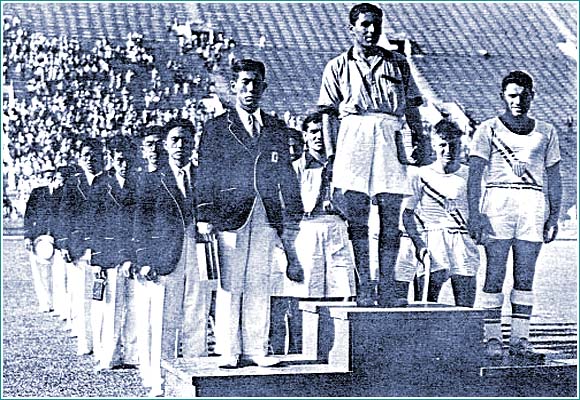
Photograph Courtesy : Stan
Salazaar's Hockey Library
he Photograph of
the Month for May features the 1932 Olympic gold medal winning Indian hockey team.
Shown on the victory stand is the captain of the Indian team, Lal Shah Bokhari. He
would later join the newly
created country Pakistan in 1947, and serve as its ambassador to Sri
Lanka.
Wrote one Los Angeles newspaper on the Indian team's superiority, "The All-India field hockey team which G. D. Sondhi brought to Los Angeles
was like a typhoon out of the east. They trampled under their feet and all but shoved out of the Olympic stadium the eleven players representing the United States."
The venerable Los Angeles Times wrote, "The Americans looked liked a junior team and were disjointed. The Indian forwards made lightening flashes, and both Dhyan and Roop were an inspiration to the side."
A cartoon published in the Evening News of India showed Dhyan Chand's stick in the form of a cobra, and Dhyan Chand whistling in front of it like a snake charmer.
The Viceroy of India sent a cable congratulating the Olympic champions. It read, "I am delighted to learn of the splendid victory of our hockey team. Please give all members of the side my warm congratulations upon retaining the world championship."
|
| Money Matters |
| Media Matters |
ndia's
national sport of hockey
may finally get its rightful place on Indian television. The IWHF is said
to have entered into a contract with Doordarshan whereby it will pay Rs. 3 lakhs as
telecast fees for every women's international
match played by India in India.
According to stick2hockey.com,
the India-USA best-of-three series is supposed to be the first
international engagement to be covered by this new contract. The website
reported that Sports Minister Uma Bharati is supposed to have taken up the
cause with the Information and Broadcasting Minister Smt. Sushma Swaraj.
In other television news, a newly launched Sharjah-based sports
channel called Ten Sports, has bought
hockey television rights from the International Hockey Federation. Ten Sports has secured the hockey rights for the Indian subcontinent,
to be later sold to interested parties of the region.
The tournaments covered by the agreement include the Men’s Champions Trophy (Cologne), Men’s and Women’s
Champions Challenge Cup (Harare), and the Olympic qualifier hockey
tournament.
Ten Sports is part of the Sharjah-based Cricketers Benefit Fund Series,
which has hosted a record 191 (and counting) one day international matches
in Sharjah. These matches played a critical role in raising the profile of
cricket in the Indian subcontinent, with their live television coverage,
exciting match results, huge cash payments to the participating cricketers,
and as a bonus, film stars in the stands to provide more glamour and glitz.
Mr. Abdul Rehman Bukhatir is the Chairman of Ten Sports, while Chris
McDonald is the Chief Executive. We hope that Ten Sports and Abdul Rehman Bukhatir
will do for
hockey what they did for cricket, thus raising the profile of this second
most popular sport in the Indian subcontinent.
|
| Visitor of
the Month |
D. N. Sinha is this edition's Visitor of the
Month. He recalls a nostalgic occasion from his life when he saw Hockey
Wizard Dhyan Chand.
This occurred more than half a century ago, sometime around
independence. I was studying intermediate then. I was returning from an
inter-university athletics tournament somewhere in central India (Jabalpur
or Bilaspur).
When the train halted in Kharagpur, I happened to see posters for
a match later that evening between an Army team led by Dhyan Chand, and
an Anglo-Indian team (or maybe Bengal Nagpur Railway team) from Kharagpur.
Even though my final destination was Visakhapatnam, I got down
from the train at Kharagpur. I made my way to the Railway ground and had
the immense satisfaction of seeing the Wizard in action. I do not recall
the final result, though I remember that there were around 20,000
spectators for the match. Dhyan Chand also gave a solo exhibition of his
stickwork on the special request of his fans.
I did not have any money to go back home to Visakhapatnam. It so
happened that one of the persons in the stadium was a guard on the night
train leaving for Visakhapatnam. He accommodated me in the guard's compartment for the journey back home.
That remains the only occasion when I saw Dhyan Chand. I treasure
this memory of Dhyan Chand from a bygone era of Indian sports when India
ruled the hockey world and his very name used to draw crowds to the
stadium.
|
| Fun With Numbers |
he first ever
foreign tour by any Indian sports team was the 1926 tour of New Zealand by
the Indian Army hockey team. This was followed by another tour of New
Zealand in 1935. India's record in these tours was as follows:
| Year |
Played |
Won |
Drew |
Lost |
Goals
For |
Goals
Against |
| 1926 |
21 |
18 |
2 |
1 |
192 |
24 |
| 1935 |
48 |
48 |
0 |
0 |
584 |
40 |
This 1926 Army tour started India's hockey story, and with it, Dhyan Chand's legendary prowess. Dhyan Chand
burst onto the world hockey scene that year by scoring over 100 goals on
India's debut tour.
In the 1935 tour of New Zealand, Dhyan Chand scored a massive 201 goals in just 43 matches, a possible world record.
Decades later, when Dhyan Chand's son Ashok Kumar toured New Zealand, an old goalkeeper on a wheelchair met him. He told Ashok, "Your father was a marvel. I saved his first shot at goal by diving full length to my right. The second shot at goal was far to my left. I dived and saved yet again.
Then Dhyan Chand said - if you save my next shot, I will stop playing hockey. True to his word, on his next possession, Dhyan Chand hit a scorcher right over my head to the centre of the net. The gap between my head and the bar was very little but the ball went
through into the goal."
|