| Where is
Hockey Positioned in Indian Television's Non-Cricket Mix? |
 ow can
the Indian Hockey Federation (IHF) position the game among the non-cricketing sports
mix on Indian
television? Even in the case of cricket, how will hockey fare against
non-Indian cricket on television? ow can
the Indian Hockey Federation (IHF) position the game among the non-cricketing sports
mix on Indian
television? Even in the case of cricket, how will hockey fare against
non-Indian cricket on television?
As Navroze Dhondy, Director at Percept IMC, put it:
"Every big country has at least three major sports; India is the only aberration
in the world. There is space in India for at least two more sports to get a big chunk of the business and
fan following. And companies can invest small amounts and get huge returns."
Thus, McDowell endorses two football clubs (Mohun Bagan and East Bengal) and recently sponsored
a 4-cities, 45-days, inter-club Signature golf tournament. The Tata group, which signed on
racing car driver Narayan Karthikeyan in early 2002, is also the title sponsor of the
$400,000 ATP Series Tata Open.
Says Peter Hutton, Vice-President at Taj Television Ltd.,
"Certain sports are above non-Indian cricket in terms of viewership. You compare the ratings of WWE or World Cup
soccer with non-Indian cricket, and the value for money becomes very clear."
Some figures to back up the above statement are given below:
According to TAM Media Research TV ADEX, the share of cricket in total sports programming
revenue was 65% in 2000, and fell to 56% in 2001. Therefore, at least in
the non-cricket World Cup years, other sports cumulatively bring in
revenues comparable to cricket.
In 2001, the share of football in the total programming revenue was 7%,
tennis 6%, car/bike racing 4% and golf 3%. Figures for hockey were not
available.
The IHF has to focus on four possible revenue streams - television rights, advertising spends,
team/tournament sponsorships and player endorsements.
For instance, the IHF can market its proposed National Hockey League (both men AND women,
please) to the new television channel TEN Sports (reach 22 million homes). It is unimaginable that hockey in India would command a lesser
audience than the Go-Karting, road racing, bowling, boxing and non-Indian
women's tennis and Ryder Cup presently shown on TEN.
If not TEN, then how about ESPN-Star Sports? 17 Formula 1 races are telecast live
every year on ESPN-Star Sports, a sport that is non-existent in India
beyond the television screen. The IHF should be able to pitch an
equivalent package of hockey to ESPN - i.e., telecast rights of at least
the finals of the 4-nation tournaments, continentals Cups, international
test series, national championships, etc. in a calendar year.
On ESPN, advertisers on just the English Premier League matches alone include Samsung, Birla AT&T, Pepsi, Fiat, Exide, Onida and TVS.
These sponsors may be as interested in a homegrown Indian NHL than a foreign
league, provided the stars are marketed well and the league is packaged
attractively for fans, advertisers and television.
Also, the IHF has to get more savvy with using superficial marketing lingo in the
English language. For example, the Tata Group is sponsoring tennis
($400,000 Tata Open) and motor racing (Narayan Karthikeyan) because,
according to a Tata spokesman, both sports are regarded as 'universal, youthful, fast and aggressive'.
For marketing Titan's FasTrack range, the company picked motor racing since the sport conveys the idea of
'working hard, partying hard'.
This is nothing but packaging of sport - even chess can be marketed
as 'universal, youthful, fast and aggressive'. The IHF would need an
intermediate sports marketing agency (IMG, Leisure Sports Management, etc.) that would present
an upbeat image of hockey to the advertisers.
Note that Rs. 1,200 crores were poured into cricket for the 2002-03
season by companies such as Pepsi, Hero Honda, LG, Bharti and ICICI. Can
the IHF set a target of at least Rs. 1 crore per year to be spent by
various corporates on hockey - i.e., 1/1000th of the money that goes into cricket?
Football, tennis, motor racing and golf are growing in popularity with
the sponsors, partly for sporting and partly for marketing reasons. Unless the IHF gets its act together, hockey will be
reduced to just a blip on the radar screen of non-cricketing televised
sports of India. First out of sight, and then out of mind of India's
sports fans.
Facts and Figures taken from an Article by
Rina Chandran for Business
Line (November 28, 2002)
|
| Hockey
in the Chota Nagpur Plateau of India |
 he
remote Chota Nagpur region of Jharkhand, home to about 30 different tribes
like Santhal, Munda and others, is a hotbed of hockey in India. Hockey is
as popular in the Chhota Nagpur region as football is in West Bengal. he
remote Chota Nagpur region of Jharkhand, home to about 30 different tribes
like Santhal, Munda and others, is a hotbed of hockey in India. Hockey is
as popular in the Chhota Nagpur region as football is in West Bengal.
Little girls playing impromptu hockey with bamboo sticks and kendu
balls are a common sight in remote forest villages like Khunti and Simdega.
And, thousands throng makeshift stadiums every Sunday to watch local
matches, popularly called 'khashi-murga' matches. And guess what are
the prizes - a khashi (goat) for the winner and a murga
(chicken) for the loser.
The whole Khunti-Simdega region is full of talented hockey players.
Sadly, such genuine talent often goes unnoticed and uncared for.
Take Karuna Purti's case, for instance. She has played for Bihar, Air India,
North-Eastern Railway and Bihar Police. But now, she sells jungle
wood in Khunti for her living. Reminds Biswasi Purti, who represented
India in the 1986 Asiad, "Like Karuna, there are so many others for whom life is yet
another liability to live on. How can we forget that this is the state where
the great Gopal Bhengra was cutting stones in mines
until he was spotted by the media?" A glaring instance of neglect
is the Krida Balika Vikas Kendra, part of the Bariyatu Government Girls
High School complex. The centre trains tribal girls in hockey besides educating
them, and provides
accommodation to the trainees in half-a-dozen hostel rooms. The centre was established in 1976, with an earmarked budget of Rs.
350 per player per month (later raised to Rs. 600 in 1998). The money from
the state government never comes on time. Successive principals of the
school, at times, had to pay up from their own pockets. Surprisingly,
the centre does not even have a full-time coach for the girls. Also, the
trainees have to buy their own sticks, boots and jerseys.
The diet served in the centre is meagre by any standards. After a
morning training session from 5 am - 8 am, they are served two slices of
bread with a cup of tea as breakfast before they go to school. A bowl of
rice and dal serves as their lunch, before their next training session at
3 pm. In the night, the girls are served two chappatis with dal as dinner.
Says trainee Sushma Horo, "We often feel weak while training.
Sometimes we collapse on the ground, but who cares? We stand up after
sometime on our own and start playing again."
Adds Mukti Tirkey, her friend: "During rains we pass the whole
night huddled together in a corner of the room. There is no other option
because the roofs of our hostels leak. There is just one tap for drinking
water in the entire hostel. Even the single toilet given to us is never
cleaned and it stinks like anything. And then, the mosquitoes. But there
is no one to take care of all these things for us."
Back in 2000, 20 trainees had to leave the centre due to lack of funds.
The budding stars of Indian women's hockey were forced to go back to their
villages in the deep forests and the surrounding mountains of the Chota Nagpur
plateau.
"We were told to either meet the expenses or make our own
arrangement. What could we do? We left everything behind to work as daily
wage labourers in the fields," said Reshma Minjur, who left the
centre with two other friends.
Since this country does not know
how to take care of its hockey players, the game is dying a slow
death in the Chhota Nagpur jungles. The cradle itself is doubling as a grave.
Article by Amarnath Tiwari of Outlook
magazine (October 9, 2000)
|
| Neglect
of 1978 World Cup Teammates Gopal Bhengra and Dung Dung |
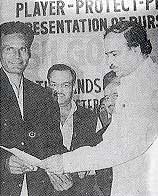
Photograph Courtesy The
Golden Boot
 ack
in 1999, there were reports in the press and television that Gopal Bhengra was working as a stone crusher in Churgi quarry, Ranchi
district, for a daily wage of Rs. 30 to Rs. 40 (less than $1), in order to
support his wife, 3 sons and 2 daughters. ack
in 1999, there were reports in the press and television that Gopal Bhengra was working as a stone crusher in Churgi quarry, Ranchi
district, for a daily wage of Rs. 30 to Rs. 40 (less than $1), in order to
support his wife, 3 sons and 2 daughters.
Gopal Bhengra, who hailed from Uyur Guria, Ranchi district, Jharkhand,
had an illustrious hockey career in which he played full-back for Army Service Corps,
Bangalore, captained Mohun Bagan in the
Kolkata league, and represented India in the 1978 World Cup.
When cricket legend Gavaskar came to know of
Bhengra's plight from a news magazine, he quietly sent a
monthly donation of Rs. 1000 from his own pocket. Following Gavaskar's example, tennis star Mahesh Bhupathi also
sent Bhengra Rs. 500 per month.
Then the hockey players came together under a scheme called
'Players-Protect-Players'. Coach M. K. Kaushik and 13
members of the victorious Bangkok Asiad hockey team contributed Rs. 11,000
each, for a total purse of Rs. 1,54,000 (the 3 exceptions were Ashish Ballal, Mukesh Kumar and Thirumala Valavan).
The Ministry for Youth Affairs and Sports chipped in with Rs. 50,000.
"Inspired by the players, coach and the media, the Government joins
you with its own contribution," said the Union Minister for Culture,
Youth Affairs and Sports, Mr. Anantha Kumar, on that occasion.
Instead of giving all the money in a lumpsum, the Rs. 200,000 was put
in a fixed deposit, with Bhengra getting Rs. 2,000 every month. For his immediate needs, Lions Club of Bengali Market, Delhi, gave
Bhengra Rs. 65,000.
The Bihar government stepped forward and gave Bhengra a temporary
coaching job at the S. S. High School, Khunti, Ranchi. The job was for a
10-month duration, and earned him Rs. 3,000 per month.
Fast forward to 2003. Gopal Bhengra's 1978 World Cup teammate Dung
Dung is surviving on a monthly pension of Rs. 2,500 to support his family of
5 dependents.
The former master craftsman begs: "For the time being, I shall be happy to coach even a school team as it will supplement my meagre
income. My only request to the Jharkhand government and the Indian Hockey Federation is to utilise my experience. This would benefit the youngsters and give me a new lease of life as
well."
Reader Ishwar Murthy speaks
for all Indian hockey fans in his email:
I would like to help Sylvanus Dung Dung by giving him some money.
Some may argue that this is merely a knee-jerk reaction, a temporary
fix, and that a better solution is to find him a coaching job,
etc.
I would agree with that point of view. However, that can also
be used as an excuse for not doing anything. Mr Dung Dung is in penury.
And if nothing is done, we may just lose him. Hence, I feel the urgency
of Indian hockey fans needing to help this gentleman out.
Many of your readers who have stated that they would like to help
hockey, might want to help Sylvanus. Well, here is the chance. The
reason for my writing to you is to see if you could set up an account to
which those interested can send money to.
Of course, the next task is to try and locate Mr. Dung Dung. I believe
the author of that article on Rediff was Mr. Ramanujam. I wrote to him and
to Rediff asking for Dung Dung's address and telephone number.
Perhaps we may have better luck if we post this appeal on the website.
Best wishes, Ishwar Murthy
Let's all pitch in and help locate
Sylvanus Dung Dung, and give him a honourable way to earn a living. That's
the least one can do for a player who won the Olympic gold medal for
India.
|
| Do We
Need This Farce Of A Selection Committee? |
 akistan's
hockey great Hassan Sardar has called for the hiring of professional coaches and
abolishing the selection committee in Pakistan. akistan's
hockey great Hassan Sardar has called for the hiring of professional coaches and
abolishing the selection committee in Pakistan.
Hassan said once a professional coach was hired, it would automatically make the selection committee redundant, as the trainer would be responsible for the selection of the squad.
"If the Europeans do not have selection committees, it is because they have professional coaches. The
concept of a selection committee is related to the concept of a honorary coach. If we have a professional coach, it will reduce the importance of the selection committee," he
emphasised.
Hassan said only a professional coach could be answerable and under obligation to produce
results. Regarding the selection committee, Hassan felt that if it cannot
be done away with, then it should at least consist of paid selectors who
should be obligated to visit the training camps, and not just the 2-day or
3-day trials.
"The Pakistan Hockey Federation should make sure all the selectors come to the
camps and thus be made accountable for the team selection. If the selectors
cannot do justice to their job, they should quit," he remarked.
Even in India, the concept of a selection committee in India is a farce
primarily because Gill, sitting in Delhi, exercises veto power on the team
selection.
For an example, refer to this following exchange, quoted verbatim,
between Gill (in Delhi) and the then chief coach M. K. Kaushik (in
Bangalore) on the Indian team selection for the 1998 Commonwealth Games.
This extract is from the book 'The Golden
Boot', written by M. K. Kaushik
and Shanti Kumar Arumugam.
Gill: I direct you to send Sanjeev Kumar back. You give me
three alternate names.
Kaushik: Sir, he fits into my game plan very well. He scored two goals in today's match. You can also take the opinion of the other two coaches. Sir, Sanjeev is in my first eleven.
Gill: No, no. I don't want to talk further on this topic. Sanjeev is a blind man. How can you put him in this game.
Kaushik: He is not playing for the country for the first time. He has played many important tournaments. His eyesight is not a sudden problem. I discussed this with you during the trials. You also spoke to the doctors.
Gill: You are cheating, I did not expect this from you.
Kaushik: If you feel, sir, that I am cheating you, I am prepared to leave the camp.
Gill: You cannot do that. I order you to send Sanjeev back. I will give you his replacement. You carry on. This is my order.
At this stage, Gill cut the line, leaving Kaushik red-faced, tense and hurt.
Sanjeev was given a ticket and told to go home.
With authoritarian non-hockey officials like K. P. S. Gill pushing our national
hockey coaches around, why do we need
this farce of a 'Selection Committee'?
|
| Pakistan's
Hockey Loving Prime Minister Jamali |
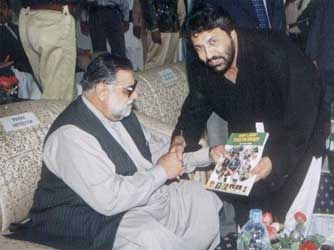
Pakistan's prime minister Jamali with journalist
Sardar Khan
hings are
looking good for Pakistan hockey under Prime Minister Mir Zafarullah Khan
Jamali, a former first class hockey player, two-time
chief selector for the Pakistan national hockey team, and now the
ex-officio patron in-chief of the Pakistan Hockey Federation (PHF).
Jamali has restored the sports quota, and public sector companies have be
instructed to form sports teams and start offering employment on the basis of sports.
Their national carrier Pakistan International Airlines has restored the discounted,
sometimes almost free, air tickets for internationals. The PHF's request for synthetic turfs, financial support and other facilities
will be fully addressed.
Jamali was the chief guest at the prize giving ceremony of Pakistan's golden jubilee
national hockey championship, probably the first time a serving prime
minister was the chief guest at any nationals.
By virtue of the prime minister's presence, the nationals attracted a wealth of sponsors. The winners
(WAPDA) got Rs. 75,000, runners-up Rs. 25,000, and the third position holders
Rs.15,000. Even the officials were honoured, with the coaches of the winners and
runners-up getting a cash prize of Rs. 25,000 and Rs.15,000, and the
winning and runners-up managers getting Rs. 15,000 and Rs. 10,000 respectively.
Sohail Abbas drove away in a brand new Suzuki Mehran car, sponsored by Dawlance, after being selected as the best
player in Pakistan's golden jubilee national hockey championship. This is
unheard of in the Indian context, of the best player in the nationals
being awarded a car. The closest one can remember is that the best player
of the 1998 Chennai women's nationals, Seeta Gossein, was awarded a cycle.
In his speech at the prize giving ceremony, Jamali said that his government will give sports its due importance as "this was one field which contributes heavily towards the healthy progress of any
society," and then added, "With all due respect to other sports, hockey will be on the top of my priority list."
|
| The Lure
of Foreign Hockey
Clubs and the IHF's Response |
 n 2002,
Malaysia's Chua Boon Huat was playing for his club Sapura in Malaysia's
National Hockey League (MHL), when he got an offer from the German
Bundesliga's Rott und Weiss, Munchen. Though he had already played two
matches in the MHL, his club was far-sighted enough to release him to play in the German league. n 2002,
Malaysia's Chua Boon Huat was playing for his club Sapura in Malaysia's
National Hockey League (MHL), when he got an offer from the German
Bundesliga's Rott und Weiss, Munchen. Though he had already played two
matches in the MHL, his club was far-sighted enough to release him to play in the German league.
Malaysia's National Sports Council director general Datuk Wira Mazlan Ahmad
has encouraged this trend. "I am all for sending Malaysian players on attachments with German clubs, and will get Paul
Lissek to arrange matters with the clubs. We sent players to Germany in 1997 and 2002,
and the experience gained was evident."
Mazlan had the following to say to the Malaysian clubs, "The stint
abroad will benefit the players in the long run, and is an investment the club should undertake.
After all, the players will probably miss only two weeks of the MHL should they decide to play in
the German hockey season from April to June."
K. Logan Raj, Chua Boon Huat and S. Kuhan may play in Germany this
year, with the latter having received an offer to play for Hamburg HC.
Contrast the Malaysian scenario with the short-sighted approach of the
IHF bureaucratic babus.
Back in 1999, when Mukesh Kumar signed an 8-week contract to play
in the MHL (September 4 - October 24), IHF secretary Kandaswamy
wrote to the Malaysian Hockey Federation and forced the recall of Mukesh.
IHF vice president Balakrishnan remarked that the Indian Airlines management
(Mukesh's employer) has not taken to this kindly
as 'greed is getting the better of such players'.
It only showed that the IHF was being run by a bunch of clerks. Players accepting offers from foreign clubs is a fact of modern sports.
This is true of cricket, of football, of basketball, and should be true of
hockey too. This applies to players, and this applies to coaches too.
Just one example from world sports will suffice. The 2002-03 National Basketball Association (NBA)
season in USA features 66 foreign players from 34 countries, with 27 of the 29
teams having at least one foreign player. The
star foreign import in this year's NBA, Yao Ming of China, is
single-handedly responsible for a hundred-fold increase in NBA's television
viewership in China.
As long as India does not have a professional national hockey league of
its own, it is the duty of the IHF not to stand in the way of talented
players who get offers from foreign leagues.
|
| DAV
College (Jalandhar) Wins Nehru Champion Colleges Tournament |
he
10th Nehru
Champion Colleges Hockey Tournament, sponsored by Oil and Natural Gas
Commission, was held at the Shivaji Stadium in Delhi from February 11 to
February 20.
Two Punjab colleges - Dayanand Anglo-Vedic College, Jalandhar, and
Brijendra College, Faridkot, reached the final, with the following match
results:
| Date |
DAV College |
Brijendra College |
| Feb 16 |
beat Kirori Mal College 9-0 |
|
| Feb 19 (semis) |
beat Jamia Millia 5-4 (TB) |
beat St. Joseph's College 4-3 (TB) |
In the final played on February 20, DAV College overwhelmed Brijendra
College 6-1 to win the Champion Colleges tournament. Brijendra College
clearly felt the absence of its key striker Buta Singh, who was red-carded in the semifinal
for starting a brawl.
Earlier, in the third place playoff, St. Joseph's College (Bangalore) defeated
defending champion Jamia Millia Islamia (Delhi) 2-1.
|
| Kolkata
Retains All-India Major Ports Hockey Title |
he 24th All-India Major
Ports hockey tournament was held at the Visakhapatnam Port Trust Stadium
from February XX to February 17.
Kolkata Port Trust and Mumbai Port Trust reached the final, with the
former beating Tuticorin 3-0 in the first semi-final played on February
16, while Mumbai beat hosts Visakhapatnam 3-2 via the golden goal in the
other semi-final.
In the final played on February 17, Kolkata Port Trust retained the All-India Major
Ports hockey title beating Mumbai Port Trust 6-5 in sudden death.
With the full time ending goalless, the tie-breaker was introduced, which also ended in a stalemate with both converting all the five penalties.
In sudden death, Kolkata's Mukti Prakash's first stroke was blocked by the goalkeeper,
but Mumbai's Azad Khan scooped out. In the next set of strokes, Prakash Thopo put Kolkata ahead finding the target, while Mumbai captain Abhijit Shrishat's
push went past the right post by a couple of inches, handing Kolkata the
title.
Host Visakhapatnam again finished third, beating Tuticorin 3-0 in the losing semifinalists' match.
Iqbal Singh Rahal of Kolkata was adjudged as the best player and best forward of the tournament. John Kennedy Shazan of Tuticorin was the best goalkeeper, Ch. Dastagiri Basha of Chennai was
the best half-back, G. Srinivas of Visakhapatnam was best full-back, while
Paradeep Port Trust received the best disciplined team award.
|
| Photograph
of the Month |
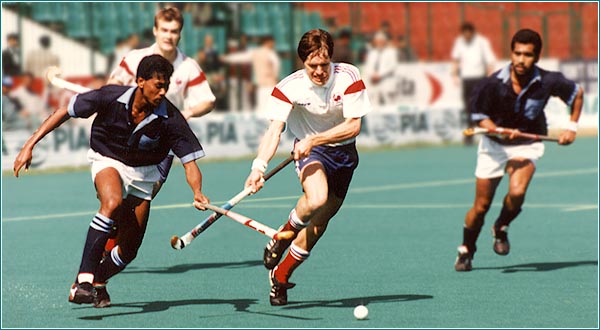
India-France 1990 World Cup Match (Photograph
courtesy Christophe Prat)
he Photograph of
the Month for March features the 1990 World Cup match between India and
France. In a stunning upset, France beat India 2-1 to register its only
World Cup victory over India.
India lost despite having stars like Pargat Singh, Ashish Ballal, Jude
Felix, Jagbir Singh, Thoiba Singh and Dhanraj Pillai in the team. The two
Indians in the photograph are Ajeet Lakra (left) and Ashok Kumar, both defenders.
The two Frenchmen in the picture are Timothee Delavenne (foreground) and
Jean Louis Ponthieu (background).
France finished 7th in the 1990 World Cup, while India ended up a shocking 10th.
Coach M. P. Ganesh was sacked following the debacle.
|
| Money Matters |