| Hero Honda World Cup Lessons Learned - Continental Divide |
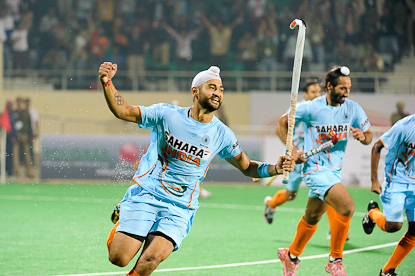
Photograph by Stanislas Brochier for the FIH
 he following are Observations and Lessons Learned from the Hero Honda World Cup, with respect to the growing divide between India and the rest of the hockey world. Trending data from prior Word Cups has been taken into account in the analysis below. he following are Observations and Lessons Learned from the Hero Honda World Cup, with respect to the growing divide between India and the rest of the hockey world. Trending data from prior Word Cups has been taken into account in the analysis below.
India vs. the Continents
- In the 2002 World Cup, India were winless against 2 continents - Asia (JPN, KOR, MAL), Oceania (AUS, NZL)
- In the 2006 World Cup, India were winless against 3 continents - Asia (KOR), Europe (GER, ENG, NED), America (ARG)
- In the 2010 World Cup, India were winless against 4 continents - Europe (ENG, ESP), Oceania (AUS), America (ARG), Africa (SAF)
Over the last 3 World Cups, India has been progressively unable to claim hockey mastery over all the hockey playing continents in the world.
Losing Streaks
- In the 2002 World Cup, India went winless for 4 games in a row
- In the 2006 World Cup, India went winless for 6 games in a row, winning only 1 match in the entire tournament
- In the 2010 World Cup, India went winless for 5 games in a row, winning only 1 match in the entire tournament
While defeats are to be expected at this level, India does not have the ability to immediately follow up a defeat with a victory.
Acknowledge the Problem
- Over the last 32 years (1978-2010) India won 0 medals in 0 semi-final appearances over 9 consecutive World Cups
- Over the last 32 years (1978-2010), Australia won 8 medals in 9 semi-final appearances over 9 consecutive World Cups
- Over the last 32 years (1978-2010), Germany won 6 medals in 9 semi-final appearances over 9 consecutive World Cups
Two generations of Indians have grown up without knowing what it means to win any World Cup medal - gold, silver or bronze.
Senior-Junior Transition
- Australia, Germany and Netherlands were the medal winners of the 2009 Jr. Men's World Cup
- Australia, Germany and Netherlands were the medal winners of the 2010 Sr. Hero Honda World Cup
- Australia, Germany and Netherlands have won 7 of the 9 FIH Jr. Men's Player of the Year awards
- Australia, Germany and Netherlands have won 11 of the 12 FIH Sr. Men's Player of the Year awards
India needs to develop a strong junior programme, and a structured transition from the junior to the senior ranks.
Lack of Offensive Power
- In the 2010 World Cup, the following countries scored 6+ goals in a match - AUS (12), KOR (9), GER, NED, ENG (6)
- In the 2006 World Cup, the following countries scored 6+ goals in a match - AUS (7), NED (6)
Over the last 2 World Cups, India did not have a single breakout game where they had a tennis score (6+) of goals. Over the last 24 years (1986-2010), no Indian has scored the maximum goals in a World Cup tournament.
-----------------------------------
Given all of the above background, it was not surprising that India over-promised and under-performed to finish 8th in the 12th Hero Honda World Cup, held at the Major Dhyan Chand National Stadium in Delhi from February 28 to March 12. India's match results were as follows:
| Date |
Match |
Goal Scorers (India) |
| Feb 28 |
India 4 - Pakistan 1 |
Shivendra Singh (27 m), Sandeep Singh (35,57 m), Prabhjyot Singh (37 m) |
| Mar 2 |
Australia 5 - India 2 |
Vikram Pillai (35 m), Rajpal Singh (53 m) |
| Mar 4 |
Spain 5 - India 2 |
Sandeep Singh (39 m), Gurvinder Singh Chandi (43 m) |
| Mar 6 |
England 3 - India 2 |
Gurvinder Singh Chandi (54 m), Rajpal Singh (58 m) |
| Mar 8 |
India 3 - South Africa 3 |
Sarvanjeet Singh (17 m), Divakar Ram (24 m), Shivendra Singh (66 m) |
| Mar 12 |
Argentina 3 - India 2 |
Sandeep Singh (42 m, PS), Shivendra Singh (49 m) |
The final standings were: 1. Australia, 2. Germany, 3. Netherlands, 4. England, 5. Spain, 6. South Korea, 7. Argentina, 8. India, 9. New Zealand, 10. South Africa, 11. Canada, 12. Pakistan
The following were the Hero Honda World Cup awards given:
- Player of the Tournament: Guus Vogels (NED)
- Goalkeeper of the Tournament: Guus Vogels (NED)
- Defender of the Tournament: Maximilian Mueller (GER)
- Top Scorer: Luke Doerner (AUS) and Taeke Taekema (NED), 8 goals
- Fair Play: New Zealand
|
| Hero Honda World Cup Lessons Learned - Television Coverage |
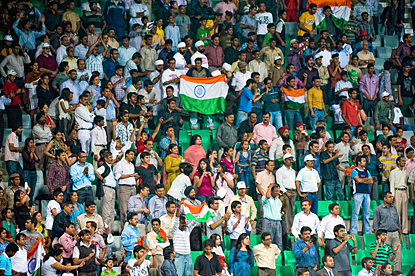
Photograph by Alex Masters for the FIH
he following are the Observations and Lessons Learned with respect to television coverage of the 12th Hero Honda World Cup.
Global Television Footprint
The Hero Honda FIH World Cup was viewed live on all 6 continents, by the following portfolio of broadcasters:
- Asia - Ten Sports, Doordarshan, Pakistan Television, Astro Super Sports, Starhub, Showtime
- Europe - Zee United Kingdom, NOS, Sport 1, Teledeportes, Sport Digital
- Oceania - Fox Sports, Sky Sports
- North America - CricketPlus
- South America - ESPN Sur
- Africa - SuperSport
In terms of households, and reach (calculated at 5 per household), the following are the numbers:
- Ten Sports - 10 million households, 50 million reach
- Pakistan Television - 17 million households, 85 million reach
- Doordarshan - 110 million households, 550 million reach
When the final numbers come in, the Hero Honda World Cup will be the highest watched hockey tournament in history.
Ad Inventory
Ten Sports sold close to 100% of its ad inventory for the tournament. Unlike cricket, there was no sponsor clutter, and brands got the exclusive visibility they were looking for. The following were the sponsored slots on Ten Sports:
- Hockey Legends, sponsored by Hero Honda
- Fan of the Day, sponsored by Hero Honda
- Man of the Match, sponsored by Hero Honda
- Man of Steel, sponsored by Steel Authority of India Limited
- Celebration Moments, sponsored by Coca Cola
- Blazing Goals of the Day, sponsored by MTS India
- Power Player of the Day, sponsored by Musli Power
- Street Talk, sponsored by Nokia
- Player Profile, sponsored by Seagrams
India alone contributes more than 50% of the FIH revenue, mainly from television rights and sponsorship deals.
Number of Cameras
Ten Sports has revolutionised the way hockey can be shown on television. Each World Cup match had ELEVEN television cameras, distributed as follows:
- 2 cameras on the centre-line, on either side of the field
- 2 cameras behind the goal posts, on either side of the field
- 2 cameras near each of the corner posts, on either side of the field
- 5 cameras along the 100-yard length of the field
The 2 cameras along the centre-line operated at 100 frames per second, and were used for super slo-mo footages. The remaining 9 cameras operated at the standard 25 frames per second. Footage from any of the cameras could be shown on the giant video screen in the stadium.
The Ratings Game
The viewership of the India-Pakistan match on the opening day equalled the viewership of the India-Sri Lanka cricket ODI matches in 2009. In fact, the India-Pakistan game is projected to be the most-watched single hockey game in history.
The following are the TAM television ratings associated with the Hero Honda World Cup:
- 2.02 TVR - India vs. Pakistan
- 1.93 TVR - India vs. Australia
- 2.13 TVR - India vs. Spain (must-win match for India, in order to qualify for the semi-finals)
Audience Demographics
For the first time in India, television viewers saw fathers and mothers and little kids and grandparents and college-age boys and girls, all enjoying a game of hockey in the stadium. Title Sponsor Hero Honda's television ad promoted hockey as a father-son family bonding moment.
Hockey had suddenly become a family viewing event, both in the stadium and on the television screens. The ratings for hockey did not fare too bad with the ratings for popular television serials during the duration of the World Cup, as seen below:
- 4.2 TVR - Uttaran (Colors)
- 4.2 TVR - Rahul Dulhaniya Le (Imagine)
- 4.5 TVR - Bidayi (Star Plus)
- 4.5 TVR - Pavitra Rishta (Zee Television)
The Hero Honda World Cup proved that sponsors, and viewers, will line up for top quality hockey, provided the following criteria are met:
- The event should feature India (e.g., no India in the Beijing Olympics, no television viewership in India)
- The event should be hosted in India (e.g., the 2006 World Cup, hosted in Europe, had minimal viewership in India)
- The event should feature national teams (e.g., unlike club-based PHL, the entire nation was following the team's fortunes)
Finally, it is important that we have good quality Event Managers for high-profile properties like the World Cup. Per a newspaper report, the FIH event manager, Tina Brullo, was rather curt during her interactions with members of the media, and even suggested that she was least bothered about the media coverage here. Who exactly is Tina Brullo, and why couldn't the FIH arrange someone local as the Event Manager?
|
| Hero Honda World Cup Lessons Learned - Coaches & Officials |
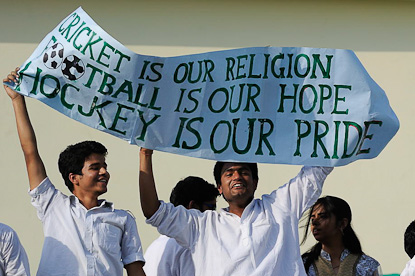
Photograph by Stanislas Brochier for the FIH
 et's get one thing straight. Among the 1.2 billion population of India, there is not a single Indian who can coach the national hockey team to the World Cup title. et's get one thing straight. Among the 1.2 billion population of India, there is not a single Indian who can coach the national hockey team to the World Cup title.
Indian coaches are not even the best in Asia, let alone the world. Indian coaches are good at writing articles in newspapers and giving analysis within the confines of television studios. But put them on the field, and it will be nothing but disaster for India.
Coach Ric Charlesworth was hounded out of India by short-sighted officials. The coach who took his place, Joaquim Carvalho, never allowed Charlesworth to interact with players. Charlesworth had won 1 World Cup (1986) and 3 Champions Trophy titles as a player, and could have provided valuable insight to the players.
The IHF, in utter foolishness, left Charlesworth stranded in Australia when the Olympic Qualifier was held in Chile. India, under coaches Carvalho and M. P. Singh, failed to take India to the Olympics for the first time in its history.
As IndianHockey.com put it: "I could never understand the arrogance of Joaquim Carvalho and M. P. Singh. Both these coaches had never won an Olympic or a World Cup medal, either as a player or a coach, and neither had any coaching qualifications to speak of. But both of them walked as if they owned the hockey world."
Now let's take a look at our ministers and politicians, masquerading as sports administrators and policy makers. After the India-Pakistan match on the opening day of the Hero Honda World Cup, a smug IOA president Suresh Kalmadi told a live international television audience "Brasa is better than Charlesworth".
12 days later, Charlesworth's boys were the kings of the world, and it was a sheepish Kalmadi who had to walk alongside the FIH president to present gold medals to Australian team.
Now to our Sports Minister, M. S. Gill. During the 2008 Junior Asia Cup in Hyderabad, when asked why Charlesworth was not present, Gill replied: "India has players whose houses are full of gold medals; they can be better coaches than Charlesworth, and we can pay them one tenth of what we pay to a foreigner."
Who made this fellow our Sports Minister? Who are these Indian coaches whose are supposed to be better than Charlesworth?
Charlesworth, the only person on this planet to coach both a women's team and a men's team to World Cup titles, has the following coaching record:
- 2 Women's Olympic Games gold medals (1996, 2000)
- 2 Women's World Cup gold medals (1994, 1998)
- 4 Women's Champions Trophy gold medals (1993, 1995, 1997, 1999)
- 1 Women's Commonwealth Games gold medal (1998)
- 1 Men's Champions Trophy gold medal (2009)
- 1 Men's World Cup gold medal (2010)
During the above time span, India did not win a single Olympic, World Cup or Champions Trophy medal, failed to qualify for the Olympics for the first time ever, returned medal less from the Asian Games for the first time ever, and returned medal less from the Asia Cup for the first time ever. The IHF changed 15 Indian coaches in 14 years, with zero results.
There is not a single Indian hockey coach, whether in men's hockey or women's hockey, whether in the past or in the present, who has the credentials of Ric Charlesworth. Gill, Kalmadi and their cohorts, are unable to, or unwilling to, accept this bitter truth.
As The Times of India put it, "Our sports officials are thick-skinned people, oblivious to the demands of the modern game of hockey, the desire of the fans, and the ethics of an administration that is supposed to be accountable to the tax-payers on whose money the game is run."
|
| Hero Honda World Cup Lessons Learned - Club/City/Country? |
Photograph by Getty Images, courtesy Times of India
 hould we popularise and promote Indian hockey by means of club teams, or city teams like the PHL/IPL, or by means of nation vs. nation contests? Let us examine each scenario. hould we popularise and promote Indian hockey by means of club teams, or city teams like the PHL/IPL, or by means of nation vs. nation contests? Let us examine each scenario.
Club Teams
Hockey clubs in the Indian context mean Public Sector Undertaking (PSU) teams. These Institutional teams are a uniquely Indian concept. For instance:
- Lufthansa and Quantas do not have hockey teams, we do (Indian Airlines, Air India)
- Shell and Texaco do not have hockey teams, we do (Indian Oil, Bharat Petroleum)
- Amtrak and British Rail do not have hockey teams, we do (Indian Railways)
- Bank of England and Deutsche Bank do not have hockey teams, we do (Punjab & Sindh Bank)
- New York Police Department (NYPD) and Los Angeles Police Department (LAPD) do not have hockey teams, we do (Punjab Police)
However, sports plays a very minor roles for these PSUs. These institutional hockey teams are used to provide employment through the sports quota, and participate in the domestic circuit of tournaments. Loftier goals like winning medals for the country are incidental.
The kids who pick up hockey in India are in many cases children of daily labourers, subsistence farmers, tribal foragers, mofussil clerks, petty shopkeepers, and some of the poorest of the poor in India. These kids look at hockey as a career option, to enable them to hold day jobs in the armed forces, paramilitary forces, police, railways, airlines, banks and PSUs. After their playing careers are over, the players settle into their jobs as junior commissioned officers, sub-inspectors, bank tellers, stewards and clerks, and melt into the vast Indian middle class.
The FIH wants to introduce a new property called World Club Championship, as early as December 2010. Given the background of hockey clubs in India (and also in Pakistan), a World Club Championship just does not make sense in the subcontinent. It is as unappealing as Lufthansa playing British Rail for the Euro Hockey League championship.
City Teams
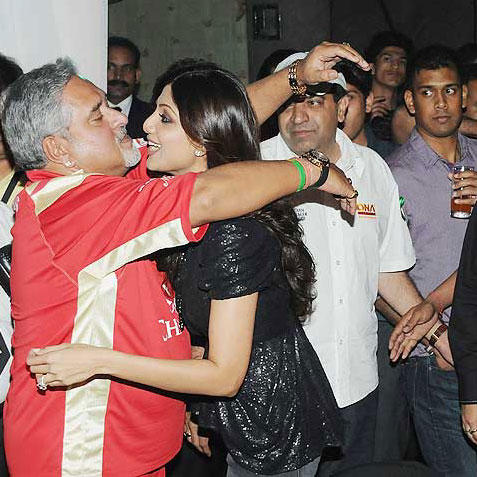
Take a close look at the picture above. It shows Vijay Mallya, the head of Kingfisher Airlines, named after one of his liquor brands. He also owns an IPL team called Royal Challengers Bangalore (RCB), named after another of his liquor brands.
Mallya is an extremely successful and high-profile businessman, and is known for his lavish parties, multiple villas, range of automobiles, and his private yacht, The Indian Empress.
However, when it comes to cricket, Mallya has neither played cricket at the national or international level, nor has he coached cricket, nor has he served in any Selection Committee, nor has he been a Cricket Board administrator.
Mallya's connection with cricket is that he successfully bid for the Bangalore franchise in a private league of teams called the IPL. Ownership of teams in the IPL is mainly a business venture. The owners look at the IPL as a vehicle by which they can increase the brand valuations of their respective franchises. Players get hired and fired by virtue of the value they bring to the franchise.
In a league like the IPL, the sport is incidental. If the original format does not make good business sense (5 days of cricket), the league will play by its own rules (20 overs a side). If revenues start declining for even this format, the IPL, as a private league, can take a business decision to change the format to Ten10. No other league or tour or circuit in the world - NFL, EPL, NBA, AFL, ATP, PGA - changes the very core of its sport.
Think of the following analogy. Suppose we shorten the sport of golf from 4 rounds to one quarter of a single round of golf. i.e., a golf event will get over in 3 hours instead of 4 days of golf. If golfers happen to be tied after 3 hours, a Super Hole will be played as a tie-breaker. These 3 hours of golf will be played under floodlights (to telecast on prime time television) and cheerleaders will be introduced on the golf course. This may make great television, but it is no longer golf.
In the IPL, teams like RCB artificially bring together Indians and foreigners for 45 days to play as a 'team'. RCB is essentially a team of short-term contractors, temporarily united by money. The minute the IPL is over, there will be a spontaneous combustion, the RCB 'team' will disappear for the rest of the year, and all the players will go back to their actual real-world teams.
While fashion shows and designer clothes and brand ambassadors and television promotions will certainly catch people's attention, there is absolutely no national team building involved. If a top Indian player gets injured towards the end of the IPL season and is ruled out of the Twenty20 World Cup that immediately follows, it is of minimal or no consequence to RCB.
It is not possible, nor desirable, to replicate such a model in hockey. The Premier Hockey League, heavily subsidised by ESPN through 4 editions, has shown that it is difficult to have fan loyalties or sustain viewer interest for artificially made up teams and temporary player-team associations, that exist for a month of so every year. One cannot build up a hockey rivalry by 30-second television promotions.
The PHL died a natural death 2 years ago. God bless its soul, let it rest in peace, do not attempt to resuscitate it.
Nation vs. Nation Contests
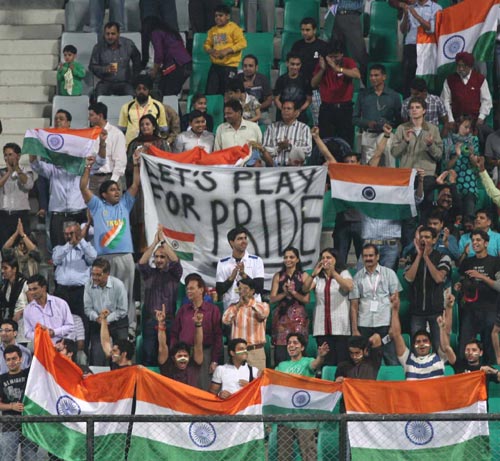
The fans in the stadium for the Hero Honda World Cup provided an interesting lesson. Whenever India played, the crowd ranged anywhere from 12,000 to 18,000 feet stomping, flag waving, and screaming fans. Before India's games, vendors were painting the Indian flag on people's faces for Rs. 25/-. National flags were being sold outside the National Stadium. The fans kept cheering the Indian team, through wins, draws and losses.
Hockey, more than any other game, is intrinsically associated with the concept of India as a nation. Hockey comes with a historical baggage that we cannot shake off, nor ignore in India. Asia's first Olympic gold medal was won by the 1928 Indian Olympic hockey team. The first Indian sports team to do a round-the-world tour was the 1932 Indian hockey team. The first sporting achievement of independent India was the 1948 Olympic hockey gold medal.
Only in hockey have India and Pakistan met in an Olympic final. Only in hockey have India and Pakistan met in a World Cup final. Hockey is the national game of both India and Pakistan, and a nation vs. nation contest between India and Pakistan is a natural rivalry that needs no television promotions to arouse the passion in the subcontinent's hockey fans.
Every World Cup will have a team that comes last, but when the Pakistani team came last in the Hero Honda World Cup, the entire team took moral responsibility and immediately retired from hockey. Such is the degree of emotion associated with hockey in the subcontinent.
Chak de! India, the blockbuster hit of 2007, was a movie about the women's hockey team of India, not of a club team or a city team. One of the more stirring scenes in the movie was when the girls lined up before the coach and announced their names, and then declared India as their place of origin, not their respective states.
Another point to note - the PHL had significance and relevance to only India and Pakistan, and was telecast in only these regions. On the other hand, the Hero Honda World Cup, featuring official international matches between country teams, had global relevance and following, and was telecast live on all 6 continents. Therefore, if you want to bring in the fans to the stadiums in India, as well as bring in television viewers worldwide, focus on nation vs. nation contests, not club or city competitions.
|
| Hero Honda World Cup Lessons Learned - The World Series |
Photograph from T. Narayan's Blog
et's summarize the observations and lessons learned from the Hero Honda World Cup.
- Continental Divide: India was winless against 4 continents in the 2010 World Cup - Europe, Oceania, America and Africa
- Winless Streaks: India had a 6-game winless streak in the 2006 World Cup, and a 5-game winless streak in the 2010 World Cup
- Acknowledge the Problem: Over the last 32 years, India won 0 medals in 0 semi-final appearances over 9 consecutive World Cups
- Global Television Footprint: A hockey tournament featuring nation vs. nation contests can be telecast live on all 6 continents
- Ad Inventory: It is possible to sell close to 100% of ad inventory, for nation vs. nation telecasts featuring India, and hosted in India
- Jr. Programme: Australia, Germany, Netherlands first won medals in the 2009 Jr. World Cup, before winning medals in the 2010 World Cup
Keeping the above lessons in mind, how can we promote hockey in India, which has the largest number of players, fans, viewers, advertisers and sponsors. Also, how can we align with the strategic objectives of the FIH, which are as follows:
- Triple total revenue by 2016
- Introduce a new property called Hockey World Series by 2012
- Involve India more in international hockey
- Raise the world-wide level of play in hockey
To best position the proposed FIH World Series for success, the following need to be kept in mind.
- Duration: The Hockey World Series should have a 4-5 week duration; anything longer will not sustain audience interest
- Location: The Hockey World Series should be a multi-venue league, geographically spread out across India
- Format: To bridge the Continental Divide, the Hockey World Series should bring the world to India, one Continent at a time
- Calendar: Like Wimbledon, the Hockey World Series should have a fixed time slot in the international hockey calendar
- Age Group: Like Wimbledon, the Hockey World Series should operate both the Jr. and Sr. Series in parallel
- Gender Equality: Like Wimbledon, the Hockey World Series should operate both the Men's and Women's Series in parallel
The structure of the proposed Hockey World Series can be as follows:
- 4 Continents: Asia, Europe, Oceania, America
- 4 Levels: Jr. Women, Jr. Men, Sr. Women, Sr. Men
- 4 Nations: India vs. the top 3 of each Continent
- 4 Venues: one each from North, East, West and South India
- 4 Title Sponsors: one for each Continent
- 4 Weeks: within which all the Continental Series gets over, with the 5th week being World Series Finals week
The unique feature of this World Series is that in no other sport, in no other country, does a single nation simultaneously play against 4 continents at 4 levels (men's, women's, senior and junior) every year. Also, this is probably the only time Indian fans will see Olympic-class sports teams from non-Commonwealth countries like Germany, Spain, Argentina, Korea and China, none of whom play international cricket.
In all of 2009, exactly TWO hockey matches were shown live in India. Just imagine if only 2 T20 cricket matches were shown live in India in an entire year - such a scenario is unthinkable in Indian cricket.
This gender-equal (men, women), multi-level (senior/junior) globally telecast Hockey World Series will be a game changer for Indian and world hockey - an immersive hockey event featuring 4 Continents, 4 Venues, 4 Weeks, 64 Teams, 128 Matches and 192 Hours of Television Inventory every year.
| Venue |
Week 1 |
Week 2 |
Week 3 |
Week 4 |
Total Matches |
| North India |
Sr. Men (Europe) |
Sr. Men (Oceania) |
Sr. Men (Asia) |
Sr. Men (America) |
32 Matches |
| East India |
Jr. Women (Europe) |
Jr. Women (Oceania) |
Jr. Women (Asia) |
Jr. Women (America) |
32 Matches |
| West India |
Jr. Men (Europe) |
Jr. Men (Oceania) |
Jr. Men (Asia) |
Jr. Men (America) |
32 Matches |
| South India |
Sr. Women (Europe) |
Sr. Women (Oceania) |
Sr. Women (Asia) |
Sr. Women (America) |
32 Matches |
| Nos. of Teams |
16 Teams |
16 Teams |
16 Teams |
16 Teams |
64Teams/128Matches |
In short, this will be a win-win situation for all - the national men's teams, women's teams and junior teams of all continents, broadcasters, sponsors, advertisers, the huge Indian fan base and the global television viewing audience.
Hockey would have finally come home.
|
| Photograph of the Month |
Photograph and text courtesy SAIL4Sports.com
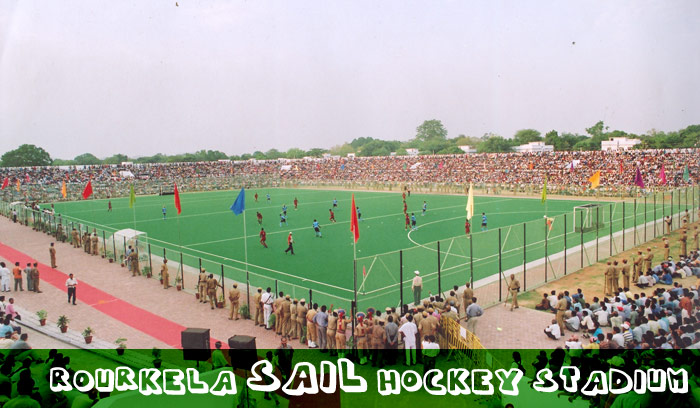
he Photograph of the Month for March 2010 shows a packed Biju Patnaik Hockey Stadium in Rourkela, in the heart of Orissa's tribal hockey belt. This hockey-only stadium was built by the Steel Authority of India Limited (SAIL), and fitted with artificial turf in June 2005.
Rourkela is in Sundargarh, where hockey is almost a way of life for the tribals. The locals have a natural affinity for the game, and many of them in the villages start playing the game with hockey sticks carved out from branches of trees.
The SAIL Hockey Academy was established in Rourkela in 1992, in order to impart specialised scientific training to the budding hockey youngsters of the area.
The Academy hosts 32 Cadets every year, who are provided training for a period of three years. The Academy provides free boarding and medical facilities, a monthly stipend, a balanced diet, furnished accommodation, education, and a state-of-the-art gymnasium to the selected trainees. These cadets are imparted coaching for 6 hours a day, 6 days a week, under the watchful eyes of expert coaches.
Dribbling, long and short passes, drag flicks, scooping, blocking and many such facets of contemporary hockey are taught to the cadets. The cadets also get to play in many important national-level tournaments, to provide them the much needed match exposure
Since 1992, a total of 202 Cadets have passed out, out of which as many as 150 have been recruited by various organizations like Indian Army, Indian Railways, CRPF, Seema Suraksha Bal (BSF), Orissa Police, Indian Navy, MECON, Bharat Petroleum, Govt. of Orissa, RSP etc.
Some of the achievements of SAIL Hockey Academy in the recent years are given below:
- u-21 Jr. National Hockey Championship, Jabalpur, November 2004 - 2nd
- u-18 Sub-Jr. National Hockey Championship, Guntur, April 2007 - Champion
- u-18 Sub-Jr. National Hockey Championship, Hyderabad, February 2008 - Champion
International players produced by SAIL Hockey Academy include Birendra Lakra, Jerom Lakra and Sushil Xalxo.
SAIL sponsors the annual Jawaharlal Nehru Champion Colleges hockey tournament every year. SAIL also was the Presenting Sponsor of the 2010 Hero Honda World Cup, and awarded the SAIL Man of Steel to the best defender in every match of the World Cup.
|
| Money Matters |
he following were the sponsors associated with the 2010 Hero Honda World Cup:
- Hero Honda - Title Sponsor of the World Cup
- Steel Authority of India (SAIL) - Presenting Sponsor of the World Cup
- Reebok - Official Apparel Partner of the World Cup
- Coca Cola - Official Beverage Partner of the World Cup
- Karbonn Mobile - Major Partner of the World Cup
- ING Life Insurance - Major Partner of the World Cup
- Sports Technology International (STI) - Official Pitch Supplier of the World Cup
Said Subhinder Singh Prem of Reebok India, "As a brand, we are rooted in the ideology of sports, and we are proud to contribute to our national game by being part of the World Cup."
Reebok was also a sponsor of the 1996 Atlanta Olympics hockey team, and had put out a print ad featuring Dhanraj Pillai (This is my Planet) and a television ad featuring the entire Indian team (Jinhe Naaz Hain Hind Per Voh Kahaan Hain) back in 1996.
Title Sponsor Hero Honda and Presenting Sponsor SAIL reportedly pledged Rs. 12 crores and Rs. 8 crores respectively, much more than the FIH can manage anywhere else in the world. Major partners like Karbonn Mobile and ING Life Insurance paid between Rs. 1.5 to 2 crores each.
Before the tournament, SAIL announced the following cash incentives to the Indian team:
- Rs. 1 crore - for winning the tournament
- Rs. 50 lakhs - for winning silver
- Rs. 25 lakhs - for winning bronze
The Indian team did not even come close to claiming any of the above cash awards.
Finally, the Sports Authority of India (SAI), which owns the Dhyan Chand National Hockey Stadium, sent a bill of Rs. 85 lakhs to the Sports Ministry as rent for holding the 14-day event on its premises.
Of the total amount charged, the power bill component alone came to around Rs. 15 lakhs. This was for operating the 4 generators and the air conditioning system installed at the National Stadium.
|
| Media Matters |
Photograph courtesy Bollywood Hungama
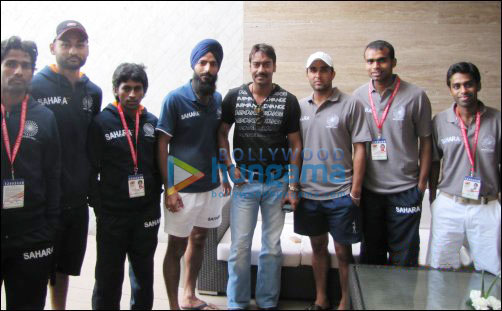
 ilm star Ajay Devgn was in Delhi for promoting his latest movie 'Atithi Tum Kab Jaoge?'. When Ajay was informed that the Indian hockey team was staying in the same hotel as he was, he immediately expressed his keenness to meet the Indian hockey players. ilm star Ajay Devgn was in Delhi for promoting his latest movie 'Atithi Tum Kab Jaoge?'. When Ajay was informed that the Indian hockey team was staying in the same hotel as he was, he immediately expressed his keenness to meet the Indian hockey players.
Even though he had his appointment diary full of meetings, appointments and interviews in connection with his film, Ajay took time off from his hectic schedule to meet the entire hockey team, and wished them the best for their matches in the Hero Honda World Cup.
The players were delighted to meet the star, and chatted with him for some time before they left for their match.
Chak de, Ajay, for being a true sports lover!
|
| Visitor of the Month |
he March 2010 Visitor of the Month is Anand Shah, who wrote the following to BharatiyaHockey.org:
I am an ardent fan of the sport of hockey, and want my children (aged 6 years and 2 years) to experience this sport early in their life. Can someone please help me to identify a coaching/training program in Bangalore that would be willing to enroll such young children. My children are in love with the sport, and I would like to nurture their skill with some professional coaching.
|
| Fun With Numbers |
Statistics by B. G. Joshi
 old medals won by India in FIH's top-level tournaments and continental championships are given below. old medals won by India in FIH's top-level tournaments and continental championships are given below.
- It has been 35 years and counting, since India has won the gold medal in an Olympics, World Cup or Champions Trophy.
- 12 of the 14 major gold medals won by India have come on foreign soil.
- Dhanraj Pillai as captain won both an Asian Games gold medal as well as an Asia Cup gold medal
FIH PREMIER TOURNAMENTS
| Tournament |
Date |
Venue |
Score |
Indian Captain |
| Olympics |
May 26, 1928 |
Amsterdam |
India 3 - Netherlands 0 |
Eric Penniger/Jaipal Singh |
| |
Aug 4, 1932 |
Los Angeles |
India 11 - Japan 1 (round robin) |
Lal Shah Bokhari |
| |
Aug 15,1936 |
Berlin |
India 8 - Germany 1 |
Dhyan Chand |
| |
Aug 12, 1948 |
London |
India 4 - Great Britain 0 |
Kishan Lal |
| |
July 24, 1952 |
Helsinki |
India 6 - Netherlands 1 |
K. D. Singh 'Babu' |
| |
Dec 6, 1956 |
Melbourne |
India 1 - Pakistan 0 |
Balbir Singh Sr. |
| |
Oct 23, 1964 |
Tokyo |
India 1 - Pakistan 0 |
Charanjeet Singh |
| |
July 29, 1980 |
Moscow |
India 4 - Spain 3 |
Vasudevan Baskaran |
| World Cup |
Mar 15, 1975 |
Kuala Lumpur |
India 2 - Pakistan 1 |
Ajeetpal Singh |
CONTINENTAL CHAMPIONSHIPS
| Tournament |
Date |
Venue |
Score |
Indian Captain |
| Asian Games |
Dec 19, 1966 |
Bangkok |
India 1 - Pakistan 0 |
Shankar Lakshman |
| |
Dec 19, 1998 |
Bangkok |
India 1 - South Korea 1 (TB) |
Dhanraj Pillai |
| Asia Cup |
Sep 28, 2003 |
Kuala Lumpur |
India 4 - Pakistan 2 |
Dhanraj Pillai |
| |
Sep 9, 2007 |
Chennai |
India 7 - South Korea 2 |
Prabodh Tirkey |
| Afro-Asian Games |
Nov 17, 2003 |
Hyderabad |
India 3 - Pakistan 1 |
Dileep Tirkey |
|