GOLDEN OLYMPIC MOMENTS

- A great deal had transpired in the years between the Berlin Olympics in 1936 and the
London Olympics in 1948. India got its independence, but suffered a devastating partition
when a new state of Pakistan was carved out.
- Many Anglo-Indians left the country, and a number of Muslims migrated to Pakistan. India
lost a rich recruiting ground for hockey talent. A brand new Indian team left for London,
without a single player who had played in an earlier Olympics.
- The captain of the Pakistan hockey team in the 1948 Olympics was A. I. S. Dara.
He had represented India in
the 1936 Berlin Olympic Games. Besides Dara, Paul Peter Fernandes and
Bhopal's Akhtar Hussain and Latif-ur-Rehman, have done duty for both India
and Pakistan in the Olympics.
- India beat Austria 8-0 in their first match. India followed up this victory by defeating
Argentina 9-1, Spain 2-0, and Holland 2-1 to enter the finals.
- The first time that India met Britain in an Olympic hockey match was on
September 12, 1948, at Wembley grounds, in the Olympic hockey final. In this long awaited meeting,
India beat Britain 4-0 in to win its fourth consecutive
gold medal - its first as a free country. Balbir Singh Sr. (Punjab Police) was the find
of independent India as a centre-forward. He scored both the first half goals for India,
while Pat Jansen and Trilochan Singh (penalty corner) shared the other two.
-
Balbir Singh Sr. went on to win two more Olympic gold medals, and manage the World Cup winning Indian team at Kuala Lumpur in 1975.
His well-known autobiography is 'The
Golden Hat Trick'. He presently resides in Burnaby, British Columbia in Canada.
- The victorious captain Kishan Lal fulfilled a childhood boast when he dined with
King George. As a schoolboy in Mhow, Kishan Lal had upbraided a sweets vendor for
allowing flies to settle on his wares. The haughty hawker snapped back: 'Who do you think
you are? The son of a nawab? Do you dine with princes and rajas?' Kishan retorted:
'Don't be so smart. One day, I'll dine with the King of England.' Kishan Lal, the
finest outside-right that India has ever produced, did dine with the British monarch at a
formal banquet.
- After the victory, V. K. Krishna Menon, free India's first High Commissioner
to England, gave an official reception at India House. The victorious Indian
team went on a goodwill tour of the European mainland - visiting France,
Czechoslavakia and Switzerland.
- The team returned by ship to Bombay, where a red carpet
welcome was given to the team. The victory celebrations culminated in
Delhi, where President Rajendra Prasad and Prime Minister Jawaharlal
Nehru attended a match involving the Olympic team at the jam packed
National Stadium.
- India's record in the 1948 Olympics at London was as follows :
- Played: 5
- Won: 5
- Goals For: 25
- Goals Against: 2
- The following were the members of the 1948 Indian Olympic Team :
- Kishan Lal (captain)
- Kunwar Digvijay Singh (Babu) (vice captain)
- Leslie Claudius
- Walter D'Souza
- Keshav Dutt
- Lawrie Fernandes
- Ranganathan Francis
- Randhir Singh Gentle
- Gerry Glacken
- Akhtar Hussain
- Patrick Jansen
- Amir Kumar
- Leo Pinto
- Jaswant Singh Rajput
- Latif-ur-Rehman
- Reginald Rodrigues
- Balbir Singh
- Grahanandan Singh
- Trilochan Singh
- Maxie Vaz
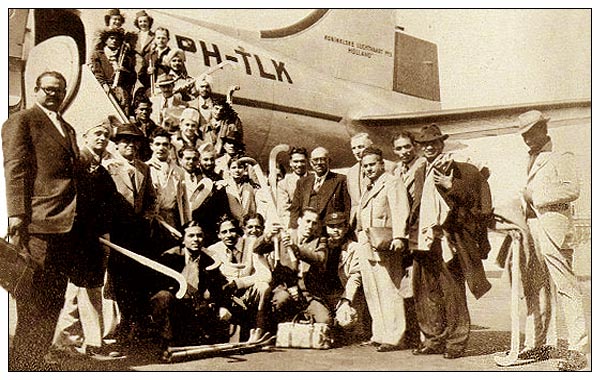
Photo Courtesy Wills Book of Excellence - Hockey