GOLDEN OLYMPIC MOMENTS

- India beat Austria 4-0 and Great Britain 3-1 in the knockout matches en route to the
finals. Holland challenged the Olympics champions but lost 1-6, and India won the hockey
crown for the 5th time in a row.
- Balbir Singh Sr. scored 9 goals of the 13 scored by India at
Helsinki, including 5 of the 6 goals in the final. Chinnadorai Desamuthu became the youngest gold medallist for India. He was 19 years
and 272 days when India won the Olympic title in the Helsinki Games.
- India's hockey captain K. D. Singh 'Babu' received the Helms Trophy in
1953 for being the best hockey
player in the world (1952) and the best sportsman of Asia (1953). This was the first
time an Asian was awarded the Helms Trophy - America's Nobel Prize in Sports. Ten years
later, in 1963, another Indian star Milkha Singh would received the Helms Trophy for being
the best quarter-miler in the world.
- Babu's artistry, craftsmanship and creative instincts saw him blossom into one of the
finest inside-rights that India has produced. His ball and body control was instinctive, a
sort of sixth sense. Babu, an all-time great hockey player of India committed suicide in
April 1978. The main sports stadium of Lucknow is named the K. D. Singh (Babu) Stadium in
his memory.
- India's record in the 1952 Olympics at Helsinki was as follows :
- Played: 3
- Won: 3
- Goals For: 13
- Goals Against: 2
- The following were the members of the 1952 Indian Olympic Team :
- Kunwar Digvijay Singh 'Babu' (captain)
- Balbir Singh (vice captain)
- Ranganathan Francis
- Chinnadorai Deshmuthu
- Randhir Singh Gentle
- Dharam Singh
- Swarup Singh
- Govind Perumal
- Keshav Dutt
- Leslie Claudius
- Jaswant Singh Rajput
- Meldric Daluz
- Raghbir Lal
- Udham Singh
- Muniswamy Rajagopal
- G. S. Dubey
- Grahanandan Singh
- C. S. Gurung
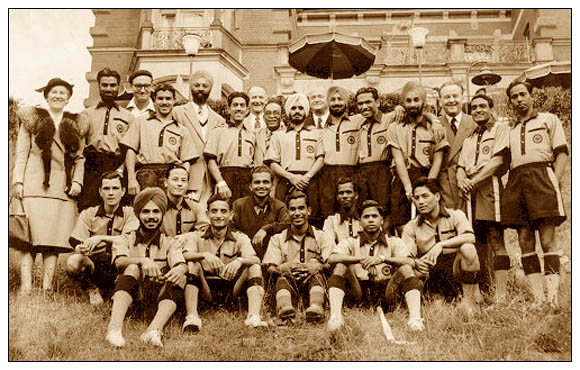
Photo Courtesy Balbir Singh Sr.'s Personal Collection