GOLDEN OLYMPIC MOMENTS

- The Tokyo Olympics were the first Olympics to be held on Asian soil. India made a bold
bid to regain her lost supremacy in world hockey. India was coached by Habul Mukherjee,
who used to play hockey in a dhoti in his heydays. The team went on a
two-and-a-half month tour to New Zealand and Malaysia before heading to
Tokyo.
- In the pool matches, India finished at
the top with 12 points. India beat Belgium 2-0, was held to a draw by both Germany and
Spain, beat Hong Kong 6-0, Malaysia 3-1, Canada 3-0 and Holland 2-1. In the semi-final,
India beat Australia 3-1 to set up their third consecutive clash with Pakistan in the
Olympic finals.
- The final was played on a cold afternoon on November 23, 1964, at the
Kamazawa Park in Tokyo. The first half was
played at a scorching pace but no goal was scored.
There was an unruly incident with some of the Pakistanis attacking the
Indian players. The match was briefly interrupted for the
tempers to cool down. Manager Inder Mohan Mahajan couldn't bear the tension
and started pacing outside the field, all the while keeping in touch on the
progress of this grim battle for Olympic supremacy.
- The forward line comprising Harbinder Singh and Joginder Singh was
irresistible that day. 5 minutes into the second half, a
penalty corner was awarded to India which was taken by India's 'Rock of Gibralter'
Prithipal Singh.
- Prithipal had been fantastic in the Tokyo Olympics thus far, and had
scored 11 goals. However, this penalty corner was to be his most important. His stinging
shot was deflected off the goalkeeper's pad and stopped by Pakistan's full back Munir Dar
with his foot. Centre-half Mohinder Lal converted the resultant penalty stroke
in the 41st minute to give India a 1-0 lead.
- IHF President Ashwini Kumar did the running commentary for Akashvani in
the final at Tokyo. Each move forward by India was a potential goal in his
eyes. And when Mohinder Lal converted the penalty stroke, a hysterical
Ashwini Kumar cried himself hoarse. It was an instant in which Akashvani and
Ashwini Kumar were made for each other, a sound-byte that would become
frozen in time.
- Pakistan fought back ferociously in the closing stages of the match and gave India many
anxious moments. Shankar Lakshman, the Indian custodian, played superbly and saved two
sizzling penalty corner hits. India held on to its slender lead to win its seventh gold medal in eight Olympic Games.
Shankar Lakshman, one of India's best ever goalkeepers, was declared the Man of the Match.
- Euphoria swept the land. There was a massive reception at Palam Airport to welcome
Charanjit Singh's returning heroes. The players were driven in a motor cavalcade through
the streets of Delhi and Jalandhar. Admiring fans sought their autographs on currency
notes.
- Left-in Udham Singh (1952-1964) joined right-half Leslie Claudius (1948-1960) as the
only Indians to have won 3 Gold Medals and 1 Silver Medal in the Olympic
hockey. Udham Singh passed away in his native village Sansarpur on March 23, 2000.
- V. J. Peter played in the 1960, 1964 and 1968 Olympics Games. After he retired, his
brother V. J. Phillips played in the 1972 and 1976 Games. Thus the two brothers
represented India over a period of 16 years, winning for India 1 Gold, 1 Silver and 2
Bronzes in 5 Olympics. V. J. Peter died in Chennai on June 30, 1998. V. J.
Phillips is presently a Sports Officer with the Railways, and umpires
hockey matches in Chennai.
- India's record in the 1964 Olympics at Tokyo was as follows :
- Played: 9
- Won: 7
- Drawn: 2
- Goals For: 22
- Goals Against: 5
- The following were the members of the 1964 Indian Olympic Team :
- Charanjit Singh (captain)
- Shankar Lakshman (goalkeeper)
- Rajendran Christie
- Prithipal Singh
- Dharam Singh
- Gurbux Singh
- Mohinder Lal
- Jagjit Singh
- Rajinder Singh
- Joginder Singh
- Haripal Kaushik
- Harbinder Singh
- Bandu Patil
- Victor John Peter
- Udham Singh
- Darshan Singh
- Syed Ali
- Balbir Singh Kular
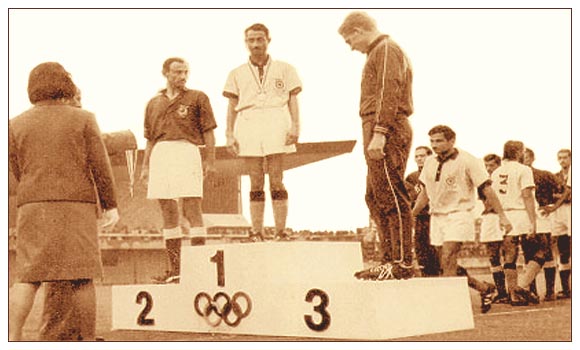
Photo Courtesy Wills Book of Excellence - Hockey