July 2000 Bulletin

Photograph of the Month


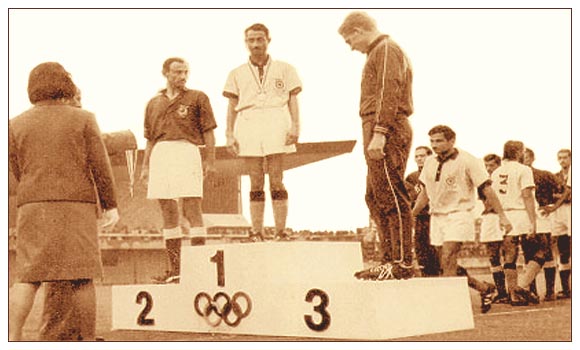
In this Olympic year, we now highlight the 1964 Indian Olympic hockey team.  

The Tokyo Olympics were the first Olympics to be held on Asian soil. The hockey final marked the 3rd consecutive time that India and Pakistan met in the Olympics final. India had won in 1956 (Melbourne) and lost in 1960 (Rome). Whose turn it would be this time?

The final was played on a cold afternoon on November 23, 1964. The first half was played at a scorching pace but no goal was scored. There was an unruly incident with some of the Pakistanis attacking the Indian players. The match was briefly interrupted for the tempers to cool down.

The forward line comprising Harbinder Singh and Joginder Singh was irresistible that day. 5 minutes into the second half, a penalty corner was awarded to India which was taken by India's 'Rock of Gibralter' Prithipal Singh.

This would turn out to be the most important penalty corner of Prithipal Singh's career. His stinging shot was deflected off the goalkeeper's pad and stopped by Pakistan's full back Munir Dar with his foot. Centre-half Mohinder Lal converted the resultant penalty stroke to give India a 1-0 lead.

Pakistan fought back ferociously in the closing stages of the match. Shankar Lakshman, the Indian custodian, played superbly and saved two sizzling penalty corner hits. India held on to its slender lead to win its seventh gold medal in eight Olympic Games. Shankar Lakshman, one of India's best ever goalkeepers, was declared the Man of the Match.

Euphoria swept the land. There was a massive reception at Palam Airport to welcome Charanjit Singh's returning heroes. The players were driven in a motor cavalcade through the streets of Delhi and Jalandhar. Admiring fans sought their autographs on currency notes.

India were once again kings of the hockey world.

1964 Gold Medal Winning Team

Photo Courtesy : Wills Book of Excellence - Hockey

Sports Advertisement of the Month


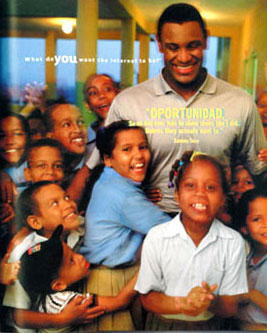
Home run king Sammy Sosa is pitching for Nortel Networks in this advertisement. Sosa's answer to the question "What do you want the Internet to be?" is "Opportunidad. So that no kid has to shine shoes like I did. Unless they actually want to."

Sammy Sosa, who hails from the Dominican Republic, is best known for his home run race with Mark McGwire during the 1998 baseball season. Sosa plays for the Chicago Cubs in the National League of Major League Baseball.

Sammy Sosa for Nortel Networks

Visitor of the Month


Gaurav Singh, son of Ashok Kumar and grandson of Dhyan Chand, is this edition's Visitor of the Month. This was his email to the Indian hockey website:

The Dhyan Chand Hockey Club in Delhi is slowly coming up. This club will eventually have branches in other countries around the world - e.g., England, USA and Canada.

Presently, I am in Phoenix, Arizona. I was here to play in the California Cup for a club named Phoenix Scorpions. I may come back for the Guru Nanak Hockey Tournament in Los Angeles, which will be held on the weekend of July 8-9.

Media Matters


This month's edition of Media Matters focuses on Zee Television Network and Nimbus Communications, who both have become major players in the Indian sporting scene.

Zee TV is launching a sports channel, most likely in October, though in practical terms, it will be yet another channel devoted to cricket.

Zee TV is also constructing sports complexes in South Asia, though in practical terms, it means construction of cricket stadiums. Zee recently completed construction of a cricket stadium in Kathmandu. Their next targets appear to be Malaysia and Singapore.

Zee TV has joined hands with Trans World International (TWI) for a combined bid on the television rights for the next two cricket world cups, in South Africa in 2003 and West Indies in 2007. The bid is expected to be in the range of $600 million - $650 million.

Zee's only foray into a non-cricket sport so far is football. Zee is negotiating to buy, or have a strategic alliance with Churchill Brothers, runners-up in the 1999 National Football League.

Zee TV has no plans for hockey - India's national game.

Nimbus Communications is also bidding for the cricket World Cups of 2003 and 2007 as part of the UK-based World Sports Group.

In football, Nimbus obtained exclusive India television rights to the Euro 2000 football championships, along with exclusive first options right on the football World Cup 2002, Euro 2004, and other smaller football events.

In tennis, Nimbus obtained exclusive India television rights to the 2000 and 2001 ATP Tennis Masters Series, consisting of the top nine major tennis championships plus the year ending world championships.

In hockey, Nimbus did the television production of India's hockey matches at the 1998 Bangkok Asian Games, where India won the gold after 32 long years.

How to Create a Sports League


This column usually takes examples of successful sports leagues from around the world. In this month's edition, we talk of the building blocks of a league - professional sports clubs. Examples of professional clubs will be taken from India's very own National Football League. 

FC Kochin was the first professional club in Indian football floated through corporate support. In 1999, the club registered itself under the Registrar of Companies as FC Kochin Sports Limited. 

The management will soon be floating shares on a "private placement" basis to expand their financial base. The shares will be valued at Rs. 100 each, and each subscriber will have to purchase shares worth at least Rs. 2500. At present, a limited number of shares are being held by the seven-member Board of Directors.

The revenue for the club will come from sponsorship, gate sales and appearance money in various tournaments. The team was sponsored in 1999-2000 by Hi-Power, a NRI Gulf-based company. For the coming season, the club is negotiating with a number of industrial houses for a sponsorship deal worth at least Rs. 1 crore.

The club is also planning to have it's own stadium, instead of the present arrangement where they lease the ground. The club has a foreign coach - Jerrico Nagbe of Liberia, in addition to four Liberian players - Sunday Seah, Isaac Tondo, Eugene Grey and Benjamin. Local flavour is provided by homegrown stars I. M. Vijayan and Jo Paul Ancheri. 

Mumbai-based Bengal Mumbai Football Club is the second professional football club in India floated through corporate support.

Liquor king Vijay Mallya, chairman of the United Breweries group, recently acquired rights to run the top two Calcutta clubs - Mohun Bagan and East Bengal.

Zee Television and Churchill Brothers have in principle agreed to work together as part of the promotion of Zee's sports channel, likely to be launched in October. According to a Zee spokesman, the television company and the soccer club are still at the 'handshake stage'.

Fun With Numbers


The 22nd Men's Champions Trophy in Amstelveen (May 26 - June 4, 2000) marked the first time that Pakistan was not represented in the Champions Trophy. Pakistan had finished last in the previous edition of the tournament held in Brisbane.

Defending champion Australia had a bad run in the tournament. The men's team finished 5th, making it only the 4th time in 22 Champions Trophy tournaments that Australia finished out of the medals tally. 

In an even bigger upset, the Australian women ended up third in at Amstelveen. Ric Charlesworth's team had won the last 5 Champions Trophy tournaments, and came in to the tournament as overwhelming favourites.

Upset at Australia's loss, Hockeyroos coach Ric Charlesworth used the post-match press conferences to rail against what he felt was inconsistent umpiring, negative and unsportsmanlike tactics by opponents, and to criticise coaches who had a go at him.

In return, German coach Berti Rauth accused the Australians of systematic foul play and Dutch coach Tom van't Hek decried Charlesworth for speaking to the umpires during games.

Money Matters


This month's edition of Money Matters talks about match fees and sponsor logo fees, and how cricketers in India make more money for a month's work than any hockey player in India would make even after a lifetime of work.

Presently, Indian cricketers get Rs. 1.95 lakhs per test and Rs. 1.56 lakhs per one-day international (ODI). The breakup is as follows:

Category Test Matches One-Dayers
Match Fees Rs. 40,000 Rs. 25,000
Sponsor Logo Fees Rs. 1.55 lakhs Rs. 1.31 lakhs
TOTAL Rs. 1.95 lakhs Rs. 1.56 lakhs

So if a cricketer plays, on the average, 4 tests (Rs. 7.8 lakhs) and 10 ODIs (Rs. 15.6 lakhs) in an year, he would earn Rs. 23.4 lakhs. Not bad for essentially a month's worth of working days.

Even the coach of the Indian cricket team receives sponsor logo fees of Rs. 1,42,500 per test and Rs. 1.2 lakh per ODI.

Our hockey federation can learn from its cricketing counterpart in paying players for each match they play for their country. Presently, our national hockey coach does his work in an honorary capacity, while our national team players have to fight with the federation to get paid.